
Zhiyuan's GO-2 Model Brings Robot Thinking Closer to Human Actions

Zhiyuan Robotics Breaks New Ground with GO-2 AI Model

In a significant advancement for robotics, Zhiyuan Robotics has introduced its Genie Operator-2 (GO-2) embodied foundation model. This isn't just another incremental improvement - it represents a fundamental shift in how robots process information and interact with the physical world.
Image

A New Way for Robots to Think

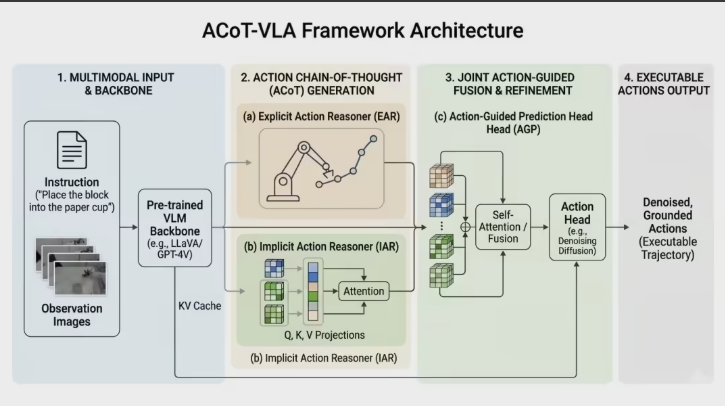
What sets GO-2 apart is its revolutionary 'Action Thought Chain' approach. Imagine teaching a child to tie their shoes - you wouldn't just move their hands through the motions. Instead, you'd explain the steps first. That's essentially what GO-2 does for robots.

  • Planning before acting: Unlike traditional models that jump straight to movement commands, GO-2 creates a detailed action plan first
  • Structured reasoning: This intermediate step allows the robot to better understand the relationship between perception and action
  • Academic recognition: The technology behind this breakthrough has already earned acceptance at CVPR 2026, one of the top AI conferences

Two Brains Are Better Than One

To tackle the challenge of reliable execution, Zhiyuan developed an ingenious dual-system architecture:

  • The 'Brain' system operates at a slower pace, focusing on high-level planning and creating what engineers call an "intention flow"
  • The 'Muscle' system runs much faster, constantly adjusting movements to match the Brain's plan while compensating for real-world variables

This approach solves a critical problem in robotics - how to maintain precision when environments change unexpectedly. If an object slides or a surface isn't perfectly level, the Muscle system makes instant corrections without waiting for new instructions.

Performance That Speaks for Itself

The proof of any technological advancement lies in real-world results, and GO-2 delivers:

  • LIBERO Benchmark: Achieved a remarkable 98.5% success rate across four core tasks
  • Genie Sim3.0: With simulation-only training, it attained an 82.9% success rate in physical environments - a significant lead over competitors like π0.5

Beyond the Lab: Real-World Applications

Zhiyuan isn't just developing technology for technology's sake. The company envisions GO-2 as the foundation for practical, evolving robotic systems:

  • The Genie Studio platform allows continuous learning from real-world interactions
  • Designed as a "general brain" for embodied intelligence, GO-2 aims to smooth the transition from virtual testing to complex industrial settings

Key Points

  • GO-2 introduces a novel 'Action Thought Chain' that mimics human planning processes
  • Its dual-system architecture combines high-level planning with adaptive execution
  • The model has set new performance records in standard benchmark tests
  • Designed for continuous learning and real-world industrial applications
  • Represents a significant step toward robots that can reliably perform complex physical tasks

As robotics continues to advance, developments like GO-2 bring us closer to machines that don't just think, but can effectively act on those thoughts in our unpredictable physical world.
Enjoyed this article?

Subscribe to our newsletter for the latest AI news, product reviews, and project recommendations delivered to your inbox weekly.

Weekly digestFree foreverUnsubscribe anytime

Related Articles

News

DeepSeek V4 Emerges: A Glimpse Into China's Next-Gen AI Powerhouse

The tech world is abuzz as DeepSeek V4 enters intensive testing, revealing three distinct versions tailored for different needs. From lightning-fast responses to advanced visual analysis, this homegrown AI showcases China's push for technological independence. What makes this release particularly exciting is its deep integration with domestic chips, signaling a strategic move away from foreign dependencies. As the AI arms race heats up, could this be the model that redefines what Chinese-developed artificial intelligence can achieve?

April 8, 2026
AI DevelopmentChinese TechMachine Learning
News

Alibaba's New AI Algorithm Pushes Reasoning Limits Beyond OpenAI's Mini Model

Alibaba's Tongyi Lab has unveiled FIPO, a groundbreaking algorithm that dramatically enhances AI reasoning capabilities. This innovation allows models to process over 10,000 tokens in complex problems, outperforming even OpenAI's o1-mini in certain benchmarks. The technology introduces clever mechanisms like Future-KL to help AI 'think ahead,' marking a significant leap in machine intelligence.

April 8, 2026
AI ResearchMachine LearningAlibaba
News

Alibaba's AI Model Hits Trillion Token Milestone, Tops Global Rankings

Alibaba's Qwen 3.6 Plus has made history by becoming the first AI model to surpass 10 trillion tokens in daily usage on OpenRouter, securing the top spot in global rankings. This achievement signals China's growing influence in the AI landscape, with domestic models gaining traction through competitive pricing and rapid innovation. Meanwhile, the capital market shows strong interest in AI technologies, with trading volumes hitting 1 trillion yuan on Chinese exchanges.

April 7, 2026
Artificial IntelligenceAlibabaOpenRouter
Alibaba's New Algorithm Helps AI Think More Like Humans
News

Alibaba's New Algorithm Helps AI Think More Like Humans

Alibaba's Tongyi Lab has developed a breakthrough algorithm called FIPO that helps large language models identify and focus on the most important parts of complex reasoning tasks. Unlike traditional methods that struggle to distinguish critical information, FIPO uses a novel 'Future-KL' mechanism to reward tokens that significantly impact later reasoning steps. Early tests show impressive results, with models handling reasoning chains over 10,000 tokens long while improving accuracy in mathematical problem-solving.

April 7, 2026
AI ResearchMachine LearningAlibaba
Google's Gemma 4: Small AI Models Pack a Big Punch
News

Google's Gemma 4: Small AI Models Pack a Big Punch

Google has open-sourced its Gemma 4 AI models, and they're turning heads in the tech world. What makes them special? Some of these compact models outperform giants 20 times their size, bringing powerful AI capabilities to everyday devices like smartphones. With optimized versions for mobile and IoT devices, Gemma 4 could change how we interact with AI in our daily lives.

April 7, 2026
AIMachine LearningGoogle
News

Google's Gemma 4: A Powerhouse AI Model Set to Shake Up Open-Source Landscape

Google is gearing up to unveil Gemma 4, its next-generation open-source AI model that promises four times the parameters of its predecessor. With a rumored 120 billion parameters and innovative MoE architecture, this release marks Google's strategic move to reclaim influence in the open-source AI space. The tech world watches closely as this development could redefine the balance between commercial and open-source AI models.

April 2, 2026
AI DevelopmentOpen Source TechMachine Learning