Tesla's AI5 Chip Hits Major Milestone with Musk's Hands-On Oversight

Tesla's AI5 Chip Reaches Manufacturing Phase After Intensive Development

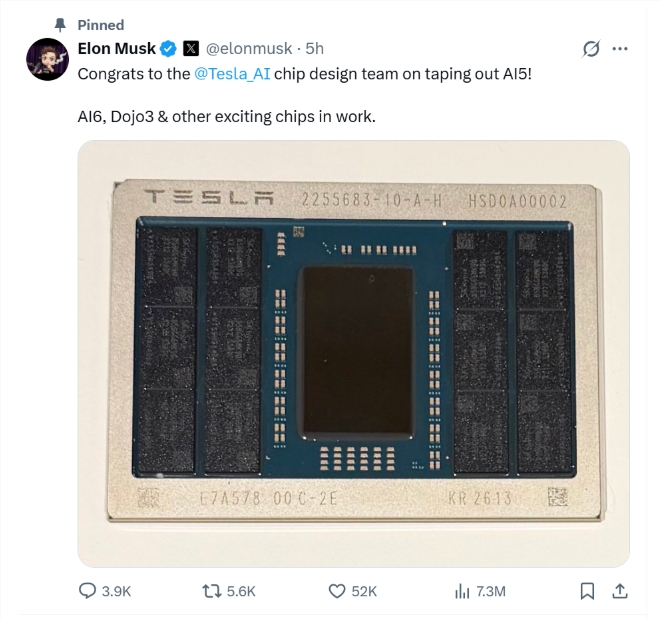
Tesla has cleared a major hurdle in its quest to develop cutting-edge AI chips entirely in-house. The company's next-generation AI5 processor has successfully completed the tape-out process, meaning the design is now ready for manufacturing.

Musk's Personal Investment in the Project

Elon Musk didn't just oversee this project from the sidelines—he rolled up his sleeves and got directly involved. "Solving AI5 is crucial for Tesla's survival," Musk admitted in a candid social media post. He revealed dedicating every Saturday for several months to the chip's development, with two separate teams working in parallel to accelerate progress.
Image

Performance That Turns Heads

The specs sheet tells an impressive story:

  • Single-chip performance matching NVIDIA's Hopper architecture
  • Dual-chip configuration approaching Blackwell-level capability
  • 40x improvement in key metrics over previous AI4 generation
  • 9x memory increase and 8x computing power boost

What makes these numbers particularly striking is Tesla's claim that AI5 achieves this while maintaining significantly lower costs and power consumption than comparable NVIDIA products.

Manufacturing and That Awkward TSMC Mix-up

Production will be handled through an unusual collaboration between industry rivals Samsung and TSMC, with manufacturing occurring at:

  • Samsung's facility in Tyler, Texas
  • TSMC's Arizona plant

This arrangement ensures the entire production process remains within U.S. borders. However, Musk's announcement wasn't without its hiccups—he accidentally tagged the wrong TSMC account, briefly sending social media into a confused frenzy before the error was corrected.

What's Next for Tesla's Chip Ambitions?

With AI5 now moving toward mass production (slated for 2027), Musk says he can finally turn attention back to the previously shelved Dojo3 supercomputer processor project. Meanwhile, development of the AI6 chip continues as planned, signaling Tesla's long-term commitment to controlling its silicon destiny.

Key Points

  • Tape-out complete: AI5 design finalized and sent for manufacturing
  • Performance leap: Massive improvements over previous generation
  • Dual-chip advantage: Competitive with NVIDIA's Blackwell when paired
  • U.S. production: Manufactured entirely domestically by Samsung and TSMC
  • Musk's hands-on role: CEO personally invested months of weekends
  • Future projects: Dojo3 and AI6 development back on track
Enjoyed this article?

Subscribe to our newsletter for the latest AI news, product reviews, and project recommendations delivered to your inbox weekly.

Weekly digestFree foreverUnsubscribe anytime

Related Articles

Amazon Shifts Gears: From Cloud Giant to AI Chip Powerhouse
News

Amazon Shifts Gears: From Cloud Giant to AI Chip Powerhouse

Amazon is making a bold move into the competitive AI chip market, planning to sell its custom-designed processors externally rather than keeping them exclusively for internal cloud services. CEO Andy Jassy revealed in his shareholder letter that the company's chip division could potentially generate $50 billion annually as an independent business. With their Trainium AI chips already outperforming competitors in cost-effectiveness and the upcoming Trainium3 showing strong pre-launch demand, Amazon appears poised to challenge NVIDIA and Intel's dominance in the AI hardware space.

April 10, 2026
AmazonAI chipssemiconductors
News

Upscale AI seeks $200M in fresh funding at $2B valuation

Artificial intelligence startup Upscale AI is negotiating its third funding round in just seven months, eyeing $180-200 million at a $2 billion valuation. The company, backed by Tiger Global and other major investors, focuses on developing custom AI chips despite having no commercial products yet. This aggressive funding strategy comes as the AI infrastructure market heats up, with Upscale positioning itself as a potential key player in chip-to-chip communication technology.

April 17, 2026
AI fundingsemiconductorsstartups
OpenAI Bets Big on Chip Startup Cerebras in $2 Billion AI Hardware Push
News

OpenAI Bets Big on Chip Startup Cerebras in $2 Billion AI Hardware Push

OpenAI has made a strategic $2 billion commitment to AI chip startup Cerebras, marking a bold move to diversify its hardware infrastructure and reduce dependence on NVIDIA. The deal includes stock warrants and funding for specialized data centers, leveraging Cerebras' innovative wafer-scale technology to boost AI performance. This partnership could reshape the competitive landscape of AI computing hardware.

April 17, 2026
AI hardwaresemiconductorsOpenAI
Tesla's 2026 Spring Update: Voice-Activated Grok and Easier FSD Access
News

Tesla's 2026 Spring Update: Voice-Activated Grok and Easier FSD Access

Tesla's latest software overhaul brings major quality-of-life improvements. Drivers can now summon the Grok AI assistant with just their voice, while Full Self-Driving becomes more accessible with one-tap subscriptions. The update also introduces longer dashcam recording, smarter pet mode, and enhanced weather displays. While some anticipated features like Apple CarPlay remain absent, Tesla continues pushing the boundaries of what cars can do beyond transportation.

April 14, 2026
TeslaAutomotive TechAI Assistants
News

Amazon gears up to challenge NVIDIA with its own AI chips

Amazon is making a bold move into the AI chip market, shifting from renting computing power to selling its own hardware directly. With its Trainium chips offering better value and strong demand already lining up, the tech giant is eyeing a $50 billion revenue opportunity. This strategic pivot could reshape the AI computing landscape and provide much-needed alternatives to NVIDIA's dominance.

April 10, 2026
AmazonAI chipsNVIDIA
News

Siemens and NVIDIA slash AI chip verification time from months to days

In a breakthrough collaboration, Siemens and NVIDIA have dramatically accelerated AI chip verification using Siemens' Veloce™ proFPGA system combined with NVIDIA's optimized architecture. What previously took months can now be done in days, potentially revolutionizing AI chip development timelines. This partnership not only speeds up time-to-market but also improves design accuracy, marking a significant step forward for the AI hardware industry.

April 10, 2026
AI chipssemiconductorhardware acceleration