
Stickerbox: The AI-Powered Magic Wand That Turns Kids' Stories into Real Stickers

The Toy That Brings Imagination to Life

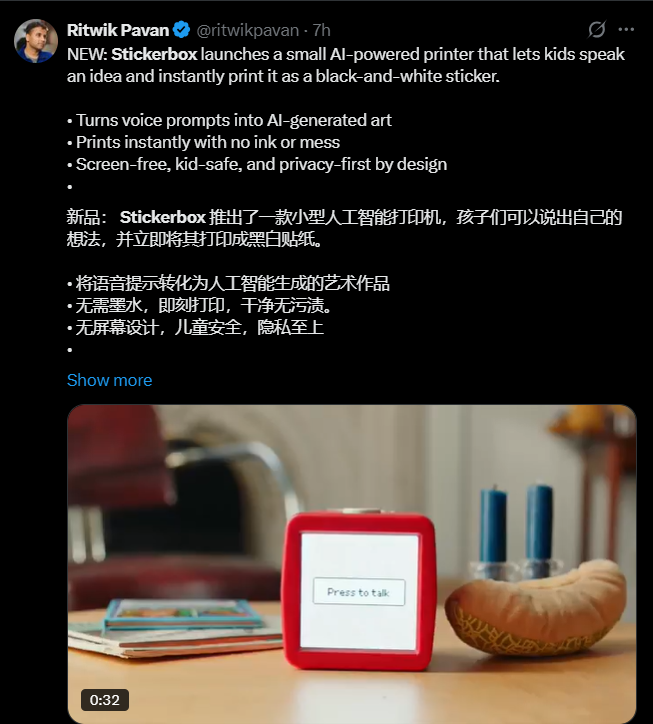
Picture this: Your child describes a scene where astronauts race dinosaurs on the moon. Moments later, that exact scene appears as a colorful sticker from a small box on your kitchen table. This isn't magic - it's Stickerbox, the latest innovation blending AI technology with children's creativity.
Image

How It Works: Simplicity Meets Innovation

The process couldn't be simpler:

  • A child speaks their idea into the device
  • Advanced AI interprets and illustrates the concept
  • A built-in printer produces vibrant stickers in 3-5 seconds

What makes Stickerbox special is its complete lack of screens. Unlike tablets or phones that dominate children's attention, this device encourages verbal storytelling while producing physical creations kids can hold and decorate.

Designed With Kids' Safety in Mind

The developers considered every aspect of child safety:

  • Screen-free operation protects young eyes from excessive blue light
  • Content filters ensure age-appropriate outputs
  • Eco-friendly materials mean no messy inks or harmful chemicals
  • Durable design withstands enthusiastic use by preschoolers to preteens

Parents particularly appreciate how the thermal paper stickers become canvases for additional creativity - kids can color them, cut them out, or collect them like trading cards.

More Than Just a Toy - A Creativity Catalyst

The real magic happens when children realize their wildest ideas can become real objects. One parent shared how their daughter spent an entire afternoon creating an entire sticker zoo after visiting the real one. Another described their son proudly covering his school folder with stickers of "the story I made up about robot pirates."

Educators are taking notice too. Some preschool teachers report using Stickerbox to help children visualize storytelling concepts or as rewards for classroom participation.

Why This Matters for AI's Future

Stickerbox represents an important shift in AI applications - moving beyond adult productivity tools into childhood development. By making advanced technology accessible and fun for young users, it demonstrates how AI can enhance rather than replace human creativity.

The device's success suggests a growing market for tech products that bridge digital capabilities with tactile experiences - especially those that encourage rather than limit imaginative play.

Key Points:

  • Instant creation: Turns spoken words into stickers in seconds
  • Screen-free design: Promotes verbal storytelling over passive viewing
  • Safe materials: Non-toxic, BPA-free thermal paper
  • Educational value: Encourages creative thinking and self-expression
  • Family-friendly: Parents report high engagement across age groups

Enjoyed this article?

Subscribe to our newsletter for the latest AI news, product reviews, and project recommendations delivered to your inbox weekly.

Weekly digestFree foreverUnsubscribe anytime

Related Articles

News

Haivivi Secures $28M in Series A Funding for AI Toy Expansion

Chinese AI toy manufacturer Haivivi has raised 200 million yuan ($28M) in Series A funding to accelerate product development. The company plans to launch new IP collaborations including Ultraman and Peppa Pig toys, with its upgraded CocoMate series featuring improved voice interaction technology set for release this month.

August 25, 2025
AI toysHaiviviventure capital
News

JD.com Teams Up with Suyu District to Revolutionize Playtime with AI Toys

China's e-commerce giant JD.com has partnered with Suyu District to create an AI toy innovation hub, showcasing their JoyInside smart hardware platform. The collaboration has already boosted interaction rates by 120% with 40 major brands. This initiative promises to transform simple playthings into intelligent companions that could reshape how families interact and children learn through play.

January 22, 2026
AI toyssmart hardwareJD.com
ChatGPT Joins the Ad Game: OpenAI Tests Sponsored Messages for Free Users
News

ChatGPT Joins the Ad Game: OpenAI Tests Sponsored Messages for Free Users

OpenAI is breaking its 'no ads' tradition by testing sponsored messages in ChatGPT for U.S. free users and $8/month 'Go' subscribers. The AI company promises ads will be topic-relevant but won't share conversation data, while premium users keep their ad-free experience. The move comes amid industry tensions, with competitor Anthropic mocking AI ads during Super Bowl season.

February 10, 2026
OpenAIChatGPTAI Monetization
News

Alphabet Bets Big on AI with $20 Billion Bond for Data Center Expansion

Google's parent company Alphabet is making a massive $20 billion bet on artificial intelligence infrastructure. The bond issuance, larger than initially expected, will fund an aggressive expansion of data centers to support AI development. This move mirrors similar investments by tech giants like Amazon and Microsoft, signaling an industry-wide race to dominate the next generation of computing power.

February 10, 2026
Artificial IntelligenceTech InvestmentData Centers
News

Game Developer Hails Chinese AI Video Tech as Industry Game-Changer

Feng Ji, the visionary behind 'Black Myth: Wukong,' has sparked excitement by praising ByteDance's new Seedance 2.0 video generation model. He believes this Chinese-developed AI could revolutionize film production, slashing costs while raising quality. While acknowledging potential challenges like deepfake concerns, Feng expresses national pride in China's AI advancements. The technology promises to blur creative boundaries, potentially flooding the market with high-quality content at unprecedented speed.

February 10, 2026
AI-videoSeedance2.0BlackMythWukong
News

Zhibian's MemoryLake Gives AI Models a Human-Like Memory Boost

Zhibian Technology has unveiled MemoryLake, a groundbreaking multimodal memory platform that's redefining how AI systems retain and use information. Unlike traditional databases, this system mimics human memory processes, allowing AI to make more informed decisions across industries from finance to gaming. The technology is already serving over 1.5 million users worldwide, marking a significant shift in AI infrastructure.

February 10, 2026
AI InnovationCognitive ComputingEnterprise Technology