Security Flaws Found in OpenClaw AI Agent Raise Concerns

AI Security Wake-Up Call: OpenClaw Vulnerabilities Exposed

A recent discovery by Chinese cybersecurity firm 360 has sent shockwaves through the AI community. Their specialized vulnerability detection system identified three significant security flaws in the popular OpenClaw AI agent, including one particularly dangerous vulnerability that could give attackers complete control over users' devices.

The Vulnerabilities Explained

The most serious issue involves script approval mechanisms. Attackers could modify already-approved scripts to execute unauthorized code - essentially turning a trusted process into a hacker's playground. Imagine giving someone permission to water your plants, only to find they've used that access to copy your house keys.

Two other medium-risk vulnerabilities were also uncovered:

  • OAuth authorization flaws that could compromise users' Google accounts
  • WebSocket resource management issues during voice calls that might crash devices

"These aren't just surface-level bugs," explains a 360 security researcher who asked not to be named. "They strike at the heart of how AI agents handle permissions and protocols - areas we're just beginning to understand from a security perspective."

Smarter Than Your Average Scanner

What makes this discovery noteworthy isn't just the vulnerabilities themselves, but how they were found. 360's system doesn't rely on traditional rule-based scanning. Instead, it mimics the intuitive approach of human security experts while automating the tedious parts of vulnerability detection.

Think of it like training a bloodhound versus using a metal detector. One follows predefined patterns, while the other sniffs out problems based on experience and instinct.

Why This Matters for AI's Future

As AI agents increasingly handle sensitive tasks - from scheduling meetings to making purchases - their security becomes everyone's concern. These findings suggest current safeguards might not be keeping pace with how quickly AI capabilities are evolving.

The silver lining? Automated systems like 360's could help close this gap by continuously testing AI applications in ways human teams simply couldn't match for speed or scale.

Key Points:

  • High-risk vulnerability allows unauthorized code execution through script tampering
  • Two additional flaws found in OAuth authorization and WebSocket management
  • Vulnerabilities highlight fundamental challenges in AI agent security design
  • Detection system uses intelligent automation rather than traditional scanning methods
  • Findings underscore need for robust security as AI integrates deeper into workflows
Enjoyed this article?

Subscribe to our newsletter for the latest AI news, product reviews, and project recommendations delivered to your inbox weekly.

Weekly digestFree foreverUnsubscribe anytime

Related Articles

Anthropic's Mythos AI Uncovers Hidden Cyber Threats in Exclusive Preview
News

Anthropic's Mythos AI Uncovers Hidden Cyber Threats in Exclusive Preview

Anthropic has unveiled Mythos, its most advanced AI model yet, currently available only to select security partners. This powerful tool has already identified thousands of previously unknown vulnerabilities in software code, some dating back decades. While demonstrating remarkable potential for cybersecurity defense, concerns linger about its potential misuse. The company is navigating complex discussions with US officials while maintaining strict controls over access to this groundbreaking technology.

April 8, 2026
AI SecurityCybersecurityAnthropic
News

Anthropic's Mythos AI: A Cybersecurity Game-Changer with a Troubling Edge

Anthropic has unveiled Mythos, its most powerful AI model yet, specializing in uncovering hidden software vulnerabilities. This digital detective can spot flaws even in decades-old code, outperforming human experts. But its capabilities come with risks - the same tech that could protect systems might also be weaponized. Currently limited to select tech giants and government partners, Mythos is sparking debates about AI ethics and security in an increasingly vulnerable digital world.

April 8, 2026
AI SecurityCybersecurityAnthropic
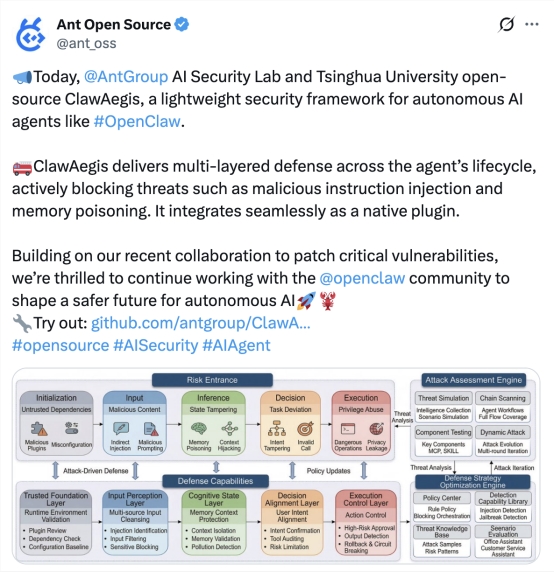
Ant Group and Tsinghua Unveil Open-Source Security Shield for AI Agents
News

Ant Group and Tsinghua Unveil Open-Source Security Shield for AI Agents

Ant Group's AI Security Lab and Tsinghua University have released ClawAegis, a groundbreaking security plugin for OpenClaw-type AI agents. This lightweight solution tackles risks like skill poisoning and data contamination across an agent's entire lifecycle. The tool offers real-time threat detection while maintaining transparency for end users - a significant step toward safer autonomous systems.

April 2, 2026
AI SecurityOpen SourceAutonomous Agents
Tech Giants Unite Against AI-Powered Cyber Threats with Glass Wing Project
News

Tech Giants Unite Against AI-Powered Cyber Threats with Glass Wing Project

In a groundbreaking move, Apple, Google, and other tech leaders have joined forces with AI startup Anthropic to combat sophisticated cyber threats. Their 'Project Glasswing' initiative leverages advanced AI to detect vulnerabilities - including a 27-year-old flaw in critical systems. The collaboration marks a new era in cybersecurity defense as artificial intelligence becomes both weapon and shield in digital security.

April 8, 2026
CybersecurityArtificialIntelligenceTechCollaboration
News

Hackers Exploit Claude Code Leak in Sophisticated GitHub Phishing Scheme

A major security breach has put developers at risk after Anthropic's Claude Code tool accidentally exposed over half a million lines of source code. Cybercriminals have seized the opportunity, creating fake GitHub repositories that distribute malware disguised as 'unlocked' versions of the leaked code. Security experts warn these traps install Vidar trojan malware capable of stealing sensitive data including cryptocurrency wallets. The attackers are using search engine optimization to make their malicious repositories appear legitimate, prompting urgent warnings for developers to stick to official channels.

April 3, 2026
CybersecurityAI DevelopmentPhishing Attacks
Claude Code's Security Flaw: When Too Many Commands Overwhelm AI Defenses
News

Claude Code's Security Flaw: When Too Many Commands Overwhelm AI Defenses

A newly discovered vulnerability in Anthropic's Claude Code tool reveals how hackers can bypass its security measures simply by flooding it with commands. When the system receives more than 50 sub-commands at once, its automatic rejection mechanism fails, potentially exposing users to dangerous operations. Security experts warn this flaw could be particularly risky in automated development environments where permission checks might be skipped.

April 2, 2026
AI SecurityAnthropicSoftware Vulnerabilities