

Musk's Cosmic Encyclopedia: Grokipedia Goes Open-Source with Space Ambitions
Musk Bets on Space as Ultimate Backup for Human Knowledge
In a move straight out of science fiction, Elon Musk revealed plans to send his AI-powered encyclopedia Grokipedia into space during a recent interview with Baron Capital. The xAI founder described the project as nothing less than "a modern Library of Alexandria" - but this time with interplanetary backups.
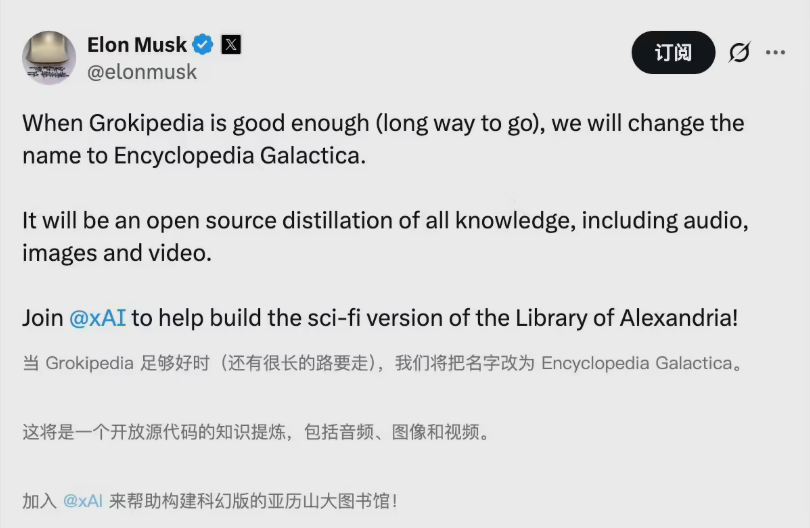
From Wikipedia Challenger to Cosmic Archive
The encyclopedia currently contains about 885,000 articles, all generated by xAI's Grok large language model. What sets it apart? Each entry comes stamped with verification timestamps, and users can interact directly with the content - highlighting text sections to suggest corrections or additions.
Yet Grokipedia remains dwarfed by Wikipedia's 7 million+ English articles. Musk acknowledges this gap but sees bigger horizons ahead. "When we reach sufficient quality," he explained, "we'll rebrand it as Encyclopedia Galactica" - a nod to Isaac Asimov's legendary Foundation series.
Permanent Preservation Through Space Tech
The most eye-catching aspect? Musk's plan involves:
- Etching the entire database onto heat-resistant oxide wafers
- Launching them aboard SpaceX missions starting in 2026
- Targeting lunar and Martian deployments first
- Maintaining Earth-based copies in orbit and data centers
The goal? Prevent another catastrophic loss of knowledge like the burning of Alexandria's ancient library. "Civilizations rise and fall," Musk noted. "This time, we're spreading our backups across multiple planets."
Why This Matters Beyond Sci-Fi Dreams
Industry analysts see multiple strategic plays:
- Data Advantage: Building high-quality training material for xAI's models
- Cultural Positioning: Claiming narrative ground in AI-space convergence
- Long-Term Vision: Establishing infrastructure for off-Earth knowledge access
The open-source approach could accelerate adoption while addressing concerns about centralized AI control. Starting next year, researchers worldwide will gain API access and full database downloads.
Key Points:
- Grokipedia contains 885K AI-generated articles with verification timestamps
- Plans call for complete open-sourcing including API access
- Oxide wafer backups will launch on SpaceX missions beginning 2026
- Future rebrand to "Encyclopedia Galactica" honors Asimov's sci-fi legacy
- Strategy combines practical AI development with visionary space ambitions


