Microsoft Unveils Mu: A Compact AI Model for Windows 11

Microsoft Launches Device-Side AI Model Mu for Windows 11

Microsoft has officially announced Mu, a new small language model (SLM) designed to power the AI assistant in Windows 11 Settings. With 330 million parameters, Mu is optimized to run locally on devices equipped with neural processing units (NPUs), offering low-latency and high-privacy interactions.

Mu: The Intelligent Core of Windows Settings

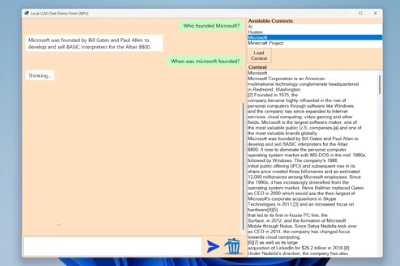
Mu is an encoder-decoder model tailored for Co-pilot+ PCs, enabling users to control system settings via natural language commands. For example, saying "turn on dark mode" or "increase screen brightness" triggers Mu to execute the action directly, bypassing manual menu navigation. Currently in testing for Windows Insiders Dev Channel, Mu supports hundreds of system settings with high accuracy.
Image

Key Features of Mu

  • Efficient Local Processing: Runs entirely on-device, achieving speeds of over 200 samples per second and reducing latency by 47%.
  • Privacy-Focused: No cloud data transfer ensures enhanced security.
  • Hardware Integration: Compatible with NPUs from AMD, Intel, and Qualcomm.

Technological Innovations

Mu builds on Microsoft’s expertise in small models, leveraging:

  • Quantization: Reduces memory usage while maintaining accuracy.
  • Parameter Sharing: Compresses model size by sharing weights.
  • Task-Specific Fine-Tuning: Trained on 3.6 million samples for precise settings comprehension.

The model was trained on Azure Machine Learning using NVIDIA A100 GPUs, combining high-quality data and knowledge distillation techniques.

User Experience Revolution

Mu transforms the traditionally complex Windows Settings app into a conversational interface. It handles ambiguous commands (e.g., "increase brightness") by prioritizing common actions and integrating search results for accuracy. Initially available on Qualcomm Snapdragon X devices, support will expand to AMD and Intel platforms soon.

Industry Impact and Challenges

Mu exemplifies the shift toward edge computing AI, offering near-Phi-3.5-mini performance with fewer resources. However, challenges remain:

  1. Hardware Limitations: Currently restricted to high-end Co-pilot+ PCs.
  2. Complex Instructions: Handling multi-meaning commands needs refinement.
  3. Ecosystem Growth: Potential developer customization and broader applications are under scrutiny.

Microsoft’s blog provides further details: Introducing Mu.

Key Points

  • Mu is a 330M-parameter SLM for Windows 11 Settings.
  • Runs locally on NPUs for speed and privacy.
  • Supports natural language commands like "dark mode."
  • Trained with quantization and parameter-sharing techniques.
  • Future expansion to AMD/Intel devices planned.
Enjoyed this article?

Subscribe to our newsletter for the latest AI news, product reviews, and project recommendations delivered to your inbox weekly.

Weekly digestFree foreverUnsubscribe anytime

Related Articles

GPT-5.4 Arrives With Mind-Reading AI and Million-Token Memory
News

GPT-5.4 Arrives With Mind-Reading AI and Million-Token Memory

OpenAI's latest model, GPT-5.4, introduces revolutionary features that bring us closer to truly intelligent digital assistants. The new Thinking mode lets users peer into the AI's reasoning process, while million-token memory enables handling massive documents. Perhaps most impressive are its native computer operation abilities - this AI doesn't just talk, it can actually work across your applications.

March 6, 2026
AIOpenAIGPT
News

Windows 12 Arrives Late 2026: AI Takes Center Stage in Modular Makeover

Microsoft's Windows 12 is set to debut late next year with groundbreaking changes. The new OS embraces modular design through CorePC architecture, allowing customized installations for different devices. AI becomes deeply integrated as Copilot evolves from assistant to system core, while hardware requirements jump with mandatory NPU chips - potentially leaving older PCs behind.

March 4, 2026
Windows12AIcomputingMicrosoft
News

Microsoft's AI Push Sparks 'Microslop' Backlash as Community Censors Criticism

Microsoft faces growing user frustration over its aggressive integration of AI features into Windows 11, with critics dubbing the company 'Microslop' - a blend of Microsoft and 'slop' referring to poor-quality content. The tech giant's attempt to ban the term in its official Discord community backfired spectacularly, leading to creative workarounds from users and ultimately forcing Microsoft to silence entire channels. While Microsoft claims these measures address spam attacks, many see it as avoiding deeper concerns about system stability versus flashy AI features.

March 4, 2026
MicrosoftAIbacklashWindows11
OpenAI's Stealth Move: Building a GitHub Rival That Could Shake Up Coding
News

OpenAI's Stealth Move: Building a GitHub Rival That Could Shake Up Coding

OpenAI is quietly developing its own code hosting platform, potentially setting up a clash with Microsoft-owned GitHub. The project, still in early stages, stems from frustration with GitHub's reliability issues. What makes this intriguing? Microsoft is OpenAI's biggest investor, turning this into a delicate dance between partners and competitors. The new platform could integrate AI coding tools like Codex, offering smarter automation than traditional repositories.

March 4, 2026
OpenAIGitHubMicrosoft
AI Agents Get Smarter on the Fly with New Training Framework
News

AI Agents Get Smarter on the Fly with New Training Framework

Ant Group and Tsinghua University have unveiled AReaL v1.0, a breakthrough reinforcement learning framework that lets AI agents improve themselves during actual use. Unlike traditional systems that require extensive coding, this innovative solution allows existing agents to connect seamlessly - imagine your digital assistant getting better at its job every time you use it. The system's secret weapon? An AI-powered development assistant that helped build its complex architecture in record time.

March 4, 2026
AIMachineLearningTechInnovation
StepZen's Open-Source AI Model Challenges Industry Giants
News

StepZen's Open-Source AI Model Challenges Industry Giants

StepZenith has fully open-sourced its Step3.5Flash AI model, featuring a massive 196-billion parameter MoE architecture. This energy-efficient model activates just 11 billion parameters during use, achieving remarkable speeds of 350 TPS in coding tasks. Already ranking second in usage behind OpenClaw, it's quickly becoming a favorite in the open-source community for its speed and stability.

March 4, 2026
AIOpenSourceMachineLearning