Microsoft Research Unveils Skala: A Breakthrough in Deep Learning for DFT
Microsoft Research Unveils Skala: A Breakthrough in Deep Learning for DFT
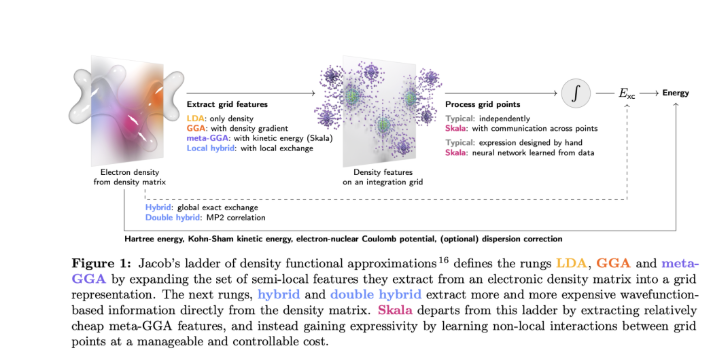
Microsoft Research has launched Skala, a novel deep learning exchange-correlation (XC) functional aimed at revolutionizing computational efficiency in Kohn-Sham density functional theory (DFT). This innovative tool bridges the gap between accuracy and computational cost, offering hybrid-level precision with the efficiency of semi-local methods.
Performance and Accuracy
Skala has demonstrated remarkable performance in benchmark tests:
- Achieved a mean absolute error (MAE) of 1.06 kcal/mol on the W4-17 molecular system.
- Reduced MAE to 0.85 kcal/mol on single-reference subsets.
- Recorded a weighted mean absolute deviation (WTMAD-2) of 3.89 kcal/mol in the GMTKN55 benchmark.
These results position Skala as a competitive alternative to top-tier hybrid functionals.
Targeted Applications
Skala is specifically designed for main-group thermochemical calculations, focusing on:
- High-throughput reaction energy (ΔE) estimations.
- Reaction barrier predictions.
- Conformational and free radical stability rankings.
- Geometry and dipole moment calculations.
The tool does not currently account for dispersion effects, relying instead on fixed D3 (BJ) dispersion corrections.
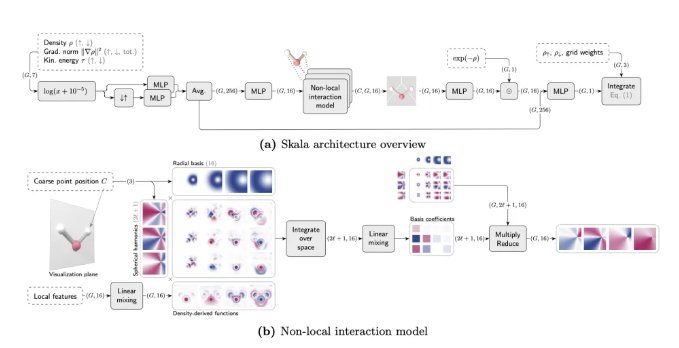
Architecture and Training
The development of Skala involved a two-stage process:
- Pre-training: Utilized B3LYP density to extract XC labels from high-level wavefunction energy data.
- Fine-tuning: Conducted within the SCF loop using Skala's own density, eliminating the need for backpropagation.
The model was trained on an extensive dataset comprising approximately 80,000 high-precision total atomic energies (MSR-ACC/TAE).
Computational Efficiency
Skala maintains an O(N³) computational complexity, optimized for GPU execution to ensure rapid processing. The open-source code is now available on:
- Azure AI Foundry Laboratory
- GitHub
This accessibility allows researchers to perform efficient batch SCF calculations using platforms like PySCF/ASE and GauXC.
Key Points
🌟 High Precision: Skala achieves MAEs as low as 0.85 kcal/mol on specialized subsets. 🛠️ Efficiency: Combines hybrid-level accuracy with semi-local computational costs. 🚀 Accessibility: Open-source release supports widespread adoption in molecular chemistry research.