
Google's Veo3 AI Achieves GPT-3-Level Breakthrough in Visual Processing

Google's Veo3 Reaches 'GPT-3 Moment' for Visual AI

Google DeepMind has announced groundbreaking advancements in its Veo3 video generation model, with capabilities that researchers are comparing to the transformative impact of GPT-3 in natural language processing. The system has demonstrated unexpected multi-task potential after completing 18,384 basic video tasks, signaling a major leap forward for visual artificial intelligence.

Zero-Shot Learning Capabilities

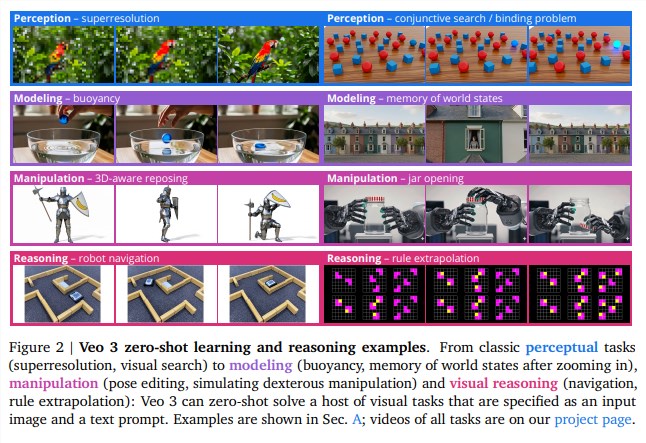
The most striking feature of Veo3 is its zero-shot learning ability. Without specific training, the model can automatically handle various complex visual tasks. This generalization capability suggests AI systems are evolving from single-function tools into more versatile intelligent assistants.
Image

Advanced Image Understanding

In image analysis, Veo3 performs exceptionally well by:

  • Automatically identifying edges, contours, and object positions
  • Analyzing complex scenes with detailed precision
  • Distinguishing between foreground and background elements
  • Establishing foundations for subsequent image processing

The system shows particular strength in understanding messy or cluttered image content while maintaining accurate object recognition.

Physical World Comprehension

Perhaps most impressively, Veo3 demonstrates physical reasoning abilities, including:

  • Determining object buoyancy properties
  • Simulating realistic light reflection effects
  • Predicting object motion trajectories under specific conditions

These capabilities enable remarkably natural video generation. For example, when creating videos of floating objects, Veo3 precisely simulates water waves and buoyancy effects.

Creative Editing Features

The model supports numerous creative applications through:

  • Automatic background removal
  • Dynamic text addition to images
  • Artistic style conversion (e.g., transforming photos into oil paintings) These features suggest broad potential for content creation tools across industries.

Logical Reasoning Emergence

The system has shown surprising logical capabilities including:

  • Solving maze images by planning optimal paths
  • Completing complex Sudoku puzzles This indicates evolution beyond pure visual processing into abstract reasoning domains.

The Google DeepMind team describes this advancement as the "GPT-3 moment" for visual AI - marking the transition from specialized systems toward general intelligence. The breakthrough could revolutionize fields like autonomous driving, medical imaging, and virtual reality.

Technical Foundations

Veo3's multi-task abilities stem from deep representation learning during large-scale video data training. By analyzing spatiotemporal relationships and physical patterns in videos, the model developed generalized visual processing capabilities beyond its original design parameters.

Challenges Remain

Despite its promise, widespread adoption faces hurdles including:

  • Significant computational resource requirements
  • Model interpretability concerns
  • Privacy protection considerations x Ethical regulation needs (especially for sensitive applications like medical imaging) Ensuring system reliability and safety will be critical for real-world deployment.

The release strengthens Google's leadership position in visual AI while setting new benchmarks for competitors. As capabilities continue improving, commercial and research applications will likely expand significantly. This development reveals an important trend: specialized AI systems may spontaneously develop general capabilities when reaching sufficient scale and complexity - offering valuable insights about future AI evolution paths. Research Paper"">">">">">">">">">">">">"""""""""""",,,,,,,,,,,,,,,,,,,,"",,",",,",",,",,",,",,",,,,
Enjoyed this article?

Subscribe to our newsletter for the latest AI news, product reviews, and project recommendations delivered to your inbox weekly.

Weekly digestFree foreverUnsubscribe anytime

Related Articles

News

South Korea's AI Ambition Hits Snag Over Chinese Code Controversy

South Korea's push for AI independence faces unexpected hurdles as domestic models show striking similarities to Chinese open-source code. Three leading tech firms, including Naver and SK Telecom, stand accused of borrowing heavily from Chinese AI projects despite government backing for 'sovereign AI'. The revelations spark debate about balancing innovation with self-reliance in the global AI race.

January 14, 2026
Artificial IntelligenceTech PolicySouth Korea
News

Instagram Co-Founder Shifts Gears to Lead Anthropic's Innovation Lab

Mike Krieger, Instagram co-founder and Anthropic's Chief Product Officer, is stepping into a new role leading the company's internal 'Labs' team focused on experimental AI products. As Anthropic plans to double its innovation team size within six months, Krieger sees this as a pivotal moment to shape AI applications firsthand. Meanwhile, Ami Vora will take over Krieger's product leadership duties as the startup intensifies its competition with tech giants.

January 14, 2026
Artificial IntelligenceTech StartupsExecutive Moves
Zhipu and Huawei Unveil Breakthrough AI Image Model Powered Entirely by Domestic Tech
News

Zhipu and Huawei Unveil Breakthrough AI Image Model Powered Entirely by Domestic Tech

Chinese AI firm Zhipu has partnered with Huawei to launch GLM-Image, a groundbreaking multimodal model that's entirely trained on domestic hardware. This innovative system combines text and image generation capabilities, excelling particularly at Chinese character rendering and complex visual tasks. Available now as open-source software, it promises to make advanced AI image creation more accessible.

January 14, 2026
AI InnovationDomestic TechnologyComputer Vision
News

South Korea secures priority access to NVIDIA's cutting-edge AI chips

At CES 2026, South Korean officials announced NVIDIA's commitment to prioritize delivery of next-generation Vera Rubin GPUs to the country. This strategic move comes as part of a broader partnership that includes supplying up to 260,000 GPUs for South Korea's AI infrastructure development. Officials emphasized how securing advanced chip technology early could give Korean tech firms a crucial edge in global AI competition.

January 13, 2026
NVIDIAArtificial IntelligenceTech Partnerships
News

Multimodal AI Sparks Stock Rally as Investors Bet on Tech Revolution

China's A-share market saw a surge in multimodal AI stocks as investors reacted to breakthroughs in technology that combines text, image and video understanding. Companies like Focus Technology and YiDian Tianxia hit daily limits amid growing excitement about AI's potential to transform industries from customer service to content creation. Analysts see this as more than temporary enthusiasm - it reflects real confidence in AI's ability to reshape how we interact with technology.

January 12, 2026
Artificial IntelligenceStock MarketTechnology Trends
News

Tsinghua and Uber-Backed AI Platform Secures Major Funding Boost

Manifold AI, a research platform developed through collaboration between Tsinghua University and Uber, has raised over 100 million yuan in pre-A funding. The platform specializes in streamlining machine learning research with tools for data management and automated preprocessing. Notable investors include Mei Hua Venture Capital and Huawei Habor, signaling strong industry confidence in China's growing AI capabilities.

January 12, 2026
Artificial IntelligenceResearch TechnologyVenture Funding