
Mianbi's 'Songguo Board' Brings AI to Your Fingertips with Edge Computing Power

Mianbi Intelligence Redefines Hardware Development with AI-Powered Songguo Board
Image

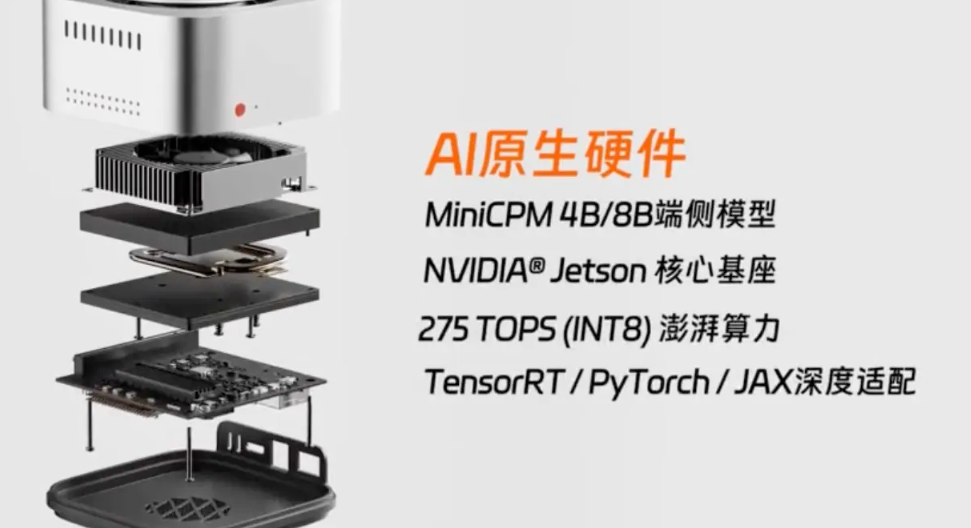
In a move that could democratize AI hardware development, Mianbi Intelligence has launched the Songguo Board - a palm-sized revolution in edge computing. This isn't just another development board; it's a complete ecosystem designed to bring artificial intelligence out of the cloud and into the physical world.

Power Packed in a Small Package

The Songguo Board runs on NVIDIA's robust Jetson platform but adds Mianbi's secret sauce: seamless integration with their MiniCPM edge-side large models. With 275TOPS of INT8 computing power packed into its compact frame, developers can now process complex AI models locally without constant cloud connectivity. Built-in microphones and cameras transform it into a ready-made platform for creating anything from smart home devices to autonomous robots.

"We wanted to remove the steep learning curve from AI hardware development," explains Mianbi's chief engineer. "The Songguo Board lets you focus on what your device should do, not how to make it work."

Programming Without Code Barriers

What truly sets the Songguo apart is its "Agent-native" approach. Imagine telling your development board in plain English: "Create a security camera that alerts me when it sees unfamiliar faces" - and having the system handle the technical implementation. This natural language interface opens AI hardware development to creators without advanced programming skills while still offering full customization for experts.

The board comes with comprehensive toolchains covering everything from model optimization to real-time decision making. Whether you're building a personal knowledge assistant that works offline or prototyping the next generation of service robots, all the necessary components now fit in your hand.

The Future in Developers' Hands

Early adopters are already buzzing about potential applications. Educational institutions see it as the perfect tool for teaching AI concepts through hands-on projects. Startup founders appreciate how it slashes development time for IoT products. Even established manufacturers are exploring how Songguo could streamline their prototyping processes.

As edge computing becomes increasingly crucial for responsive, privacy-conscious AI applications, Mianbi's timing appears impeccable. The Songguo Board isn't just a product launch - it might well be the start of a new era in accessible artificial intelligence development.

Key Points:

  • Game-changing performance: 275TOPS computing power in edge device form factor
  • Plug-and-play AI: Integrated support for MiniCPM large models enables complex offline processing
  • Natural language programming: Develop hardware functions through simple instructions
  • Complete ecosystem: From sensors to decision-making tools in one package
  • Broad applications: Suitable for education, startups, and enterprise prototyping

Enjoyed this article?

Subscribe to our newsletter for the latest AI news, product reviews, and project recommendations delivered to your inbox weekly.

Weekly digestFree foreverUnsubscribe anytime

Related Articles

News

Cerebras' Meteoric Rise: AI Chip Maker Lands $1B in Funding as Valuation Soars

AI chip innovator Cerebras has stunned the semiconductor world with a $1 billion Series H funding round, catapulting its valuation to $23 billion - nearly triple its worth just four months ago. Backed by Tiger Global and strategic investor AMD, the company's wafer-scale technology continues to disrupt the AI hardware space while powering partnerships like its collaboration with OpenAI.

February 5, 2026
AI HardwareSemiconductorsVenture Capital
News

ByteDance Doubles Down on AI Hardware with Douyin Phone 2 and Smart Glasses

ByteDance is making waves in the AI hardware space with its upcoming Douyin Phone 2, set to launch mid-2026. The tech giant is taking a collaborative approach, partnering with smartphone manufacturers while expanding into wearables. Their ambitious plans include two versions of AI glasses - one lightweight model arriving soon and a more interactive version later this year.

January 29, 2026
ByteDanceAI HardwareSmartphones
News

Sam Altman's Sleek Choice: Why the iPhone Air Became His AI Companion

OpenAI CEO Sam Altman recently showcased his go-to device—the ultra-thin iPhone Air—during a company Q&A. This isn't just any smartphone; at 5.6mm thick and weighing just 165 grams, it's Apple's lightest yet packs serious power with the A19 chip. Altman's preference offers intriguing clues about how tech leaders envision our AI-powered future: devices that disappear into our lives while delivering cutting-edge performance.

January 29, 2026
Sam AltmaniPhone AirAI Hardware
News

Microsoft's Maia 200 Chip: A Giant Leap for AI Processing

Microsoft has unveiled its groundbreaking Maia 200 AI inference chip, packing over 100 billion transistors into TSMC's cutting-edge 3nm process. This powerhouse delivers unprecedented computing speeds while tackling AI's biggest challenge: operational costs. Already powering Microsoft's Copilot and other projects, the chip represents a significant step forward in making large-scale AI more accessible.

January 27, 2026
AI HardwareMicrosoft InnovationsSemiconductor Technology
Peking University's Chip Breakthrough Slashes AI Power Needs Dramatically
News

Peking University's Chip Breakthrough Slashes AI Power Needs Dramatically

Researchers at Peking University have developed an innovative analog computing chip that tackles one of AI's biggest challenges - skyrocketing energy demands. Their solution achieves staggering improvements: 12 times faster processing and a jaw-dropping 228-fold boost in energy efficiency compared to current digital chips. The breakthrough could revolutionize how we handle complex tasks like image analysis and recommendation systems while dramatically cutting power consumption.

January 23, 2026
AI HardwareEnergy EfficiencyComputing Breakthrough
News

AI Startup Upscale Raises $200M to Take on NVIDIA's Networking Dominance

Silicon Valley startup Upscale AI has secured $200 million in funding to challenge NVIDIA's grip on AI networking hardware. The company's custom 'SkyHammer' chip aims to compete with NVIDIA's NVSwitch technology, offering an open alternative for large-scale AI systems. Backed by industry heavyweights like Intel and AMD, Upscale plans to bring its solution to market this year.

January 22, 2026
AI HardwareSemiconductor IndustryData Center Technology