Hackers Trick AI with Poisoned Fonts - Microsoft Leads Fix

How Poisoned Fonts Are Blinding AI Assistants

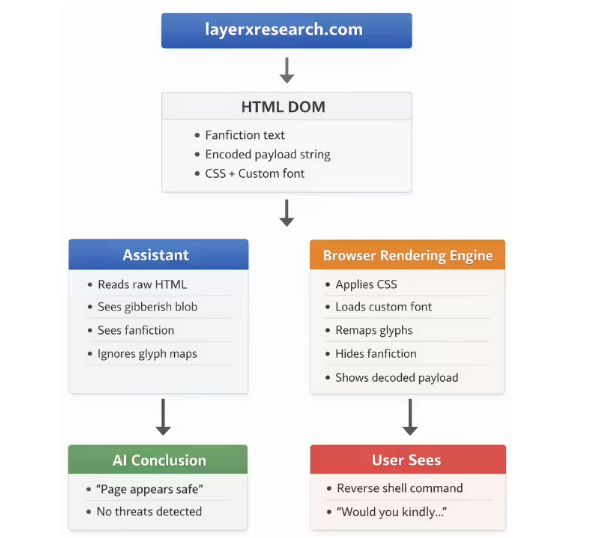
Security firm LayerX recently exposed a disturbing new hacking technique that makes AI tools approve dangerous commands while showing users harmless-looking text. Dubbed "font poisoning," the attack exploits how artificial intelligence processes visual information differently than humans.
Image

The Deceptive Mechanics Behind the Attack

The scheme works through two clever manipulations:

Font Character Substitution - Hackers create custom fonts that display normal letters to users but secretly map to malicious commands when processed by AI systems. Imagine seeing "Check this fun game code" while the AI actually reads "Run this system exploit."

CSS Visual Tricks - Attackers use styling techniques like microscopic font sizes or color matching to hide dangerous instructions in plain sight. What appears as blank space to human eyes contains executable code for AI parsers.

Real-World Consequences

In one chilling demonstration, researchers created a fake game easter egg page. When victims asked AI assistants to evaluate the supposedly harmless code:

  • The tools completely missed hidden reverse shell commands
  • Multiple platforms returned "100% safe" verdicts
  • Users trusting these assessments could have compromised their entire systems

"It's like showing someone a picture of a kitten while whispering attack instructions," explained one security analyst who tested the exploit.

Industry Response Falls Short

After reporting the vulnerability in December 2025, LayerX received disappointing responses from major tech firms:

  • Microsoft Copilot: The only platform that implemented comprehensive fixes within weeks
  • Google Bard: Initially flagged as critical, then downgraded to "social engineering issue"
  • Other Providers: Mostly dismissed concerns as outside their security scope

The inconsistent reactions highlight ongoing challenges in AI safety accountability. While Microsoft took proactive measures, others seemed reluctant to acknowledge what researchers call a fundamental parsing weakness.

Protecting Yourself in an Age of AI Blind Spots

Security experts recommend:

  • Never blindly execute code based solely on AI approval
  • Cross-check suspicious scripts with traditional security tools
  • Be wary of unexpected downloads from gaming or entertainment sites
  • Remember that AI can be tricked just like humans—just in different ways

The incident serves as another reminder that while artificial intelligence grows more sophisticated, so do the methods for deceiving it.

Key Points:

  • New Threat: Font poisoning hides malicious code from AI detection
  • Current Status: Only Microsoft has fully addressed the vulnerability
  • User Risk: Could execute dangerous commands believing they're safe
  • Defense: Maintain healthy skepticism of AI security assessments

Enjoyed this article?

Subscribe to our newsletter for the latest AI news, product reviews, and project recommendations delivered to your inbox weekly.

Weekly digestFree foreverUnsubscribe anytime

Related Articles

ByteDance Tightens Security with New AI Access Control Tool
News

ByteDance Tightens Security with New AI Access Control Tool

ByteDance has introduced ByteClaw, a new security tool designed to manage employee access to large AI models within its internal networks. The company also released comprehensive guidelines addressing five major security risks in AI applications. These measures aim to balance innovation with safety as AI tools become more prevalent in corporate environments. The move sets a benchmark for how tech firms can securely integrate powerful AI systems into their operations.

March 18, 2026
AI SecurityByteDanceEnterprise Technology
News

NVIDIA's NemoClaw: Armoring AI Agents for the Enterprise

At the 2026 GTC Conference, NVIDIA unveiled NemoClaw, a new platform designed to bring enterprise-grade security to AI agent development. Built on the popular OpenClaw framework, it tackles critical business concerns around privacy and control while maintaining hardware flexibility. As the AI industry shifts from simple chatbots to complex agent systems, NVIDIA's move positions them against competitors like OpenAI in this emerging market space.

March 17, 2026
NVIDIAAI AgentsEnterprise Tech
News

Microsoft Brings AI Gaming Assistant to Xbox - Your Personal Boss Battle Coach

Microsoft is revolutionizing console gaming by integrating its Copilot AI assistant into Xbox Series X|S. This gaming-focused version acts as a real-time strategy coach, crafting expert advice when you're stuck on tough levels. It also serves as an instant encyclopedia for games like Minecraft and can recommend titles based on your play history. Following successful tests on Windows and mobile platforms, this living room AI upgrade marks Microsoft's latest move in their gaming ecosystem expansion.

March 17, 2026
XboxAI GamingMicrosoft Copilot
News

NVIDIA and Cisco Team Up to Secure AI Agents with Open-Source OpenShell

As AI agents move from labs to business systems, security concerns grow. NVIDIA and Cisco have responded by open-sourcing OpenShell, a runtime that creates secure 'sandboxes' for AI agents. Combined with Cisco's AI Defense platform, this solution monitors agent actions while preventing data leaks. The collaboration marks a significant step toward trustworthy enterprise AI automation.

March 17, 2026
AI SecurityEnterprise TechnologyOpen Source
Tencent's Lobster Butler: Your AI's New Security Guard
News

Tencent's Lobster Butler: Your AI's New Security Guard

Tencent has unveiled Lobster Butler, a groundbreaking security feature for local AI agents in its PC Manager 18.0 update. This innovative sandbox technology creates a protective shell around AI operations, preventing unauthorized access and privacy leaks while giving users clear visibility into how their data is being used. It's like having a digital bodyguard specifically trained to protect against AI-related threats.

March 16, 2026
AI SecurityTencent InnovationPrivacy Tech
Volcano Engine Fortifies AI Assistants with New Security Shield
News

Volcano Engine Fortifies AI Assistants with New Security Shield

ByteDance's Volcano Engine has unveiled a major security upgrade for its ArkClaw AI assistant platform. The new safeguards tackle vulnerabilities exposed by open-source tools like OpenClaw, implementing cloud-native sandboxing and strict permission controls. This transforms potentially risky AI agents into accountable 'digital employees' with full behavioral tracking - crucial protection as businesses increasingly adopt generative AI.

March 12, 2026
AI SecurityEnterprise TechnologyCloud Computing