Google DeepMind's New Training Tech Keeps AI Learning Despite Glitches

Google DeepMind's Breakthrough in Fault-Tolerant AI Training

In the high-stakes world of artificial intelligence development, Google DeepMind has tackled one of the most frustrating problems head-on: what happens when your expensive hardware decides to take an unscheduled break? Their answer - a clever new architecture called Decoupled DiLoCo - could change how we train massive AI models.

The Problem With Perfect Synchronization

Traditional AI training methods operate like a perfectly choreographed ballet - every computing unit must move in perfect sync during gradient updates. It's impressive when it works, but as anyone who's dealt with technology knows, perfection rarely lasts. A single hiccup in one component can bring the entire performance to a grinding halt.
Image

Islands of Independence

Decoupled DiLoCo takes a radically different approach by creating what engineers call "computing islands." Picture these as self-contained teams working on different parts of the same project. Each island operates independently, making multiple local calculations before sending compressed updates to a central coordinator.

The magic happens in the asynchronicity. If one island experiences technical difficulties (maybe its TPU got too hot or the network connection dropped), the others simply keep working. No waiting around for stragglers, no system-wide timeouts - just continuous progress.

By the Numbers: Why This Matters

The results speak for themselves:

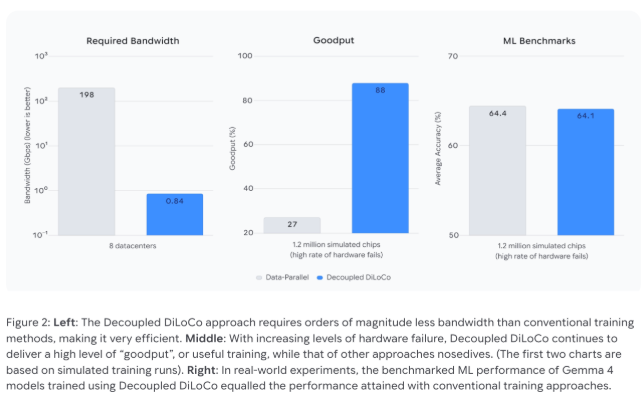
  • 88% utilization maintained even with frequent hardware failures (versus just 27% with traditional methods)
  • Bandwidth between data centers slashed from 198 Gbps to less than 1 Gbps
  • Older and newer hardware can work together seamlessly

The bandwidth reduction alone is game-changing. Suddenly, global collaboration on AI training becomes practical using existing internet infrastructure rather than requiring specialized high-speed connections.

Built-In Resilience That Would Make Cockroaches Jealous

During stress testing (what engineers charmingly call "chaos engineering"), Decoupled DiLoCo demonstrated an almost uncanny ability to keep going. Even when all learning units temporarily failed simultaneously, the system picked up right where it left off once they came back online.

This resilience extends to hardware diversity too. Different generations of TPU chips can participate in the same training process, giving older equipment new purpose and smoothing transitions during upgrades.

Key Points:

  • 🔄 Asynchronous Advantage: Independent computing units prevent single points of failure from derailing entire training processes
  • 🌍 Bandwidth Breakthrough: Dramatically reduced network requirements make global distributed training feasible
  • ⚡ Hardware Harmony: Mixed generations of processing units can collaborate effectively
  • 🧠 Self-Healing Smarts: System automatically recovers from failures without losing progress
Enjoyed this article?

Subscribe to our newsletter for the latest AI news, product reviews, and project recommendations delivered to your inbox weekly.

Weekly digestFree foreverUnsubscribe anytime

Related Articles

News

NeoCognition Labs Raises $40M to Build Self-Learning AI Agents

AI research lab NeoCognition has emerged from stealth with $40 million in seed funding to tackle one of AI's biggest challenges: reliability. Founded by Ohio State's Professor Yu Su, the startup aims to create self-learning systems that can master professional domains like human experts. Backed by top investors including Vista Equity Partners, NeoCognition plans to transform enterprise SaaS with AI agents that evolve independently across industries.

April 22, 2026
AI researchstartup fundingmachine learning
News

Meta Taps Employee Data to Train AI, Raising Privacy Eyebrows

Meta is collecting detailed work behavior data from employees—including mouse movements and keystrokes—to train its new 'Muse Spark' AI model. While the company claims this will help AI better understand human computer use, the move has sparked concerns about workplace privacy boundaries in an era of heightened data sensitivity.

April 24, 2026
AI ethicsworkplace privacymachine learning
DeepSeek V4 Launches with Two Flavors: Fast and Powerful AI at New Price Points
News

DeepSeek V4 Launches with Two Flavors: Fast and Powerful AI at New Price Points

China's DeepSeek has rolled out its V4 AI model in two versions - Flash for quick tasks and Pro for complex reasoning. The new pricing structure rewards efficient caching, with costs as low as ¥0.2 per million tokens. This release marks a strategic move to make advanced AI more accessible while maintaining high performance standards.

April 24, 2026
AI modelsDeepSeekmachine learning
Google's New AI Agents Take Research to the Next Level
News

Google's New AI Agents Take Research to the Next Level

Google has unveiled two powerful new AI research tools built on its Gemini 3.1 Pro platform. The Deep Research agents promise to transform how we conduct complex analysis, moving beyond simple web searches to sophisticated reasoning. While one version prioritizes speed for real-time conversations, the other digs deeper for comprehensive reports. With features like multimodal input and data visualization, these tools could change how professionals work with information.

April 22, 2026
AI researchGoogle Geminiautonomous agents
News

NeoCognition Raises $40M to Build AI That Learns Like Humans

AI startup NeoCognition has secured $40 million in seed funding to develop next-generation AI agents that mimic human learning. The company, led by Professor Su Yu, aims to solve the current 50% success rate problem in AI task execution by creating systems that can specialize like humans. Backed by investors including Intel's CEO, the firm plans to target enterprise markets with customizable 'AI employees' that rapidly adapt to specialized fields like law and finance.

April 22, 2026
AI developmentmachine learningstartup funding
News

Moonshot AI's K2.6 Model Breaks New Ground in Coding and AI Agents

Moonshot AI has unveiled its latest Kimi K2.6 model, marking significant strides in AI's ability to handle complex, long-term tasks. The model shines in coding marathons - capable of working non-stop for 13 hours while maintaining accuracy. Benchmarks show it competes with top global models, even outperforming them in some areas. Developers can now access these capabilities through various platforms, signaling a shift from simple AI conversations to practical execution.

April 21, 2026
AI developmentcoding assistantsMoonshot AI