Gaode's ABot-M0 Gives Robots a Universal Brain
A New Era for Robot Intelligence
The robotics world just got smarter. Gaode's groundbreaking ABot-M0 model isn't just another incremental improvement—it's a complete rethinking of how robots learn and operate. Imagine a single brain that could adapt to any robot body, from industrial arms to household helpers. That's exactly what this open-source breakthrough promises.
Why This Changes Everything
Traditional robots often struggle when faced with new environments or tasks. ABot-M0 shatters these limitations with an impressive 80.5% success rate on the Libero-Plus benchmark—a staggering 30% jump over previous solutions. It's like comparing a toddler taking first steps to an athlete running a marathon.
What makes this system special? Two key innovations:
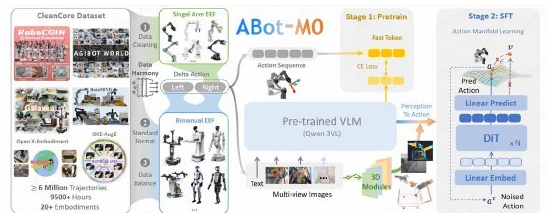
- Action Manifold Learning: Helps robots understand complex movements intuitively
- Two-stream perception: Gives machines human-like spatial awareness
The Open-Source Advantage
Gaode isn't just sharing results—they're giving away the recipe. The complete package includes:
Data: Over 6 million real-world operation trajectories in the UniACT dataset Algorithms: The full training framework and core architecture Models: Ready-to-use pre-trained versions for immediate implementation
This comprehensive approach solves two major industry headaches: fragmented data and difficult deployments. Developers can now skip years of groundwork and focus on creating specialized applications.
From Labs to Living Rooms
"True intelligence emerges through collaboration," explains Gaode's project lead. By open-sourcing ABot-M0, they're inviting global developers to refine what could become the standard language for robot brains. The implications are enormous—from factories where machines adapt instantly to new production lines, to homes where helper robots learn our preferences naturally.
The technology still faces challenges (robots won't be doing your laundry perfectly tomorrow), but this release marks a turning point. For the first time, anyone can work with—and improve upon—cutting-edge embodied intelligence.
Key Points:
- Universal architecture: One system adaptable to diverse robot forms
- Proven performance: 30% better than previous industry standards
- Complete toolkit: Data, algorithms and models all available openly
- Community-driven: Designed for global collaboration and improvement