Flapping Airplanes Lands $180M to Teach AI Like Humans

Brain-Inspired AI Startup Soars With Major Funding

In a market flooded with AI companies chasing bigger datasets, Flapping Airplanes is taking a radically different flight path. The research lab announced today it has secured $180 million in seed funding led by Sequoia Capital, with participation from Google Ventures and Index Ventures.

What makes this Silicon Valley newcomer stand out? While competitors train models by "drinking from the internet's firehose," Flapping Airplanes believes there's a better way - one inspired by our own brains.

"Current AI demands ridiculous amounts of data," explains co-founder Ben Spector. "We're treating human-level learning as the starting point, not some distant finish line."

The lab's approach focuses on quality over quantity when it comes to training data. Their secret sauce? Developing algorithms that extract more insight from less information - potentially revolutionizing how quickly and efficiently AI systems can learn.

The Human Brain Blueprint

The team isn't just chasing incremental improvements. They're aiming for orders-of-magnitude gains - specifically, making AI training 1000 times more efficient than current methods.

Co-founder Aidan Smith draws parallels to how toddlers learn: "A child doesn't need millions of cat pictures to recognize one. That's the kind of efficiency we want machines to achieve."

The founders admit their goals sound ambitious, but investors seem convinced. The hefty seed round will fund both research and hiring unconventional talent - prioritizing creative thinkers over traditional credentials.

Research Before Revenue

Unlike many well-funded startups racing to monetize, Flapping Airplanes maintains a distinctly academic vibe. There are no immediate plans for commercial products, though industry watchers speculate their breakthroughs could eventually transform fields from robotics to drug discovery.

The company name itself hints at their philosophy - marrying biological inspiration (flapping) with technological ambition (airplanes). It's this blend of curiosity-driven research and moonshot thinking that caught investors' attention.

Key Points:

  • 💰 Record-Breaking Seed Round: $180 million investment signals strong belief in alternative AI approaches
  • 🧠 Efficiency Revolution: Goal to make AI learning 1000x more data-efficient than current methods
  • 🔬 Science First: Commercialization takes backseat to fundamental research breakthroughs

Enjoyed this article?

Subscribe to our newsletter for the latest AI news, product reviews, and project recommendations delivered to your inbox weekly.

Weekly digestFree foreverUnsubscribe anytime

Related Articles

News

Tiny AI Team Lands $385M for Game-Changing Workspace Tool

A compact 20-person startup founded by ex-Baidu executives has shaken up the AI world with its $385 million Series B funding round. Genspark, their all-in-one AI workspace platform, now boasts a staggering $1.6 billion valuation. What makes this team special? They've built an AI that doesn't just chat - it actually gets work done, from crafting presentations to making real-world phone calls. Already making waves in Japan with nearly 15 million monthly visits, this could be the future of how we work.

April 1, 2026
AI startupsproductivity toolsventure capital
News

Moonshot AI's K2.5 Model Hits $100M Revenue as Clients Rush for Computing Power

Moonshot AI's Kimi K2.5 model has achieved a remarkable $100 million in annual recurring revenue just one month after launch, signaling strong market demand for advanced AI solutions. Enterprise clients are making million-dollar commitments to secure computing power access, while investors push the company's valuation toward $18 billion. The success stems from K2.5's innovative multi-agent capabilities that enable complex collaborative tasks beyond single-model limitations.

March 30, 2026
AI commercializationMoonshot AIenterprise technology
ByteDance Plants Seeds for Future AI Talent with New Campus Recruitment Drive
News

ByteDance Plants Seeds for Future AI Talent with New Campus Recruitment Drive

ByteDance has launched an ambitious campus recruitment program called Seed2027 to cultivate the next generation of AI talent. Targeting 2027 graduates, the initiative focuses on large language models and cutting-edge AI research. Selected candidates will work directly with senior scientists and gain access to powerful computing resources. This early talent grab signals ByteDance's determination to stay ahead in the intensifying AI race.

April 1, 2026
AI recruitmentByteDancemachine learning
Gaode's ABot-M0 Gives Robots a Universal Brain
News

Gaode's ABot-M0 Gives Robots a Universal Brain

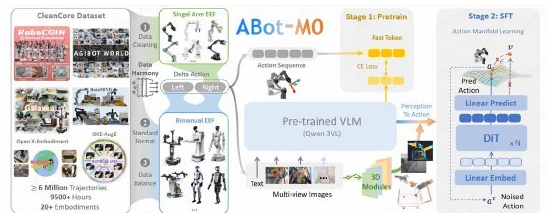
In a major leap for robotics, Gaode has open-sourced ABot-M0, the world's first unified architecture for robot intelligence. This 'universal brain' outperforms previous models by 30% on key benchmarks, while its complete open-source package—including algorithms and training data—could revolutionize how we develop smart robots for homes and industries.

April 1, 2026
roboticsAIopen-source
Qwen3.5-Omni Ushers in a New Era of AI with Multimodal Mastery
News

Qwen3.5-Omni Ushers in a New Era of AI with Multimodal Mastery

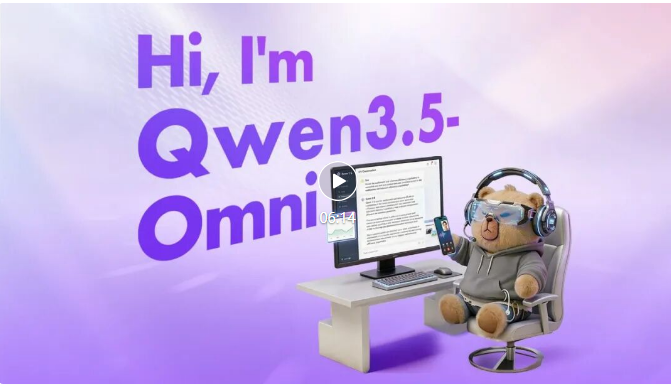
Tongyi Lab's latest AI model, Qwen3.5-Omni, has set a new benchmark with 215 state-of-the-art achievements. This multimodal powerhouse seamlessly processes text, images, audio, and video, outperforming competitors like Gemini-3.1Pro in audio understanding while maintaining top-tier visual and text capabilities. Its innovative Hybrid-Attention MoE architecture enables processing of lengthy audio and video content with remarkable precision. From real-time voice control to personalized voice cloning, Qwen3.5-Omni is redefining how we interact with technology.

March 31, 2026
AI innovationmultimodal AIvoice technology
News

Qwen Wants Your Help to Train Its AI Assistant - With Ride Credits

Qwen is recruiting a million users daily to test-drive its new AI services like smart ride-hailing and automated phone top-ups. From March 30 to April 6, participants can earn coupons while helping the AI better understand real-world requests. The program aims to tackle one of AI's toughest challenges: interpreting the messy, personalized way humans actually communicate their needs.

March 30, 2026
AI assistantsmachine learninguser experience