China Issues Guidelines for AI Large Models in Government

China Releases Framework for Government AI Adoption

The Cyberspace Administration of China and the National Development and Reform Commission have jointly issued "Guidelines for the Deployment and Application of Artificial Intelligence Large Models in the Government Sector." This landmark document establishes a framework for safe and effective AI implementation across all levels of government administration.

Strategic Implementation Approach

The guidelines recommend focusing on high-frequency needs including:

  • Government services
  • Social governance
  • Office automation
  • Decision support systems

Image

Image source note: The image was generated by AI, and the image licensing service provider is Midjourney

Authorities emphasize adapting implementations to local conditions, allowing regions to develop tailored solutions while maintaining national standards. The document specifically warns against creating "model islands" through isolated development efforts.

Resource Optimization Measures

Key operational principles include:

  1. "One region construction, multiple reuse" model to maximize efficiency
  2. Shared infrastructure development to prevent duplication
  3. Balanced workload reduction with meaningful empowerment The guidelines explicitly caution against digital formalism - superficial technology adoption without substantive operational improvements.

Safety and Governance Framework

The document establishes comprehensive safeguards:

  • Full-cycle management systems
  • Clear application boundaries
  • Defined supportive (non-decision-making) roles for AI models Special attention addresses potential risks like model "hallucinations" through technical controls and operational protocols.

The release signals China's commitment to intelligent governance transformation, aiming to enhance public service delivery while maintaining strict oversight of emerging technologies.

Key Points:

  • Establishes national standards for government AI applications
  • Promotes resource sharing across departments/regions
  • Balances innovation with risk management
  • Targets practical efficiency gains over symbolic adoption
  • Positions AI as decision-support rather than autonomous systems
Enjoyed this article?

Subscribe to our newsletter for the latest AI news, product reviews, and project recommendations delivered to your inbox weekly.

Weekly digestFree foreverUnsubscribe anytime

Related Articles

Wikipedia Bans AI-Generated Content in Major Policy Shift
News

Wikipedia Bans AI-Generated Content in Major Policy Shift

Wikipedia has taken a firm stance against AI-generated content, voting overwhelmingly to prohibit its use in articles. The new policy strengthens existing guidelines, banning not just AI-written articles but also AI-rewritten content. While editors can still use AI for suggestions, all final content must be human-verified. This move aims to protect Wikipedia's accuracy and human editorial control as AI tools become more prevalent in content creation.

March 27, 2026
WikipediaAI PolicyContent Moderation
Wuxi Offers Up to 5 Million Yuan to Boost OpenClaw AI Development
News

Wuxi Offers Up to 5 Million Yuan to Boost OpenClaw AI Development

Wuxi High-tech Zone has rolled out a bold new policy package to accelerate the adoption of OpenClaw, the open-source AI agent nicknamed 'Lobster' for its distinctive logo. The 12-point plan offers substantial financial incentives, including million-yuan subsidies for cloud platforms and up to 5 million yuan for breakthrough industrial applications. While pushing AI integration in manufacturing, the measures also address recent security concerns raised by regulators.

March 10, 2026
OpenClawAI PolicyIndustrial AI
Shenzhen's Bold Move: Zero-Cost AI Startups Get Lobster-Themed Boost
News

Shenzhen's Bold Move: Zero-Cost AI Startups Get Lobster-Themed Boost

Longgang District in Shenzhen is rolling out an innovative package to attract AI entrepreneurs, offering everything from free computing power to hefty subsidies. Dubbed the 'Lobster Ten Measures', this initiative supports OpenClaw developers and solo entrepreneurs with infrastructure, data access, and funding incentives worth millions. The policy aims to create a thriving ecosystem for AI innovation while lowering barriers for individual creators.

March 9, 2026
AI PolicyOpenClawTech Entrepreneurship
News

Beijing Bets Big on Open Source: Targets Global AI Leadership

Beijing unveils an ambitious three-year plan to transform its open-source ecosystem, aiming to cultivate 10 world-class projects and deploy 100 AI models across industries. The strategy leverages the city's existing tech strengths while addressing critical challenges like data dependency. With comprehensive support spanning funding, infrastructure, and talent development, Beijing positions itself as a future rule-maker in global AI standards.

December 26, 2025
AI PolicyOpen SourceTech Innovation
Douyin VP Warns AI Fuels Rumor Spread, Unveils Countermeasures
News

Douyin VP Warns AI Fuels Rumor Spread, Unveils Countermeasures

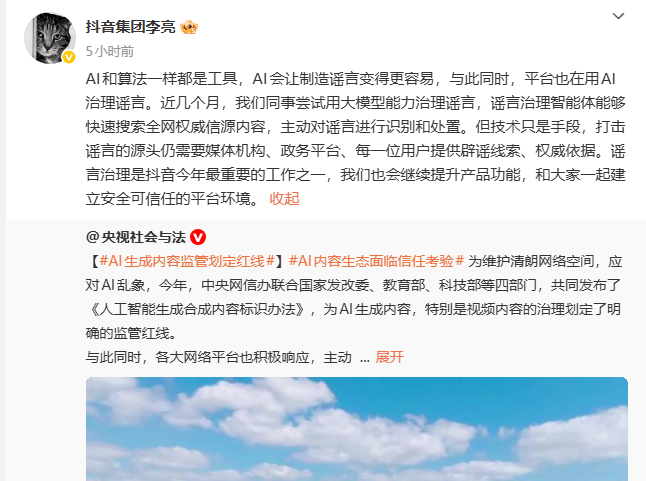
ByteDance VP Li Liang warns AI accelerates rumor propagation while revealing Douyin's AI-powered 'Intelligent Agent' system to combat misinformation. The platform emphasizes collaborative efforts with media and users alongside technological solutions.

October 29, 2025
AI MisinformationContent ModerationByteDance
WhatsApp to Ban Third-Party AI Chatbots Starting 2026
News

WhatsApp to Ban Third-Party AI Chatbots Starting 2026

Meta-owned WhatsApp will prohibit third-party general-purpose AI chatbots on its platform starting January 2026, restricting access to its Business API. The policy targets AI providers like OpenAI and Perplexity while allowing customer service bots. Meta cites technical burdens and strategic alignment as reasons, ensuring Meta AI remains the sole assistant on WhatsApp.

October 20, 2025
WhatsAppMetaAI Policy