Apple's M5 chips redefine laptop power with groundbreaking AI and battery life

Apple's M5 Series Chips Set New Standards for Performance and Efficiency
Image

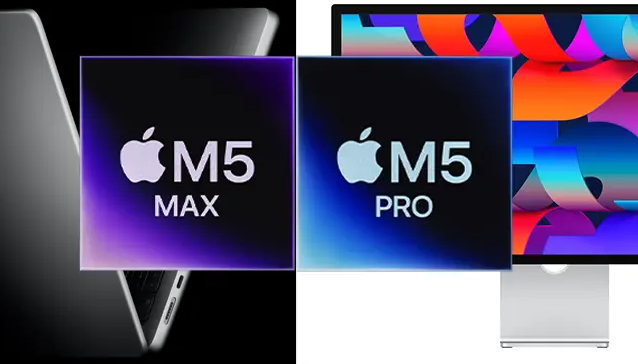
In what could be Apple's most significant laptop upgrade in years, the tech giant has introduced its M5 series chips - the Pro and Max variants - promising to reshape expectations for portable computing. The star of the show is undoubtedly the M5 Max, which packs enough punch to make professional creators take notice.

The engineering marvel behind these chips lies in their innovative dual-die architecture. By merging two cutting-edge 3-nanometer processors into one unit, Apple has achieved what many thought impossible - embedding neural network capabilities directly into each GPU core. This architectural leap translates to real-world benefits: tasks like AI image generation and video editing now run up to four times faster than before.

But raw power isn't everything. Perhaps more impressive is how Apple managed to combine this performance with exceptional efficiency. The new MacBook Pro models boast an astonishing 24-hour battery life under typical usage conditions - finally delivering on the promise of all-day computing without compromise.

Pricing That Reflects Performance

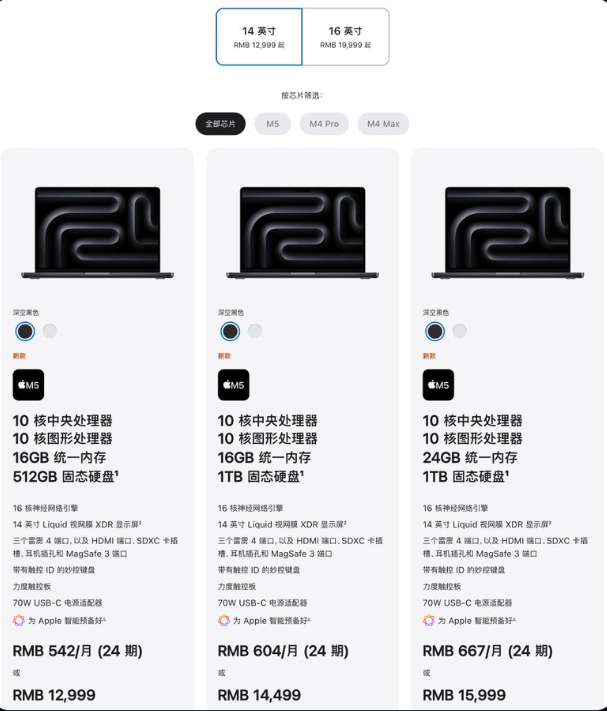
The enhanced capabilities come at a price, quite literally. The entry-level 14-inch MacBook Pro with M5 Pro starts at ¥17,999, while professionals seeking maximum performance can opt for the fully-loaded 16-inch model featuring the M5 Max chip at ¥64,719.

For those who prioritize portability over extreme performance, Apple hasn't forgotten about its mainstream audience. The updated MacBook Air now features the base M5 chip starting at ¥8,499 (512GB model), making powerful computing more accessible than ever.

Display Innovations Accompany Processing Power

Complementing these powerful machines are updates to Apple's Studio Display lineup. Both standard and XDR versions now support crisp 5K resolution, with the premium XDR model pushing brightness to an eye-searing 2000 nits - perfect for color-critical work in bright environments.

The display upgrades don't stop there. Creative professionals will appreciate support for connecting up to six displays simultaneously and buttery-smooth 120Hz refresh rates on the XDR model.

Key Points:

  • AI processing revolution: Neural processors integrated into every GPU core deliver 4× faster AI performance
  • Battery life breakthrough: New MacBook Pros last 24 hours on a single charge
  • Storage upgrades: Base configurations now include 1TB (Pro) or 512GB (Air) storage
  • Display excellence: Studio Displays feature 5K resolution, with XDR models reaching 2000 nits brightness
  • Connectivity future-proofed: All new models include Wi-Fi 7 support
Enjoyed this article?

Subscribe to our newsletter for the latest AI news, product reviews, and project recommendations delivered to your inbox weekly.

Weekly digestFree foreverUnsubscribe anytime

Related Articles

Apple Unveils M5 MacBook Pro: AI-Optimized Chip with 24-Hour Battery
News

Apple Unveils M5 MacBook Pro: AI-Optimized Chip with 24-Hour Battery

Apple has launched its new MacBook Pro featuring the M5 chip, the company's first processor optimized for AI tasks. With enhanced neural acceleration, improved GPU performance, and up to 24-hour battery life, the device targets professionals needing powerful local AI computing capabilities.

October 16, 2025
Apple SiliconAI ComputingMacBook Pro
News

Apple's M4 Chip Breakthrough Turns Mac Minis Into AI Powerhouses

In a surprising twist, engineers have unlocked hidden potential in Apple's M4 chips that could revolutionize AI development. By bypassing traditional limitations, researchers discovered Mac minis can now efficiently train complex AI models—achieving energy efficiency up to 80 times better than high-end GPUs. This breakthrough could dramatically lower the barrier to entry for AI innovation.

March 9, 2026
Apple SiliconAI HardwareEdge Computing
News

SpaceX's Million-Satellite Gamble: Building AI Supercomputers in Orbit

SpaceX has filed an audacious plan with the FCC to launch over a million satellites, not for internet service but to create orbiting AI data centers. The proposed space-based supercomputers would leverage the vacuum and cold of space to achieve unprecedented computing power while solving Earth-bound data centers' biggest headaches: energy use and heat dissipation. While promising revolutionary computing capabilities by 2030, the plan faces daunting technical and regulatory hurdles that could ground Elon Musk's latest sky-high ambition.

February 3, 2026
SpaceXAI ComputingOrbital Data Centers
Zhipu AI Rations Coding Plan Access Amid Computing Crunch
News

Zhipu AI Rations Coding Plan Access Amid Computing Crunch

Chinese AI firm Zhipu faces growing pains as its popular GLM-4.7 model strains computing resources. Starting January 23, daily sign-ups for its coding service will be slashed to just 20% of current capacity. The move aims to maintain quality for existing users during peak hours, though automatic renewal subscribers won't be affected.

January 21, 2026
AI ComputingZhipu AIResource Management
News

Luxshare Precision Bets Big with $2 Billion Stock Buyback Amid AI Push

Luxshare Precision announces a massive 2 billion yuan stock repurchase, signaling strong confidence in its future. The move comes as the company posts impressive growth figures and makes strategic advances in AI computing technology. With its market value now exceeding 410 billion yuan, Luxshare is transforming from an Apple supplier to an AI manufacturing leader.

January 5, 2026
Luxshare PrecisionStock BuybackAI Computing
Apple Bets Big on AI Independence with New Server Chip
News

Apple Bets Big on AI Independence with New Server Chip

Apple is making a bold move into AI infrastructure with its first self-designed server chip, codenamed Baltra. Partnering with Broadcom, the tech giant aims to reduce reliance on NVIDIA by focusing squarely on AI inference tasks. Slated for a 2027 debut, Baltra promises faster response times for services like Siri while cutting energy costs. This marks Apple's latest push toward controlling every piece of its technological puzzle.

December 16, 2025
Apple SiliconAI HardwareTech Innovation