Alibaba's Qwen3-Omni Model Nears Release with Hugging Face Integration

Alibaba's Next-Gen Multimodal AI Nears Open-Source Release

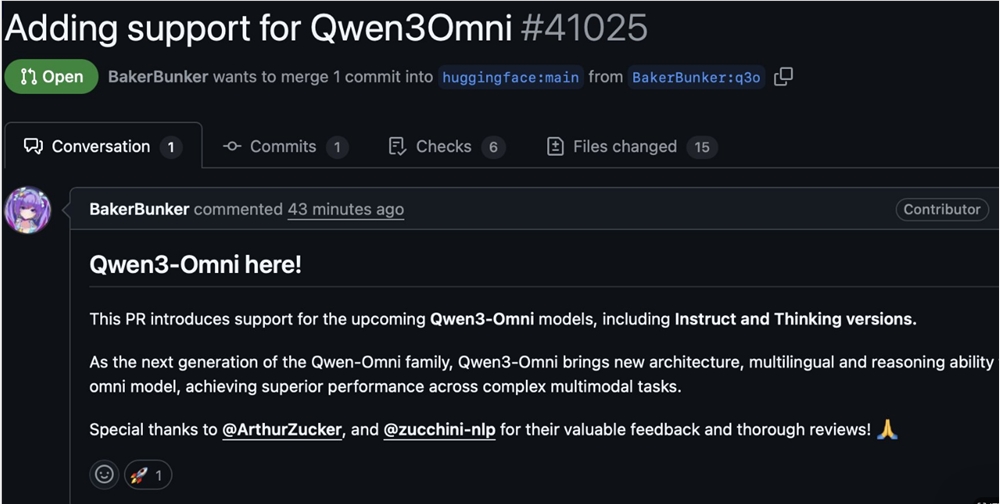
Alibaba Cloud's Qwen team has advanced its cross-modal AI technology with the upcoming release of Qwen3-Omni, now undergoing integration with Hugging Face's Transformers library through a recently submitted pull request (PR). This development marks significant progress in making sophisticated multimodal AI more accessible to developers worldwide.

Technical Advancements in Qwen3-Omni

The third-generation model builds upon its predecessors' success with enhanced end-to-end architecture capable of processing multiple input modalities including:

  • Text documents
  • Visual content (images/video)
  • Audio streams

Image

The system employs a distinctive Thinker-Talker dual-track design:

  1. Thinker module: Processes and interprets multimodal inputs, generating high-level semantic representations
  2. Talker module: Converts processed information into natural speech outputs in real-time

This architecture enables efficient streaming processing during both training and inference phases, making it particularly suitable for real-time interactive applications such as virtual assistants or customer service automation.

Deployment Optimization for Edge Devices

A key focus of the Qwen3-Omni development has been improving performance on resource-constrained devices. The team has implemented several optimizations:

  • Reduced computational overhead through architectural refinements
  • Enhanced memory efficiency for edge deployment scenarios
  • Improved streaming capabilities for continuous input processing

The submission to Hugging Face suggests Alibaba Cloud's commitment to open-source collaboration within the AI community. Developers will soon be able to leverage this technology through the popular Transformers library ecosystem.

Key Points:

  • Open-source milestone: PR submission indicates imminent public availability via Hugging Face
  • Multimodal capabilities: Unified processing of text, visual, and auditory data streams
  • Edge optimization: Designed for efficient deployment on resource-limited devices
  • Real-time performance: Thinker-Talker architecture enables low-latency interactions
  • Generational improvement: Third iteration builds on proven Qwen series foundation

Enjoyed this article?

Subscribe to our newsletter for the latest AI news, product reviews, and project recommendations delivered to your inbox weekly.

Weekly digestFree foreverUnsubscribe anytime

Related Articles

Samsung's Exynos 2600 Chip Brings AI to Your Pocket with Revolutionary Compression
News

Samsung's Exynos 2600 Chip Brings AI to Your Pocket with Revolutionary Compression

Samsung's upcoming Exynos 2600 chip is set to revolutionize mobile AI by shrinking models by an impressive 90% without sacrificing accuracy. Partnering with AI optimization specialist Nota, Samsung aims to enable complex generative AI tasks directly on your phone - no internet required. This breakthrough could transform how we interact with our devices daily.

December 30, 2025
MobileAIExynos2600EdgeComputing
Amazon Supercharges AI Development with One-Click Agent Tools
News

Amazon Supercharges AI Development with One-Click Agent Tools

At AWS re:Invent 2025, Amazon unveiled nine powerful new features that simplify AI agent deployment. Developers can now build agents faster than ever with TypeScript support, edge device compatibility, and streamlined security tools. These innovations promise to cut development time dramatically while opening AI creation to front-end engineers and embedded systems specialists.

December 4, 2025
AWSAIdevelopmentTypeScript
Zhiyuan Unveils Emu3.5: A Leap in Multimodal AI with Next-State Prediction
News

Zhiyuan Unveils Emu3.5: A Leap in Multimodal AI with Next-State Prediction

The Beijing Zhiyuan Institute has launched Emu3.5, a next-generation multimodal model featuring 'next-state prediction' (NSP) for advanced AI reasoning and operational capabilities. This innovation enables the model to predict and plan actions in complex environments, marking a shift from passive understanding to active interaction.

October 30, 2025
MultimodalAIEmu3.5NextStatePrediction
IBM Unveils Granite 4.0 Nano AI Models for Edge Computing
News

IBM Unveils Granite 4.0 Nano AI Models for Edge Computing

IBM has launched four new Granite 4.0 Nano AI models, ranging from 3.5 million to 1.5 billion parameters, designed for efficiency and accessibility. These models can run on standard laptops or browsers, enabling local deployment without cloud reliance. Released under Apache 2.0, they support commercial use and outperform competitors in benchmarks.

October 29, 2025
AImodelsEdgeComputingIBM
Alibaba's Qwen Upgrades Deep Research Tool for Multimodal AI Output
News

Alibaba's Qwen Upgrades Deep Research Tool for Multimodal AI Output

Alibaba's Qwen team has unveiled a major upgrade to its Deep Research tool, enabling one-click generation of reports, interactive web pages, and podcasts. Powered by proprietary AI models, the feature offers seamless content creation without infrastructure setup.

October 23, 2025
AIResearchMultimodalAIContentGeneration
LiblibAI Secures $130M Funding, Leads China's AI App Market
News

LiblibAI Secures $130M Funding, Leads China's AI App Market

Chinese AI platform LiblibAI has raised $130 million in Series B funding, marking the largest single investment in China's AI application sector. Led by Sequoia China and CMC Capital, the company plans global expansion and a major platform upgrade to enhance video generation capabilities.

October 23, 2025
ArtificialIntelligenceChinaTechStartupFunding