Alibaba's New AI Model Packs a Punch With Smarter Programming Skills

Alibaba's Programming Powerhouse Goes Open-Source

In a move that could reshape how developers work with AI, Alibaba's Qwen team has released their latest innovation to the public. The Qwen3.6-35B-A3B isn't just another large language model - it's a carefully engineered solution that delivers top-tier performance without the usual computational headaches.

Image

Smart Design, Smarter Performance

What makes this model special? Its "sparse mixture-of-experts" architecture means that while it has 35 billion parameters total, it only activates about 3 billion at any given time. Imagine having a team of specialists where you only call in the exact experts needed for each task - that's essentially how this model works.

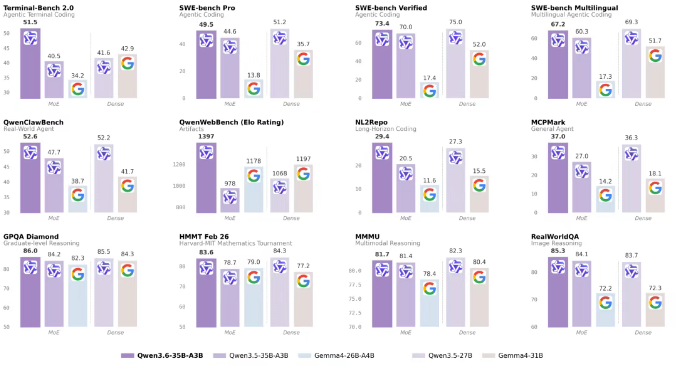
The results speak for themselves: Qwen3.6 outperforms its predecessor (the 27-billion-parameter Qwen3.5-27B) while using significantly less computing power. It even holds its own against much larger models like Gemma4-31B when it comes to complex programming logic and collaborative AI tasks.
Image

More Than Just Code

While programming capabilities take center stage, this model brings impressive visual skills to the table too. With a RefCOCO score of 92.0 (a measure of visual understanding), it's approaching the level of premium models like Claude Sonnet4.5 in some multimodal benchmarks.

Developers can already access Qwen3.6 through Alibaba's Qwen Studio and BaiLian platform, where it works smoothly with popular programming assistants including OpenClaw and Claude Code. A special "preserve_thinking" feature helps maintain continuity during complex coding sessions.

The Future of Efficient AI

As demand grows for AI that can run efficiently on edge devices and work collaboratively, models like Qwen3.6-35B-A3B point toward an interesting future. They prove that with smart architecture choices, smaller can indeed be better - or at least, more practical for real-world applications.

Key Points:

  • Open-source model with 35B total parameters (only 3B active at once)
  • Outperforms larger models in programming and logical reasoning
  • Strong visual understanding (RefCOCO score: 92.0)
  • Available now through Alibaba Cloud services
  • Represents a shift toward more efficient AI architectures

Enjoyed this article?

Subscribe to our newsletter for the latest AI news, product reviews, and project recommendations delivered to your inbox weekly.

Weekly digestFree foreverUnsubscribe anytime

Related Articles

AI Coding Assistants Clash: OpenAI's Codex Upgrade Takes On Anthropic's Claude
News

AI Coding Assistants Clash: OpenAI's Codex Upgrade Takes On Anthropic's Claude

The battle for dominance in AI-powered coding tools heats up as OpenAI unveils major upgrades to Codex, introducing background operation and browser integration. Meanwhile, Anthropic's Claude Code continues gaining enterprise traction. This latest volley brings enhanced memory features, image generation, and flexible pricing - pushing AI programming assistants into new territory.

April 17, 2026
AI programmingOpenAIdeveloper tools
News

AI Startup Factory Lands $150M to Power Next-Gen Coding Tools

In a major vote of confidence for AI-assisted programming, startup Factory just secured $150 million in funding at a $1.5 billion valuation. Backed by top investors like Khosla Ventures and Sequoia, the company helps enterprise clients like Morgan Stanley write better code by smartly switching between AI models. What makes Factory stand out in this crowded space? And how did a Berkeley PhD student turn a cold email into a unicorn?

April 17, 2026
AI programmingstartup fundingenterprise tech
MiniMax's MaxHermes: AI That Teaches Itself New Tricks
News

MiniMax's MaxHermes: AI That Teaches Itself New Tricks

MiniMax has unveiled MaxHermes, a groundbreaking cloud sandbox that learns autonomously. Unlike traditional AI tools requiring manual programming, MaxHermes extracts 'skills' from task performance and improves through user feedback. The system combines persistent memory, natural language scheduling, and multi-agent operations to create what might be the first truly self-evolving AI assistant. Powered by MiniMax's latest M2.7 model, this innovation could redefine how we think about AI capabilities in real-world applications.

April 16, 2026
AI innovationMachine learningAutonomous systems
MaxHermes Launches as World's First Self-Learning AI Cloud Sandbox
News

MaxHermes Launches as World's First Self-Learning AI Cloud Sandbox

MiniMax Xiyu Technology has unveiled MaxHermes, a groundbreaking cloud sandbox for AI agents that learns and improves through interaction. Unlike static AI tools, this assistant evolves its skills autonomously, remembering past conversations to deliver increasingly personalized responses. With seamless integration into popular platforms and a pay-as-you-go model, MaxHermes promises to make advanced AI accessible to businesses and individuals alike.

April 16, 2026
AI innovationCloud computingMachine learning
Alibaba's Tiny AI Model Packs a Punch with Smart Upcycling Technique
News

Alibaba's Tiny AI Model Packs a Punch with Smart Upcycling Technique

Alibaba's research team has achieved something remarkable - transforming a modest 0.6 billion parameter AI model into a powerful 17.3 billion parameter system that runs efficiently on standard CPUs. The secret? An innovative 'upcycling' approach that activates just 5% of parameters during operation. This breakthrough could make sophisticated AI more accessible than ever, performing tasks at 30 tokens per second without expensive hardware. It's not just about size - the clever training methods make this compact model outperform larger rivals.

April 10, 2026
AI efficiencyMachine learningMoE architecture
News

Zhipu's New AI Model Sees and Codes Like a Human

Chinese AI firm Zhipu has unveiled GLM-5V-Turbo, a groundbreaking model that combines visual understanding with coding skills. This isn't just another chatbot - it can analyze design mockups, interpret complex charts, and turn sketches into functional code. The model's 200k context window lets it handle massive projects, while maintaining top performance in benchmarks. Early tests show it can generate complete front-end projects from simple screenshots, potentially revolutionizing how developers work.

April 2, 2026
AI programmingComputer visionAutomated development