AI Now Produces More Online Content Than Humans - At What Cost?
The Tipping Point for AI Content
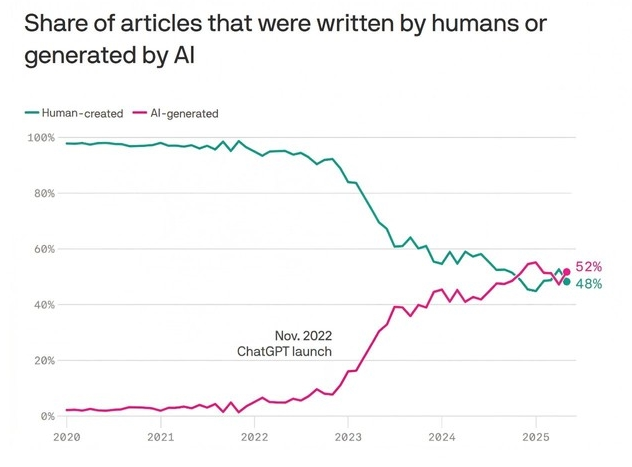
Internet research firm Graphite has released findings that mark a turning point in digital content creation: artificial intelligence now generates more online material than human writers. Their comprehensive study analyzed 65,000 websites from 2020 through 2025, tracking the dramatic surge in AI-generated articles following ChatGPT's 2022 debut.
How Researchers Tracked the Trend
The team employed Surfer, an advanced AI detection tool with an enormous database spanning 18 years of internet history. This system processes 3-5 billion web pages monthly, allowing it to spot telltale signs of machine-generated content with remarkable accuracy. Their classification is straightforward - any article with less than 50% human-written content gets labeled as AI-produced.
The Hidden Dangers of AI Dominance
"We're seeing the early warning signs of a potential knowledge crisis," explains one industry analyst who requested anonymity. The concern? AI systems might soon enter a dangerous feedback loop where they primarily learn from other AI-generated content rather than original human work. This scenario could lead to what experts call 'model collapse' - where AI capabilities stagnate or even degrade over time.
The implications extend beyond technology. Educational researchers note students increasingly struggle with critical analysis when relying too heavily on AI tools. "We're trading deep understanding for surface-level efficiency," observes Dr. Elena Torres, a cognitive scientist at Stanford University. "The ability to think independently - to question, analyze, and create - is what made human civilization thrive."
A Crossroads for Human Creativity
The report's most sobering finding suggests we may be undervaluing our own creative capacity. While AI excels at producing vast quantities of content quickly, it lacks the spark of genuine human experience - the messy, emotional, unpredictable elements that make art, literature, and scientific breakthroughs truly remarkable.
As we navigate this transition, society faces tough questions: How much automation is too much? What aspects of knowledge creation should remain distinctly human? The answers may determine whether we preserve the diversity of thought that drives progress.
Key Points:
- AI surpasses humans in online content production for the first time
- Detection tools reveal explosive growth since ChatGPT's launch
- Feedback loop risks could degrade AI quality over time
- Critical thinking decline emerges as unintended consequence
- Human creativity's value may need reassertion in the AI age