AI Content Now Outnumbers Human Writing – What Does This Mean for Creativity?
The Digital Tipping Point
Internet research firm Graphite has dropped a bombshell finding: artificial intelligence now produces more online content than human creators. Their comprehensive five-year study analyzed 65,000 websites, revealing how ChatGPT's 2022 debut became a watershed moment for digital content creation.
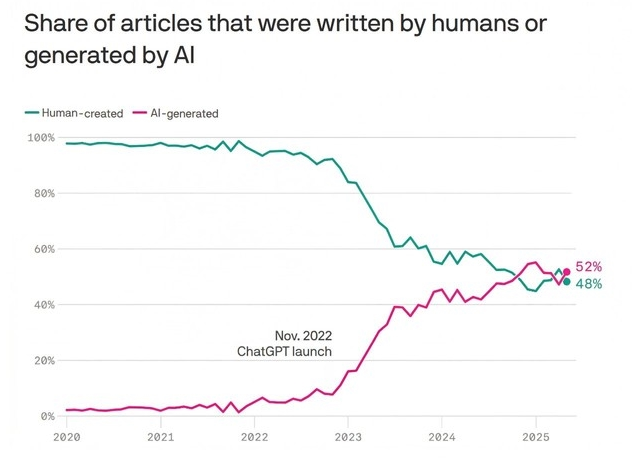
Using Surfer, an AI detection tool with an 18-year database that scans billions of pages monthly, researchers found machine-written articles crossed the 50% threshold late last year. "We expected AI content to grow," says lead researcher Dr. Elena Markov, "but the speed caught everyone off guard. By 2025's end, AI content could represent 60-65% of all web material."
The Creativity Conundrum
This seismic shift brings both promise and peril. While AI tools help small businesses and creators produce content faster, experts warn we're approaching a dangerous inflection point. "Imagine a future where AI models primarily train on other AI's output," cautions MIT's Professor Raj Patel. "It's like photocopying a photocopy – each generation loses some fidelity."
The report highlights three critical risks:
- The Data Doom Loop – As AI consumes more of its own generated content, models may stagnate or develop unpredictable biases
- The Thinking Gap – Over-reliance on AI could erode our analytical muscles, much like calculators changed our mental math abilities
- The Authenticity Crisis – When most content sounds machine-polished, will human imperfection become the new premium?
Human vs. Machine: An Unbalanced Scale
Creative professionals feel the squeeze most acutely. "I've had clients say, 'Why pay you $1/word when AI does it for free?'," shares freelance journalist Naomi Chen. "But readers can tell the difference – my inbox proves it."
Educators report students increasingly submitting AI-assisted work. Harvard writing instructor Dr. Mark Williams observes: "The best essays still come from students who wrestle with ideas, not just prompts. AI can't replicate that intellectual struggle."
The Road Ahead
Rather than rejecting AI tools outright, experts advocate for thoughtful integration:
- Transparency standards – Clear labeling of AI-generated content
- Human-AI collaboration – Using AI for research and drafting while preserving human editorial control
- Critical thinking curricula – Schools emphasizing analysis over rote content production
As Patel summarizes: "The question isn't whether AI writes better than humans – it's whether we remember why human writing matters."
Key Points
- AI content now dominates the web, surpassing human-created material
- ChatGPT's 2022 launch accelerated this shift dramatically
- Potential consequences include reduced content quality and weakened human analytical skills
- Solutions proposed include transparency measures and rethinking education approaches