
Xiaomi's MiMo AI Model Rolls Out Affordable Subscription Plans

Xiaomi Takes AI Commercialization Leap with New Subscription Model

In a strategic move to democratize AI access, Xiaomi has launched its first token-based subscription plan for the MiMo large language model. The tech giant is offering four straightforward pricing tiers - Lite, Standard, Pro and Max - with monthly fees ranging from an affordable 39 yuan to 659 yuan for power users.
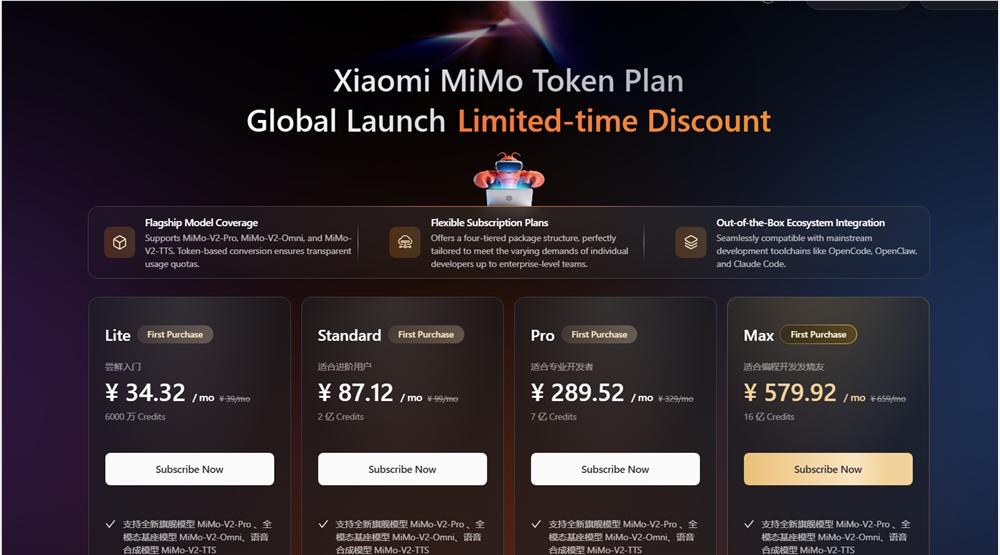
Image

Comprehensive AI Access at Competitive Prices

The new subscription system provides transparent billing through a unified credit point structure that covers all modalities - text, images and audio processing. Developers gain access to Xiaomi's top-performing models including the MiMo-V2-Omni and the recently benchmarked MiMo-V2-Pro, which ranks fifth globally in text processing capabilities according to OpenRouter evaluations.

"We're seeing tremendous demand for our AI models," said a Xiaomi spokesperson. "With weekly usage already exceeding 4 trillion tokens, we wanted to create predictable pricing that helps developers budget their projects effectively."

Technical Prowess Meets Practical Pricing

The MiMo-V2-Pro model boasts impressive specs - trillions of parameters and a context window extending to millions of tokens. While it currently trails industry leaders like Anthropic and OpenAI in some benchmarks, its competitive pricing makes it particularly attractive for developers working on budget-conscious projects.

Industry analysts see this move as significant for China's AI ecosystem. "Xiaomi is shifting the conversation from technical capabilities to practical implementation," noted tech analyst Li Wei. "By integrating these services with their existing smart home and mobile ecosystem, they're creating real-world applications that go beyond theoretical potential."

A Boost for Developers

The subscription model is especially welcomed by independent developers and startups who previously faced unpredictable costs when working with large language models. The fixed monthly fees allow for better financial planning while still providing scalable access as projects grow.

Xiaomi's approach also cleverly leverages its broader product ecosystem, including its smartphone lineup and smart home devices. This integration creates opportunities for developers to build applications that span multiple platforms while keeping costs manageable.

Key Points:

  • Four subscription tiers from 39-659 yuan/month
  • Covers text, image and audio processing
  • Weekly usage exceeds 4 trillion tokens
  • MiMo-V2-Pro ranks fifth in global text benchmarks
  • Integrates with Xiaomi's smart home ecosystem
Enjoyed this article?

Subscribe to our newsletter for the latest AI news, product reviews, and project recommendations delivered to your inbox weekly.

Weekly digestFree foreverUnsubscribe anytime

Related Articles

News

Xiaomi's MiMo AI Model Goes Paid with Affordable Starter Pack

Xiaomi has introduced its first paid subscription plans for the MiMo large language model, offering four tiers starting at just 39 yuan per month. The move signals Xiaomi's shift from free beta testing to commercializing its AI technology while keeping it accessible to individual developers and enthusiasts. Subscribers gain access to three specialized models covering professional, all-purpose, and voice synthesis capabilities.

April 3, 2026
XiaomiAI modelstech subscriptions
News

China Backs Meta's AI Startup Deal With Clear Legal Conditions

China's commerce ministry has given cautious approval to Meta's acquisition of AI startup Manus, emphasizing that all tech deals must follow Chinese laws. The move signals Beijing's balancing act between encouraging innovation and maintaining regulatory oversight in the fast-growing AI sector. Analysts see this as Meta's strategic push to strengthen its position in general artificial intelligence.

April 3, 2026
MetaArtificial IntelligenceChina Tech Policy
News

ORCA Lab 1.0 Brings Physical AI Development to Your Laptop

Shanghai Songying Technology has unveiled ORCA Lab 1.0, China's first physical AI platform designed for individual developers. This groundbreaking tool eliminates the need for expensive hardware and complex coding, allowing anyone to create and train robots using just a standard laptop. The platform's no-code approach and full life cycle support could democratize embodied intelligence development, potentially accelerating innovation in this cutting-edge field.

April 3, 2026
Artificial IntelligenceRoboticsTech Innovation
News

Google's Gemma 4: A Powerhouse AI Model Set to Shake Up Open-Source Landscape

Google is gearing up to unveil Gemma 4, its next-generation open-source AI model that promises four times the parameters of its predecessor. With a rumored 120 billion parameters and innovative MoE architecture, this release marks Google's strategic move to reclaim influence in the open-source AI space. The tech world watches closely as this development could redefine the balance between commercial and open-source AI models.

April 2, 2026
AI DevelopmentOpen Source TechMachine Learning
Tongyi Lab's Qwen3.6-Plus Brings Stability to AI Programming
News

Tongyi Lab's Qwen3.6-Plus Brings Stability to AI Programming

Tongyi Lab has unveiled Qwen3.6-Plus, a significant upgrade to its AI programming model that tackles developers' biggest frustration: unreliable task execution. This new version shines in coding tasks and long-context understanding while maintaining impressive cost efficiency. What really excites developers is its seamless integration with popular coding tools and breakthrough visual agent capabilities that can turn design drafts into functional code.

April 2, 2026
AI ProgrammingTongyi LabQwen3.6
News

Lenovo's AI Push: $10B Revenue Surge and a Bold New Direction

Lenovo Chairman Yang Yuanqing has set an ambitious $100 billion revenue target as the company pivots hard toward AI. With AI already accounting for a third of sales, Lenovo is rebranding itself as an 'AI-native' company while tackling margin pressures and mobile business challenges. The tech giant is betting big on innovative devices like its Kubit personal computing hub to drive future growth.

April 2, 2026
LenovoArtificial IntelligenceTech Industry