TikTok VP Denies 7-Month Turnover Claim, Cites AI-Generated Content

TikTok Executive Debunks Turnover Rumors, Flags AI-Generated Misinformation

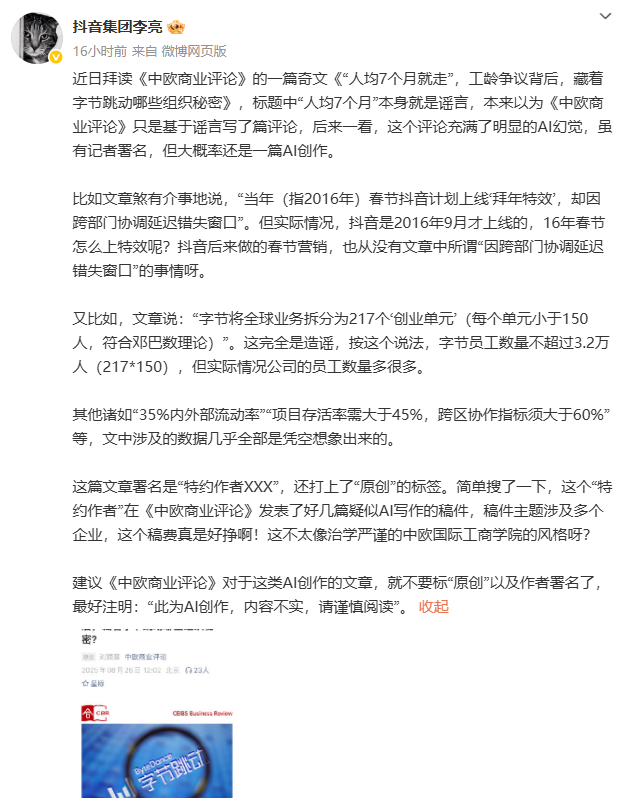
ByteDance Group Vice President Li Liang has publicly addressed circulating rumors about TikTok's alleged "7-month average turnover rate," dismissing them as baseless and likely AI-generated misinformation. The claims originated from an article published in the CEIBS Business Review, which Li asserts contains multiple factual inaccuracies.
Image

Chronological Inconsistencies Exposed

In a detailed Weibo post, Li highlighted glaring historical inaccuracies in the source material. The article claimed TikTok launched its "Bai Nian Effect" feature during the 2016 Spring Festival—a chronological impossibility since the platform didn't launch until September 2016.

"This fundamental error alone demonstrates the article's lack of credibility," Li stated. He further clarified that TikTok never missed marketing opportunities due to internal coordination issues, directly contradicting another claim in the disputed piece.

Structural Misrepresentations Corrected

The controversial article also described ByteDance's global operations as divided into 217 "entrepreneurial units" with fewer than 150 employees each—a structure Li vehemently denied.

"At that claimed scale, our total workforce couldn't exceed 32,000," he explained. "Our actual employee count far surpasses this figure." Additional statistics about 35% turnover rates and 45% project survival thresholds were similarly dismissed as fabricated.

Call for AI Content Transparency

Li revealed concerning patterns in the CEIBS Business Review's publication history, noting multiple articles exhibiting hallmarks of AI-generated content about various companies. He urged media outlets to clearly label such material:

"Publications should include disclaimers like 'This is an AI-created article; content may be unreliable' to protect readers from misinformation."

The executive emphasized that while AI tools offer efficiency benefits, their unchecked use in journalism risks eroding public trust through systemic inaccuracy.

Key Points

  • 🚫 Turnover claims debunked: The viral "7-month average turnover" statistic lacks factual basis
  • 📅 Timeline correction: TikTok launched in September 2016, not during that year's Spring Festival
  • 🤖 AI content warning: Media should disclose machine-generated articles to prevent misinformation
  • 🔍 Structural accuracy: ByteDance's operational model was misrepresented in source material

Enjoyed this article?

Subscribe to our newsletter for the latest AI news, product reviews, and project recommendations delivered to your inbox weekly.

Weekly digestFree foreverUnsubscribe anytime

Related Articles

News

TikTok Doubles Down on Shenzhen with New AI and Video Tech Hub

ByteDance's TikTok is expanding its footprint in China's tech hub Shenzhen with a second headquarters focused on AI and video technology. The Nanshan District facility will house research labs and business incubators, complementing TikTok's existing Greater Bay Area operations. This move signals the company's growing investment in southern China's innovation ecosystem.

January 8, 2026
ByteDanceShenzhenTechAIInnovation
News

ByteDance's DouBao AI Glasses Set for Limited Release

ByteDance is gearing up to ship its highly anticipated DouBao AI glasses, but with a twist - the first batch of 100,000 units will be exclusively available to existing DouBao App users. Powered by Qualcomm's Snapdragon AR1 chip, these lightweight glasses focus on audio functionality without a display screen. While the company remains tight-lipped about broader sales plans, industry insiders reveal development is already underway for a second-generation model.

January 6, 2026
wearable techartificial intelligenceByteDance
News

ByteDance Shuts Down Rumors About Doubao AI Glasses Launch

ByteDance has officially denied rumors about the imminent launch of Doubao AI glasses, stating there's no concrete sales plan yet. Despite speculation fueled by supply chain reports, the company maintains the product hasn't reached shipping phase. Industry experts suggest this reflects ByteDance's cautious approach to hardware launches, possibly due to technical challenges or strategic timing considerations.

January 6, 2026
ByteDanceAI WearablesSmart Glasses
News

ByteDance's Doubao AI Glasses Set to Shake Up Wearable Tech Market

ByteDance is making waves in wearable tech with its upcoming Doubao AI glasses, developed in partnership with Longqi Technology. These sleek glasses feature a custom chip for seamless voice interaction and translation, while keeping weight and price low. Unlike standalone devices, they smartly leverage your smartphone's power through the Doubao app. Priced under 2000 yuan, they could make AI glasses mainstream accessories rather than niche gadgets.

January 5, 2026
wearable technologyAI hardwareByteDance
ByteDance's StoryMem Gives AI Videos a Memory Boost
News

ByteDance's StoryMem Gives AI Videos a Memory Boost

ByteDance and Nanyang Technological University researchers have developed StoryMem, an innovative system tackling persistent issues in AI video generation. By mimicking human memory mechanisms, it maintains character consistency across scenes - a challenge even for models like Sora and Kling. The solution cleverly stores key frames as references while keeping computational costs manageable. Early tests show significant improvements in visual continuity and user preference scores.

January 4, 2026
AI video generationByteDancecomputer vision
ByteDance's StoryMem Brings Consistency to AI-Generated Videos
News

ByteDance's StoryMem Brings Consistency to AI-Generated Videos

ByteDance and Nanyang Technological University researchers have developed StoryMem, a breakthrough system tackling character consistency issues in AI video generation. By intelligently storing and referencing key frames, the technology maintains visual continuity across scenes - achieving 28.7% better consistency than existing models. While promising for storytelling applications, the system still faces challenges with complex multi-character scenes.

January 4, 2026
AI video generationByteDancecomputer vision