
Thinking Machines Lab Achieves 100% Consistent AI Output

Thinking Machines Lab Solves AI Randomness Challenge

In a landmark achievement for artificial intelligence research, Thinking Machines Lab has successfully addressed one of the most persistent challenges in large language model development: output inconsistency. Founded by former OpenAI Chief Technology Officer Mira Murati, the lab announced this technological breakthrough in their recent research report.

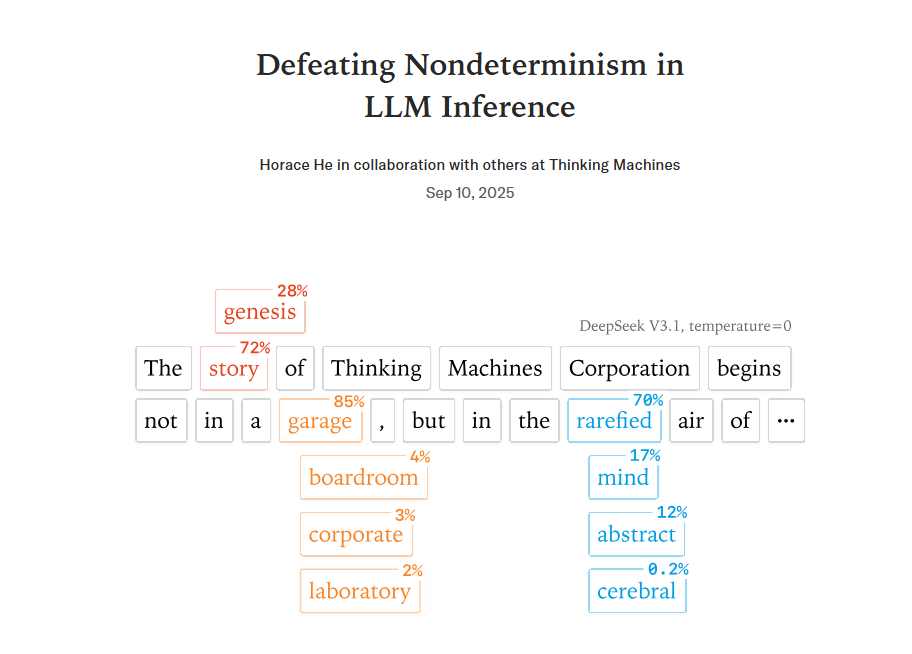
The Problem of Non-Deterministic Output

Even with temperature parameters set to zero, traditional LLMs have struggled with producing identical outputs for identical inputs. The research paper titled "Defeating Nondeterminism in LLM Inference" identifies two primary technical causes:

  1. Non-associativity of floating-point addition: In GPU parallel computing environments, slight variations occur in calculation sequences like (a + b) + c versus a + (b + c).
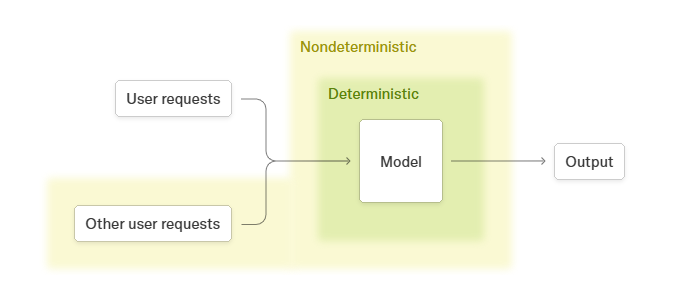
  2. Parallel computing strategy variations: Changes in batch sizes, sequence lengths, and KV cache states affect GPU kernel selection strategies.
Image

The Technical Solution

The lab developed a batch-invariant solution that ensures:

  • Consistent calculation order across different batch sizes
  • Identical results regardless of sequence splits
  • Optimized computational modules including RMSNorm and attention mechanisms

The team validated their approach using the Qwen3-235B-A22B-Instruct-2507 model (235 billion parameters). After 1,000 repeated tests, the model achieved unprecedented 100% output consistency.
Image

Industry Impact

This breakthrough carries significant implications for:

  • Financial risk assessment systems requiring absolute consistency
  • Medical diagnosis applications where reliability is critical
  • Legal document analysis needing predictable outputs The lab has made their findings publicly available, providing valuable insights for AI developers worldwide.

About Thinking Machines Lab

Established in 2023 with $2 billion in seed funding, the lab focuses on foundational AI technologies. They plan to launch their first commercial product in coming months.

The achievement marks an industry shift from pursuing sheer model scale to prioritizing application quality and reliability.

The full research report is available at: https://thinkingmachines.ai/blog/defeating-nondeterminism-in-llm-inference/

Key Points:

  • Solved persistent issue of LLM output randomness
  • Identified two primary technical causes
  • Developed batch-invariant solution
  • Achieved 100% consistency in testing
  • Significant implications for enterprise applications

Enjoyed this article?

Subscribe to our newsletter for the latest AI news, product reviews, and project recommendations delivered to your inbox weekly.

Weekly digestFree foreverUnsubscribe anytime

Related Articles

News

China Telecom Backs Tsinghua AI Startup Mianshi Intelligence in Major Funding Round

Beijing-based AI firm Mianshi Intelligence has secured hundreds of millions in fresh funding led by China Telecom, marking significant progress for Tsinghua-affiliated large language models. The company's MiniCPM series demonstrates breakthrough efficiency in edge computing applications, while its leadership team blends academic rigor with commercial savvy.

February 28, 2026
Artificial IntelligenceChina TechVenture Capital
News

Microsoft Stands Firm on OpenAI Partnership as Azure Keeps Exclusive Cloud Role

Microsoft has moved swiftly to dispel rumors about its partnership with OpenAI, reaffirming their strong alliance and Azure's exclusive position as the cloud platform for OpenAI's services. The tech giant clarified that recent industry developments won't affect their existing agreements, including intellectual property rights and revenue sharing. While acknowledging OpenAI's other partnerships, Microsoft emphasized the stability of their collaboration framework that allows both companies to explore new opportunities while maintaining their core relationship.

February 28, 2026
MicrosoftOpenAICloud Computing
News

Tech Titans Converge in Nansha to Shape Bay Area's AI Future

Top executives from China's leading AI companies gathered at Hong Kong Polytechnic University's Guangzhou campus last week, sparking exciting discussions about robotics intelligence and computing power optimization. The high-profile meeting brought together industry pioneers like Unisound and Shengshu Technology with academic leaders to bridge the gap between research and real-world applications.

February 28, 2026
Artificial IntelligenceGreater Bay AreaTech Innovation
News

ChatGPT Nears Billion-User Milestone Amid Record Growth

OpenAI's ChatGPT continues its meteoric rise, now boasting 900 million weekly active users - a staggering 100 million increase since last October. Alongside this user explosion, the AI platform has secured $110 billion in funding and attracted 50 million paying subscribers. These numbers position ChatGPT on the brink of joining tech's most exclusive club: services with over a billion regular users.

February 28, 2026
ChatGPTOpenAIAI Growth
News

Meta Bets Big on Google's AI Chips in Challenge to Nvidia's Dominance

In a bold move shaking up the AI chip market, Meta has signed a multi-billion dollar deal to rent Google's custom TPU processors for its AI development. This strategic partnership not only challenges Nvidia's long-standing dominance but signals a major shift in how tech giants are securing computing power. While Google continues buying Nvidia chips for its cloud services, it's now also competing against them by leasing its own TPUs to rivals like Meta. The ripple effects are already being felt, with reports of chip prices dropping as companies gain negotiating power.

February 28, 2026
AI ChipsTech CompetitionSemiconductor Industry
News

OpenAI and Amazon Forge $5 Billion AI Partnership

In a landmark deal shaking up the AI industry, OpenAI and Amazon announced a multi-billion dollar strategic partnership. The collaboration will see Amazon invest $5 billion in OpenAI while jointly developing advanced AI capabilities. Together they aim to create smarter 'digital employees' with memory functions, powered by AWS infrastructure. This move could redefine how businesses use artificial intelligence.

February 28, 2026
Artificial IntelligenceTech PartnershipsCloud Computing