The AI Content Tipping Point: When Machines Outwrite Humans
AI Crosses the Content Threshold
In a digital milestone that slipped by quietly, artificial intelligence has officially become the internet's primary content creator. Research firm Graphite's latest analysis of 65,000 websites shows AI-generated material now outpaces human writing - a shift that occurred faster than most experts predicted.
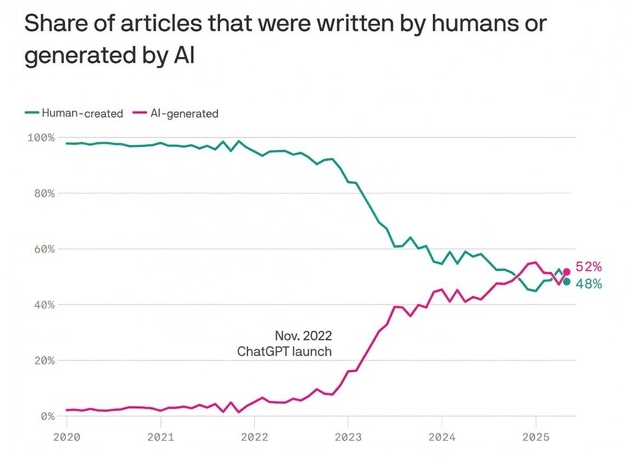
"We're witnessing a fundamental change in how information gets produced," notes lead researcher Dr. Elena Torres. "Since ChatGPT's 2022 launch, AI articles have grown from curiosity to majority in just three years."
Measuring the Machine Takeover
The study employed Surfer, an AI detection tool with an enormous database tracking web content evolution. Their criteria? Any article with less than 50% human-written content gets classified as AI-generated. Monthly scans of 3-5 billion pages reveal an accelerating trend that shows no signs of slowing.
But beyond the numbers lies a more troubling reality. As AI systems increasingly feed on their own output, experts warn we may be creating an "informational inbreeding" problem. Without fresh human perspectives, machine learning could stagnate or even regress.
The Creativity Crisis Deepens
Education specialists voice particular concern about younger generations growing up surrounded by synthetic content. "When AI does the heavy lifting of composition and analysis, we short-circuit essential learning processes," warns cognitive scientist Dr. Raj Patel. "Critical thinking muscles atrophy without exercise."
The implications extend beyond classrooms:
- Journalism: Newsrooms relying on AI risk homogenized reporting
- Science: Research papers may recycle AI-generated hypotheses
- Arts: Creative works could lose distinctive human touches
Choosing Our Digital Future
This isn't about resisting progress - AI tools offer remarkable benefits when used thoughtfully. The challenge lies in maintaining balance. As Patel observes, "We invented these tools to extend our capabilities, not replace them entirely."
What happens next depends on choices we make today about how humans and machines collaborate in knowledge creation. The alternative? A future where original thought becomes the exception rather than the norm.
Key Points
- 📊 Majority shift: AI now produces over half of web content
- 🚀 Rapid adoption: ChatGPT's release marked an inflection point
- ⚠️ Hidden costs: Potential declines in critical thinking and creativity
- 🔄 Echo chamber risk: AI systems training on AI-generated data
- 🤝 Balanced approach: Experts advocate for human-AI collaboration