Tencent's New OCR Model Breaks Records While Staying Lean

Tencent's Small But Mighty OCR Model Turns Heads
Image

In an industry where bigger often means better, Tencent's Hunyuan research team took a different approach. Their newly open-sourced OCR (Optical Character Recognition) model packs state-of-the-art performance into just 1 billion parameters - modest by today's AI standards.

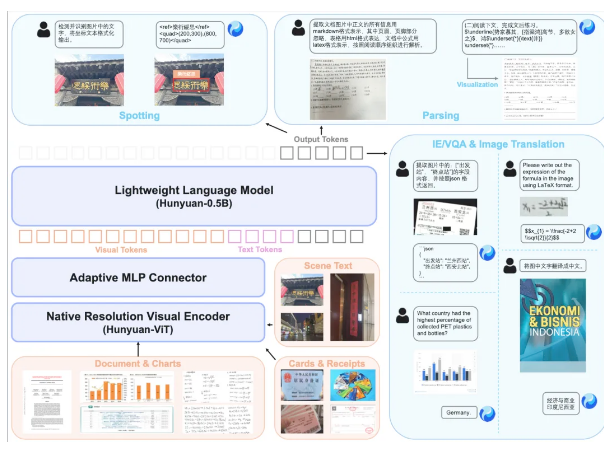
"What makes HunyuanOCR special isn't its size, but how much we've optimized its architecture," explains the technical documentation. The model combines three smart components: a video encoder that preserves original image quality, an adaptive visual processor, and Tencent's efficient language model.

Performance That Surprises
Image

The numbers tell an impressive story. On OmniDocBench's challenging document parsing test, HunyuanOCR scored 94.1 points - edging out Google's much larger Gemini3-Pro. It aced nine different real-world scenarios including:

  • Handwritten note transcription
  • Street sign recognition
  • Complex document analysis

Perhaps most remarkably, it dominated the small-model category (<3B parameters) on OCRBench with an 860-point score - about as accurate as models three times its size.

More Than Just Text Reading

The model isn't limited to recognizing characters. It can:

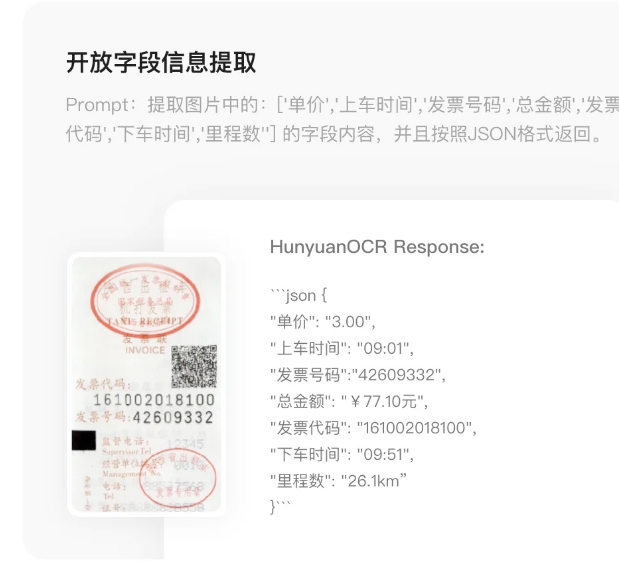
  • Extract data from tickets and forms directly into JSON format
  • Pull bilingual subtitles automatically from videos
  • Translate between Chinese/English and 14 less common languages

This multilingual capability recently earned it top honors at ICDAR2025's document translation competition.

Where You'll Find It Working Already
Image

While the technology sounds futuristic, it's already handling practical jobs:

  • Processing government ID documents
  • Assisting video creators with automatic captioning
  • Facilitating cross-border business communications

The team designed HunyuanOCR specifically for easy implementation. "Unlike complex systems requiring multiple processing steps," notes one developer, "this gives you clean results in one pass."

The model is now available through GitHub and Hugging Face, with demo versions accessible directly through web browsers.

Key Points:

  • Compact Powerhouse: At just 1B parameters, outperforms larger competitors
  • Real-World Ready: Excels at documents, handwriting, street signs and more
  • Multilingual Master: Handles translation between 16 languages including English/Chinese
  • Easy Integration: Simplified architecture means faster deployment
Enjoyed this article?

Subscribe to our newsletter for the latest AI news, product reviews, and project recommendations delivered to your inbox weekly.

Weekly digestFree foreverUnsubscribe anytime

Related Articles

News

Tencent's Yuanbao App Rolls Out AI Party Feature Ahead of Lunar New Year

Tencent's AI assistant Yuanbao has unveiled its latest social experiment - 'Yuanbao Party' - now in public beta. This innovative feature transforms group interactions by integrating AI companions that can chat, edit media, and even sync entertainment from QQ Music and Tencent Video. Available just in time for Spring Festival celebrations, the update requires version 2.56.0 or higher, with access through invitation codes or shared links.

February 2, 2026
Tencent AISocial TechnologyDigital Entertainment
News

Hikvision's AI Inspector Tackles Factory Packaging Errors

Hikvision has unveiled a smart quality control system powered by its Guanlan AI model that spots packaging mistakes instantly. Unlike traditional manual checks, this solution scans every item with precision, adapting to complex production environments. Already proving valuable in automotive and electronics plants, it marks another step toward smarter manufacturing.

January 30, 2026
industrial automationquality controlcomputer vision
Small AI Model Packs Big Punch: Step3-VL-10B Challenges Giants
News

Small AI Model Packs Big Punch: Step3-VL-10B Challenges Giants

StepZen's new open-source vision-language model Step3-VL-10B is turning heads in AI circles. Despite its compact 10 billion parameters, it's outperforming models twenty times its size in visual reasoning and math competitions. The secret? Innovative training techniques that could revolutionize how we deploy AI on everyday devices.

January 20, 2026
AI innovationcomputer visionedge computing
News

Rili Tech's UEX System Brings AI-Powered Clarity to Industrial X-ray Imaging

Chinese firm Rili Technology has unveiled UEX, a groundbreaking AI system that transforms industrial X-ray imaging. Capable of enhancing 1536×1536 pixel images in just 15 milliseconds, this technology promises to revolutionize quality control in semiconductors, batteries, and automotive manufacturing. The system combines noise reduction, sharpening, and contrast optimization while reducing radiation exposure—a game-changer for production lines demanding both speed and precision.

January 15, 2026
industrial AIX-ray technologyquality control
MIT's Automated 'Motion Factory' Teaches AI Physical Intuition
News

MIT's Automated 'Motion Factory' Teaches AI Physical Intuition

Researchers from MIT, NVIDIA, and UC Berkeley have cracked a major challenge in video analysis - teaching AI to understand physical motion. Their automated 'FoundationMotion' system generates high-quality training data without human input, helping AI systems grasp concepts like trajectory and timing with surprising accuracy. Early tests show it outperforms much larger models, marking progress toward machines that truly understand how objects move.

January 12, 2026
computer visionAI trainingmotion analysis
Chinese Researchers Teach AI to Spot Its Own Mistakes in Image Creation
News

Chinese Researchers Teach AI to Spot Its Own Mistakes in Image Creation

A breakthrough from Chinese universities tackles AI's 'visual dyslexia' - where image systems understand concepts but struggle to correctly portray them. Their UniCorn framework acts like an internal quality control team, catching and fixing errors mid-creation. Early tests show promising improvements in spatial accuracy and detail handling.

January 12, 2026
AI innovationcomputer visionmachine learning