
Shanghai Jiao Tong University Launches 3D Face Quality Dataset

Shanghai Jiao Tong University Advances AI-Generated 3D Face Evaluation

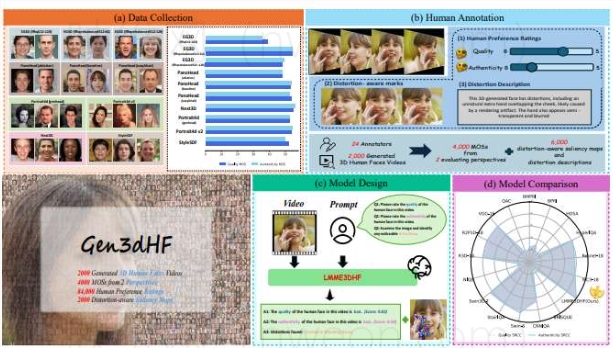
Researchers from Shanghai Jiao Tong University have unveiled Gen3DHF, a groundbreaking dataset designed to assess the quality of AI-generated 3D faces. This development comes as generative AI rapidly progresses, enabling sophisticated 3D face creation with applications in virtual reality and beyond. However, evaluating the realism and quality of these faces remains challenging due to the subjective nature of human perception.
Image

The Gen3DHF Dataset: A Comprehensive Benchmark

The Gen3DHF dataset is a large-scale resource featuring:

  • 2,000 AI-generated 3D face videos
  • 4,000 mean opinion scores (MOS) assessing quality and realism
  • 2,000 distortion perception saliency maps
  • Detailed distortion descriptions

This dataset provides researchers with an objective framework to evaluate AI-generated content, addressing a critical gap in current methodologies.

LMME3DHF: A Cutting-Edge Evaluation Metric

The team also developed LMME3DHF, a large multimodal model-based metric that:

  • Predicts quality and realism scores
  • Performs distortion perception visual question answering (VQA)
  • Generates saliency predictions

Experimental results demonstrate that LMME3DHF achieves state-of-the-art accuracy, surpassing existing methods and aligning closely with human judgments.

Addressing Key Challenges in AI-Generated Content

Despite significant advancements in AI-generated 3D faces, issues persist:

  • Perceptual distortions
  • Non-realistic artifacts
  • Inconsistent quality standards

The team emphasizes that while human evaluations offer valuable insights, they are often costly and inefficient. The development of objective measurement standards like Gen3DHF and LMME3DHF is essential for scalable progress.

Implications for Virtual Reality and Beyond

The release of Gen3DHF marks a pivotal step in:

  • Enhancing the credibility of AI generation technology
  • Advancing research in virtual reality applications
  • Establishing standardized evaluation protocols for 3D content

The dataset's focus on facial distortion uniqueness positions it as a vital tool for future innovations in the field.

Key Points:

  • 🚀 Gen3DHF Dataset: Contains 2,000 AI-generated 3D face videos with comprehensive quality metrics.
  • 🔍 LMME3DHF Metric: Outperforms existing methods in distortion perception and realism prediction.
  • 💡 Research Impact: Fills critical gaps in evaluating AI-generated 3D faces, boosting technological reliability.

Enjoyed this article?

Subscribe to our newsletter for the latest AI news, product reviews, and project recommendations delivered to your inbox weekly.

Weekly digestFree foreverUnsubscribe anytime

Related Articles

News

Google's Gemma 4: A Powerhouse AI Model Set to Shake Up Open-Source Landscape

Google is gearing up to unveil Gemma 4, its next-generation open-source AI model that promises four times the parameters of its predecessor. With a rumored 120 billion parameters and innovative MoE architecture, this release marks Google's strategic move to reclaim influence in the open-source AI space. The tech world watches closely as this development could redefine the balance between commercial and open-source AI models.

April 2, 2026
AI DevelopmentOpen Source TechMachine Learning
News

Xiaomi's MiMo AI Model Goes Paid: Token Plans Start at 39 Yuan

Xiaomi has rolled out its first paid subscription plans for the MiMo large language model, offering four pricing tiers from 39 to 659 yuan per month. The plans give developers and AI enthusiasts access to three core models, marking Xiaomi's shift from free beta testing to monetizing its AI ecosystem. This move reflects the industry's broader transition towards sustainable AI business models.

April 3, 2026
XiaomiAI ModelsTech Subscriptions
News

Indian AI Startup Sarvam Lands $350M with Amazon and NVIDIA Backing

Bangalore-based AI startup Sarvam AI is closing a massive funding round worth up to $350 million, with tech giants Amazon and NVIDIA joining the investor lineup. The deal could value the young company at over $1.5 billion, marking a significant milestone for India's growing AI ecosystem. Sarvam's focus on local language models and voice-first AI solutions has attracted global attention in the competitive artificial intelligence space.

April 3, 2026
Artificial IntelligenceStartup FundingIndian Tech
News

Meituan's New AI Model Sees, Hears and Understands Like Humans

Meituan has unveiled LongCat-Next, a groundbreaking AI model that processes images, speech and text with equal fluency. Unlike traditional systems that treat different data types separately, this native multimodal approach converts all inputs into a unified format - allowing the AI to naturally 'perceive' the physical world. Early tests show remarkable performance in visual reasoning and document analysis, potentially revolutionizing how AI interacts with our environment.

April 3, 2026
AI InnovationMultimodal LearningComputer Vision
News

China Backs Meta's AI Startup Deal With Clear Legal Conditions

China's commerce ministry has given cautious approval to Meta's acquisition of AI startup Manus, emphasizing that all tech deals must follow Chinese laws. The move signals Beijing's balancing act between encouraging innovation and maintaining regulatory oversight in the fast-growing AI sector. Analysts see this as Meta's strategic push to strengthen its position in general artificial intelligence.

April 3, 2026
MetaArtificial IntelligenceChina Tech Policy
News

ORCA Lab 1.0 Brings Physical AI Development to Your Laptop

Shanghai Songying Technology has unveiled ORCA Lab 1.0, China's first physical AI platform designed for individual developers. This groundbreaking tool eliminates the need for expensive hardware and complex coding, allowing anyone to create and train robots using just a standard laptop. The platform's no-code approach and full life cycle support could democratize embodied intelligence development, potentially accelerating innovation in this cutting-edge field.

April 3, 2026
Artificial IntelligenceRoboticsTech Innovation