OpenClaw Hits 280K Stars With Major AI Agent Upgrade

OpenClaw's Latest Update Brings Smarter AI Assistants

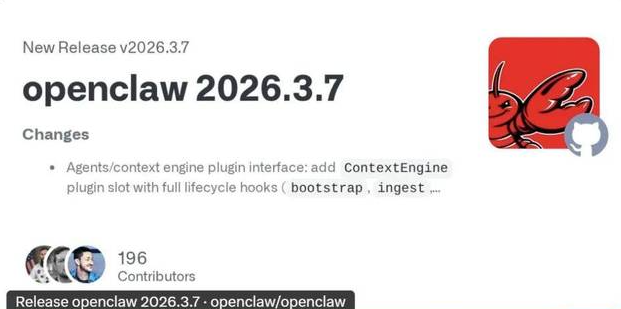
The open-source AI community is buzzing after OpenClaw's significant version 2026.3.7 release this weekend. What started as an experimental framework has now blossomed into a robust platform boasting over 280,000 GitHub stars - and for good reason.
Image

What's New Under the Hood?

At its core, this update transforms OpenClaw from a promising prototype into what developers are calling a "production-level agent operating system." The improvements address some of the most persistent pain points in AI assistant technology.

The Context Engine Plugin stands out as particularly revolutionary. Ever noticed how chatbots sometimes forget what you told them minutes ago? This new interface lets developers integrate advanced memory systems, using techniques like RAG (Retrieval-Augmented Generation) to maintain context across marathon conversations.

"We're moving beyond simple Q&A," explains lead developer Mark Chen. "With these upgrades, OpenClaw agents can maintain coherent discussions spanning days or weeks - crucial for professional applications."

Benchmark-Busting Performance

The integration of GPT-5.4 support isn't just checking a box - early tests show OpenClaw implementations outperforming OpenAI's native tools on the OOLONG benchmark. The team also optimized support for Google's Gemini 3.1 models, giving users more choice in their AI backbone.

Perhaps most impressive is the persistent channel binding through the ACP protocol. Imagine your Discord or Telegram bot picking up right where it left off after server maintenance - no more restarting conversations from scratch.

From Coders to Office Workers

What began as a developer tool is finding unexpected adoption:

  • Financial analysts use it for real-time stock analysis
  • Writers employ it for research assistance
  • Busy professionals automate routine office tasks

The revamped streaming output for local models like Ollama makes interactions feel more natural too, cleanly separating the AI's "thinking" process from its polished responses.

In performance tests combining OpenClaw with the lossless-claw plugin, the system achieved a remarkable 74.8 score on long-context comprehension tasks - outpacing commercial alternatives.

The Virtual Employee Era?

The most exciting development might be how people are using OpenClaw beyond tech circles. Affordable deployment options mean anyone can now have what amounts to a virtual employee handling repetitive work.

"It's not about replacing humans," Chen emphasizes. "It's about freeing people from drudgery so they can focus on creative problem-solving."

With these upgrades lowering barriers to sophisticated AI assistance, we might be seeing the first glimpses of truly useful digital coworkers becoming commonplace.

Key Points:

  • Memory breakthrough: Context Engine solves AI forgetfulness in long conversations
  • Model flexibility: Native GPT-5.4 and Gemini 3.1 support with optimized performance
  • Always-on agents: Persistent channel binding remembers conversation history
  • Beyond coding: Expanding use cases in finance, writing, and office automation
  • Proven performance: Scores 74.8 on long-context comprehension benchmarks
Enjoyed this article?

Subscribe to our newsletter for the latest AI news, product reviews, and project recommendations delivered to your inbox weekly.

Weekly digestFree foreverUnsubscribe anytime

Related Articles

GitHub Copilot Gets Smarter Overnight with GPT-5.4 Integration
News

GitHub Copilot Gets Smarter Overnight with GPT-5.4 Integration

GitHub has turbocharged its Copilot coding assistant by integrating OpenAI's latest GPT-5.4 model in record time. The upgrade brings significant improvements in handling complex programming tasks and multi-step workflows. Available immediately across all Copilot tiers, developers can now access smarter code suggestions through popular IDEs like VS Code and JetBrains.

March 6, 2026
GitHubCopilotGPT5AIProgramming
News

GitHub Copilot Wastes No Time Embracing GPT-5.4

Microsoft's GitHub Copilot didn't waste any time integrating OpenAI's latest model. Mere hours after GPT-5.4's release, developers worldwide gained access to smarter coding assistance featuring enhanced multi-step reasoning and real-time documentation lookup. The update brings noticeable improvements in handling complex workflows while maintaining Codex's signature code generation prowess.

March 6, 2026
GitHubCopilotGPT5AIProgramming
Notion Embraces Hybrid AI Strategy with MiniMax Integration
News

Notion Embraces Hybrid AI Strategy with MiniMax Integration

Notion shakes up its AI offerings by integrating China's MiniMax M2.5 model alongside established players like GPT-5.3 and Claude. This strategic move delivers cost-effective solutions for everyday tasks while signaling a shift toward hybrid AI ecosystems in productivity tools.

March 2, 2026
ProductivityTechAIIntegrationOpenSourceAI
News

Notion Embraces Open-Source AI with MiniMax M2.5 Integration

Notion shakes up its AI offerings by integrating MiniMax's open-source M2.5 model, giving users a powerful alternative to closed-source options like Claude and GPT. The move highlights Notion's push toward model flexibility while delivering impressive performance at lower costs. With specialized office capabilities and rapid processing speeds, M2.5 could change how teams approach productivity workflows.

March 2, 2026
NotionOpenSourceAIProductivityTech
News

AI Architecture Debate: Mistral Claims Influence Over DeepSeek's Design

A tech controversy erupted when Mistral CEO Arthur Mensch suggested China's DeepSeek-V3 model borrowed from their architecture. The claim sparked scrutiny as developers noted near-simultaneous paper releases and fundamental design differences. Interestingly, some argue Mistral's later models actually adopted DeepSeek innovations, flipping the narrative.

January 26, 2026
AIArchitectureMistralDeepSeek
AI Cracks Erdős' Toughest Puzzles: Mathematicians Stunned by GPT5.2's Breakthroughs
News

AI Cracks Erdős' Toughest Puzzles: Mathematicians Stunned by GPT5.2's Breakthroughs

In an unprecedented feat, GPT5.2 has solved 11 of Paul Erdős' legendary unsolved mathematical problems in just two weeks, verified by formal proof tools. The breakthrough has top mathematicians like Terry Tao taking notice, with Harvard's Noam Elkies building on AI-generated solutions. This marks a turning point where artificial intelligence isn't just assisting human researchers - it's making autonomous discoveries at the frontiers of pure mathematics.

January 15, 2026
Artificial IntelligenceMathematicsGPT5