
Ohio Bill Seeks to Deny AI Legal Personhood and Marriage Rights

Ohio Moves to Block AI from Gaining Legal Personhood

Representative Thaddeus Claggett (R-Licking County), chair of Ohio's House Committee on Technology and Innovation, has proposed groundbreaking legislation that would legally define artificial intelligence systems as "Non-Conscious Entities." The bill represents one of the most comprehensive attempts to date to prevent AI from acquiring legal rights traditionally reserved for humans.

Core Provisions of the Legislation

The proposed law contains several key provisions:

  • Explicitly denies legal personhood status to any artificial intelligence system
  • Prohibits marriage contracts between AI systems or between humans and AI
  • Prevents AI from exercising spousal privileges such as power of attorney or medical decision-making authority

Image

Lawmaker's Rationale

In an exclusive interview, Rep. Claggett explained his motivation: "As computer systems increasingly mimic human behavior and cognition, we must draw clear legal boundaries. This legislation ensures these technologies cannot assume human identities under the law."

The representative emphasized particular concern about marital rights, noting that marriage confers significant legal powers over another individual's affairs. "We cannot have algorithms making life-altering decisions about medical care or finances simply because someone married their chatbot," Claggett stated.

The Ohio proposal comes amid growing global debate about AI rights and responsibilities. While no jurisdiction currently grants full personhood to AI systems, some legal frameworks have begun recognizing certain rights for sophisticated algorithms:

  • The European Union's Artificial Intelligence Act includes provisions for "high-risk" AI systems
  • Saudi Arabia granted citizenship to the robot Sophia in 2017 (though with limited practical effect)
  • Some courts have considered whether AI can be listed as inventors on patents

The Ohio bill would create one of the most restrictive environments for AI development in the United States. Legal experts suggest it could influence similar legislation in other states concerned about algorithmic overreach.

Industry Reaction

The technology sector has offered mixed responses:

Supportive Views:

  • Some ethicists applaud preventing premature recognition of machine consciousness
  • Religious groups have voiced approval of protecting traditional marriage definitions

Critical Perspectives:

  • AI developers warn this could stifle innovation in human-machine collaboration
  • Civil liberties organizations question whether such prohibitions are premature

The bill awaits committee assignment in the Ohio legislature. If passed, it would take effect 90 days after signing by Governor Mike DeWine.

Key Points:

  1. Ohio proposes classifying all AI as "Non-Conscious Entities" under law
  2. Legislation would ban AI from obtaining legal personhood status
  3. Explicitly prohibits marriage contracts involving artificial intelligence
  4. Aims to prevent algorithmic decision-making in spousal matters
  5. Part of growing global debate about appropriate boundaries for machine rights
Enjoyed this article?

Subscribe to our newsletter for the latest AI news, product reviews, and project recommendations delivered to your inbox weekly.

Weekly digestFree foreverUnsubscribe anytime

Related Articles

News

Meta Makes Billion-Dollar Bet on AI Startup Manus

Meta has made a strategic move in the AI arms race, acquiring Singapore-based startup Manus for billions of dollars. The deal marks Meta's third-largest acquisition ever and brings aboard Manus' innovative 'general agent' technology that's been turning heads in Silicon Valley. Founder Shao Hong will join Meta as VP, signaling the social media giant's serious commitment to advancing its AI capabilities.

December 30, 2025
MetaAI startupsTech acquisitions
News

OpenAI's Soaring Valuation Raises Eyebrows as Experts Question Financial Stability

OpenAI's staggering $830 billion valuation and $100 billion funding push have economists questioning whether the AI powerhouse is truly 'too big to fail.' While the company dominates headlines with trillion-dollar deals, Harvard professor Jason Furman cautions against assuming government intervention would save the unprofitable startup if financial troubles arise. The rapid expansion comes with growing concerns about sustainability in an increasingly competitive AI market.

December 19, 2025
OpenAIAI economicsTech bubble
Grok4 Outperforms GPT-5 in Reasoning, But at Higher Cost
News

Grok4 Outperforms GPT-5 in Reasoning, But at Higher Cost

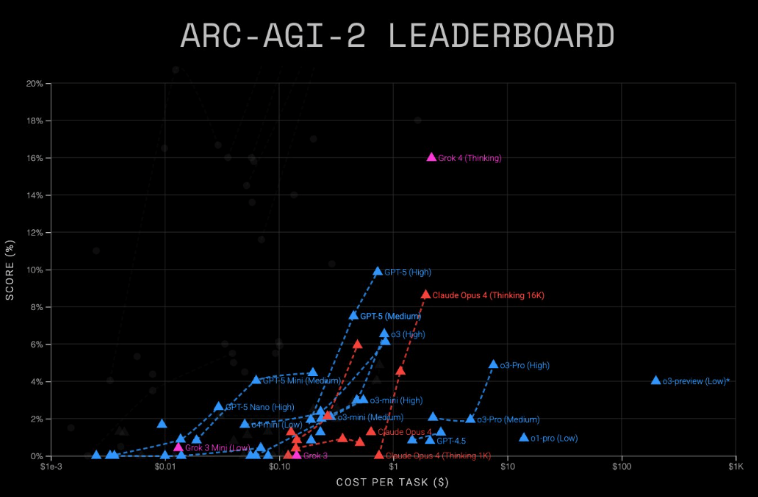
Recent benchmark tests by ARC Prize reveal Grok4 leads GPT-5 in reasoning tasks but with significantly higher costs. GPT-5 maintains better cost-efficiency, while lightweight variants show promising results. The study highlights trade-offs between performance and affordability in cutting-edge AI models.

August 8, 2025
AI benchmarksLanguage modelsMachine learning
Cursor Faces Backlash Over Pricing Changes, CEO Apologizes
News

Cursor Faces Backlash Over Pricing Changes, CEO Apologizes

Cursor, a leading AI programming tool, sparked user outrage after unclear communication about its Pro plan pricing adjustments. CEO Michael Truell issued a public apology and promised refunds for unexpected charges. The controversy highlights the growing cost pressures in the AI coding tool market.

July 9, 2025
AI developmentSaaS pricingTech backlash
News

Indian Startup Emversity Secures $30M to Train Workers AI Can't Replace

As AI reshapes job markets worldwide, Indian vocational training startup Emversity has doubled its valuation to $120 million by focusing on an unexpected niche: jobs that resist automation. The company's $30 million Series A funding will expand its programs training nurses, therapists and hospitality workers - roles requiring human touch that AI struggles to replicate. Partnering with universities and employers, Emversity bridges India's skills gap while creating career paths insulated from technological disruption.

January 15, 2026
vocational trainingfuture of workskills gap
Google Trends Gets Smarter: AI-Powered Comparisons Now Available
News

Google Trends Gets Smarter: AI-Powered Comparisons Now Available

Google Trends just leveled up with Gemini AI integration, transforming how we explore search trends. The update introduces smart sidebars that automatically suggest related searches and visual improvements making data easier to digest. Now comparing up to eight topics at once, journalists and researchers can uncover hidden connections faster than ever.

January 15, 2026
GoogleData AnalysisAI Tools