NVIDIA Unveils Open-Source Quantum AI Breakthrough, Sparking Market Rally

NVIDIA's Quantum Leap: How Open-Source AI Is Reshaping Computing

In a move that could accelerate the quantum computing revolution, NVIDIA has unveiled Ising, the world's first open-source quantum artificial intelligence model series. The April 14 announcement immediately sent shockwaves through financial markets, with quantum technology stocks experiencing significant gains the following day.

The Ising Advantage

The Ising series represents a major step forward in making quantum computing practical. It consists of two powerful models:

  • Ising Calibration: This vision-language model tackles one of quantum computing's trickiest problems - keeping quantum processors stable. It automates calibration tasks that previously required painstaking manual intervention.
  • Ising Decoding: Using advanced 3D convolutional neural networks, this model corrects quantum errors at speeds 2.5 times faster than current methods while boosting accuracy by an astonishing 300%.

"Ising transforms quantum machines," NVIDIA CEO Jensen Huang explained. "AI becomes both the control plane and operating system, turning fragile qubits into robust quantum-GPU systems."

Market Impact

The tech world took notice immediately. On April 15:

  • Shenzhou Information's stock hit its daily limit-up
  • China Xidian, Guodun Quantum and Luobo Tech led sector gains
  • Luobo Tech alone saw nearly 500 million yuan in main fund inflows

Research institutions including Harvard University and Berkeley Lab have already begun implementing Ising, available on GitHub and Hugging Face.

The Bigger Picture

With the quantum computing market projected to surpass $11 billion by 2030, NVIDIA's move achieves two important goals:

  1. Strengthens its leadership in high-performance computing
  2. Helps transition quantum computing from lab experiments to real-world applications

This development marks a turning point where AI begins driving quantum computing's automation - potentially shortening the timeline for practical, general-purpose quantum computers.

Key Points

  • NVIDIA releases first open-source quantum AI models (Ising series)
  • Two core components address calibration and error correction
  • Quantum tech stocks surge following announcement
  • Models available on GitHub and Hugging Face
  • Adoption by major research institutions underway
  • Could accelerate quantum computing's commercial viability

Enjoyed this article?

Subscribe to our newsletter for the latest AI news, product reviews, and project recommendations delivered to your inbox weekly.

Weekly digestFree foreverUnsubscribe anytime

Related Articles

News

Xiaohongshu Shakes Up AI World by Open-Sourcing Its Relax Training Engine

In a surprising move, lifestyle platform Xiaohongshu has open-sourced its AI training engine called Relax, designed for multi-modal scenarios. This sophisticated tool handles text, images, audio and video through innovative parallel processing. The unexpected contribution from a non-traditional AI player signals the company's serious ambitions in artificial intelligence development and its desire to build influence in the tech community.

April 15, 2026
AIOpen SourceMachine Learning
Anthropic's Secret AI Model Mythos Showcased to Trump Team
News

Anthropic's Secret AI Model Mythos Showcased to Trump Team

Anthropic co-founder Jack Clark revealed at the Semafor summit that his company demonstrated its unreleased AI model Mythos to Trump administration officials, citing its advanced cybersecurity capabilities. Despite an ongoing legal battle with the Pentagon over military AI use, Clark emphasized the importance of government-tech collaboration. The revelation comes as major banks reportedly test the powerful new system, while Clark offers surprising optimism about AI's employment impact compared to his CEO's dire predictions.

April 15, 2026
Artificial IntelligenceCybersecurityGovernment Tech
News

Investors Shift Focus as Anthropic Surges, Leaving OpenAI Valuation in Question

The AI investment landscape is shifting dramatically as Anthropic's explosive growth challenges OpenAI's dominance. While OpenAI boasts an $852 billion valuation, Anthropic's revenue tripled to $30 billion in just three months, fueled by demand for its coding tools. Secondary market activity shows investors favoring Anthropic's stock, trading OpenAI shares at a discount. The rivalry echoes past tech battles where early leaders didn't always finish first.

April 15, 2026
AI InvestmentTech ValuationArtificial Intelligence
News

DeepMind CEO Predicts AGI Within Five Years: A Revolution Unlike Any Before

DeepMind CEO Demis Hassabis has made bold predictions about artificial intelligence's future, suggesting AGI could arrive within five years. He describes this shift as a "tenfold industrial revolution happening ten times faster" than historical changes. Hassabis also warns about widening gaps between top AI companies and the patchy nature of current AI systems. The interview reveals how the rules of AI development are changing, with innovation becoming more crucial than raw computing power.

April 14, 2026
AGIDeepMindAI Future
News

OpenAI's 'Spud' Model: A Direct Challenge to Anthropic's AI Dominance

A leaked internal memo from OpenAI reveals their ambitious strategy to counter rival Anthropic with a new AI model codenamed 'Spud'. This next-generation reasoning model reportedly outperforms Anthropic's Claude Mythos in complex tasks and reliability. OpenAI is also developing the 'Frontier' platform to set enterprise AI standards while subtly distancing itself from Microsoft dependence. The memo includes sharp criticisms of Anthropic's computing power management and revenue reporting practices, signaling a shift in AI competition from raw power to practical implementation.

April 14, 2026
OpenAIArtificial IntelligenceTech Competition
Google's Vantage Uses AI to Measure Teamwork and Creativity in Education
News

Google's Vantage Uses AI to Measure Teamwork and Creativity in Education

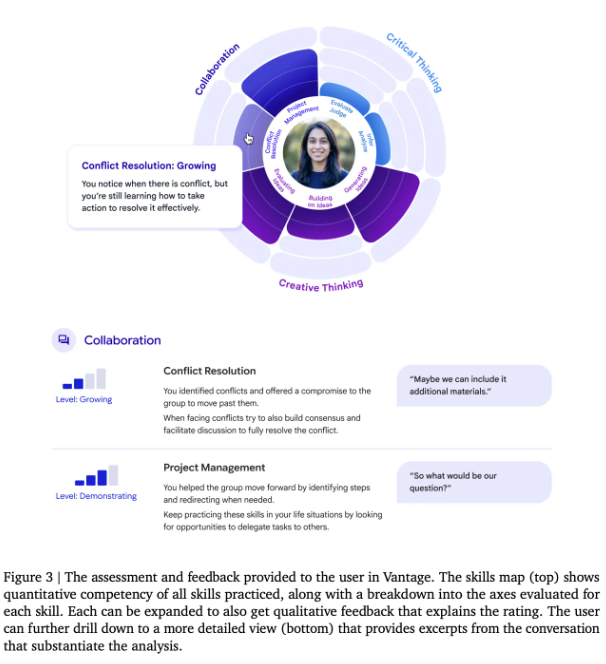
Google researchers have developed Vantage, an innovative method using large language models to assess traditionally hard-to-measure skills like teamwork, creativity, and critical thinking. Unlike standardized tests that evaluate individual knowledge, Vantage simulates real group interactions where AI participants challenge human test-takers. Early results show AI scoring aligns well with expert human evaluations, potentially revolutionizing how we measure essential life skills in education.

April 14, 2026
AI in educationSkills assessmentGoogle Research