
NVIDIA Praises Google's AI Advances While Defending Its Market Lead

NVIDIA Navigates Praise and Competition in AI Chip Market
Image

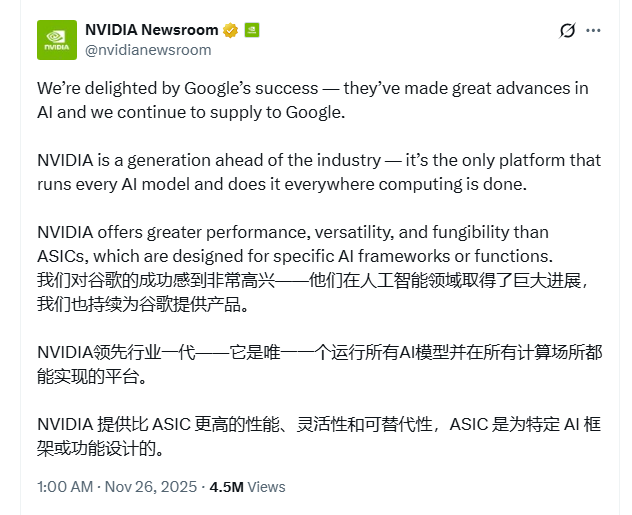
In a rare public show of sportsmanship, NVIDIA recently celebrated Google's rapid advancements in artificial intelligence through its social media channels. But beneath the congratulatory tone lay a clear message: when it comes to powering AI systems, NVIDIA still wears the crown.

The California-based chipmaker emphasized its unique position as the only global platform capable of running all major AI models across computing environments - from massive cloud servers to compact edge devices. "We're about a generation ahead," the company suggested, though competitors might argue with that assessment.

The Flexibility Advantage

CEO Jensen Huang didn't mince words when comparing NVIDIA's general-purpose GPUs to specialized AI chips (ASICs). "Our architecture outperforms purpose-built chips in every meaningful way," he asserted, pointing to superior performance, adaptability, and upgrade paths. This versatility has become crucial as AI models evolve unpredictably.

Market analysts see NVIDIA's statement as strategic positioning. "They're acknowledging Google's progress while reminding everyone who builds the roads these AI systems run on," noted tech analyst Miriam Chen of Bernstein Research.
Image

Market Jitters Over Potential Shifts

The diplomatic exchange coincided with significant stock volatility. On November 25, NVIDIA shares dipped 2.59% to close at $177.82 after swinging between $169.55 and $178.15 on heavy trading volume - clear signs of investor unease.

The turbulence followed Bloomberg reports that Meta Platforms is negotiating to purchase Google's custom Tensor Processing Units (TPUs) for its AI data centers. Such a deal could displace some NVIDIA GPU orders, though industry experts caution against overstating the impact.

"This isn't about replacing NVIDIA overnight," explained financial strategist David Kwon. "But it does show tech giants want alternatives to avoid being locked into one supplier."

The news created divergent market reactions: while NVIDIA shares stumbled early trading, Alphabet and Meta saw their stocks climb over 6% and 3% respectively.

Key Points:

  • NVIDIA acknowledges Google's AI progress while asserting its infrastructure leadership
  • General-purpose GPUs maintain advantages over specialized chips for evolving AI needs
  • Stock volatility reflects investor concerns about shifting industry alliances
  • Meta-Alphabet talks signal growing desire among tech giants for chip alternatives
Enjoyed this article?

Subscribe to our newsletter for the latest AI news, product reviews, and project recommendations delivered to your inbox weekly.

Weekly digestFree foreverUnsubscribe anytime

Related Articles

News

Mistral AI and Samsung Explore Chip Partnership in High-Stakes Meeting

Mistral AI's CEO Arthur Mensch recently held talks with Samsung Electronics' top brass, including Vice Chairman Oh Young-soo, signaling potential collaboration on AI semiconductor technology. The Paris-based AI firm seeks stable chip supplies for its computing needs, while Samsung could provide crucial memory components like High Bandwidth Memory. Industry watchers see promising synergies as both companies aim to strengthen their positions in the competitive AI hardware market.

April 7, 2026
AI ChipsSemiconductor IndustryTech Partnerships
News

Samsung's Stunning Comeback: AI Chip Craze Fuels Record Profits

Samsung Electronics just posted its most profitable quarter ever, with operating profits skyrocketing over 800% year-over-year to $37.9 billion. The surge comes as AI data centers scramble for memory chips, driving prices up dramatically. After playing catch-up in high-bandwidth memory, Samsung is now closing the gap with rivals like SK Hynix in the race to supply NVIDIA and other AI hardware makers.

April 7, 2026
SamsungAI ChipsSemiconductors
News

Microsoft Bets Big on Homegrown AI to Challenge Industry Leaders

Microsoft is making an aggressive push into developing its own AI models, aiming to compete head-to-head with OpenAI and Anthropic by 2027. The tech giant is investing heavily in computing power with NVIDIA's latest chips and has already seen promising results with a new speech transcription model. This strategic shift comes after Microsoft gained more independence from its partnership with OpenAI, signaling its ambition to become a leader rather than just an integrator of AI technology.

April 3, 2026
MicrosoftAI DevelopmentTech Competition
News

Microsoft Bets Big on Homegrown AI to Rival OpenAI by 2027

Microsoft is making a bold push into AI independence, aiming to develop its own cutting-edge models that can compete with industry leaders like OpenAI. The tech giant plans to achieve full autonomy within 3-5 years while continuing to support external partnerships. With massive investments in NVIDIA's latest chips and early success in voice transcription technology, Microsoft's move signals a potential shift in the AI power dynamics.

April 3, 2026
MicrosoftAI DevelopmentTech Competition
News

Anthropic's Safety Reputation Takes a Hit After Back-to-Back Data Leaks

Anthropic, the AI company that built its reputation on safety, has suffered two major security breaches in just one week. First came the accidental release of 3,000 internal documents, followed by an even more damaging leak of over 512,000 lines of source code due to a packaging error. These incidents have raised serious questions about the company's internal controls while inadvertently revealing the strength of its Claude Code technology - so impressive it reportedly pushed OpenAI to temporarily shelve its Sora video tool.

April 1, 2026
AI SecurityData BreachTech Competition
Tesla's AI6 Chip: A Game-Changer in Edge Computing
News

Tesla's AI6 Chip: A Game-Changer in Edge Computing

Elon Musk has revealed Tesla's next-gen AI6 chip, set to complete tape-out by December. This powerhouse promises performance matching dual AI5 chips while being optimized for Tesla's humanoid robots and self-driving taxis. With a $16.5B deal with Samsung for 2nm production, Tesla is betting big on hardware-software co-design. Musk also shared intriguing views on AI's future limitations shifting from chips to energy.

March 19, 2026
TeslaAI ChipsEdge Computing