North Korean Hackers Weaponize AI Against Blockchain Experts

Cybercriminals Harness AI for Sophisticated Attacks

Security firm Check Point sounded alarms this week after discovering North Korea's notorious Konni hacking group (also known as Opal Sleet) employing artificial intelligence to craft malicious software. Their targets? Blockchain developers across the Asia-Pacific region.

Image

The AI Fingerprint in Malicious Code

What tipped off investigators wasn't just the attacks themselves, but their unusual craftsmanship. The PowerShell backdoors used showed telltale signs of AI generation:

  • Unnatural precision: Unlike typical hacker scripts with messy code, these contained perfectly structured documentation comments
  • AI giveaway phrases: Lines like "# <– Your permanent project UUID" mirror exactly how language models respond to programming prompts
  • Modular efficiency: The code followed textbook organization that human hackers rarely bother with

The discovery suggests cybercriminals are using AI not just for scale, but for quality - producing cleaner, harder-to-detect malware.

Image

Anatomy of an AI-Assisted Attack

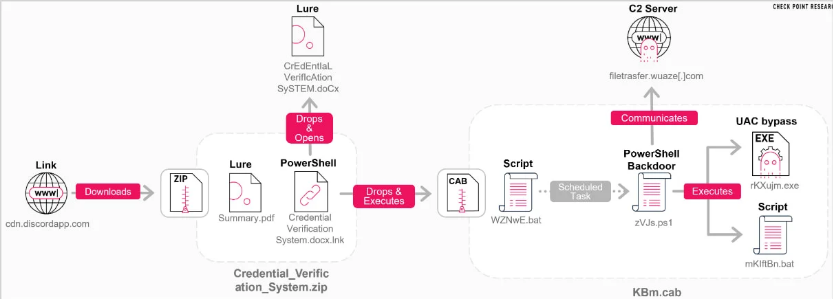
The hackers' playbook reveals chilling sophistication:

  1. Bait: Phishing links distributed through Discord lure victims
  2. Hook: A malicious shortcut file triggers the infection chain when opened
  3. Hide: Malware disguises itself as OneDrive updates with hourly scheduled tasks
  4. Hunt: Advanced environment checks avoid security sandboxes before stealing:
    • Infrastructure access
    • API credentials
    • Crypto wallet private keys

The attacks have already hit targets in Japan, Australia and India according to BleepingComputer reports.
Image

What This Means for Cybersecurity

The Konni group's tactics represent a quantum leap in cybercrime:

  • Lower barriers: Less skilled hackers can now produce professional-grade malware
  • Faster iteration: AI enables rapid testing and refinement of attack methods
  • Harder detection: Machine-generated code lacks human coding fingerprints

Security experts warn developers to treat unsolicited documents and links with extreme caution, especially on social platforms.


Enjoyed this article?

Subscribe to our newsletter for the latest AI news, product reviews, and project recommendations delivered to your inbox weekly.

Weekly digestFree foreverUnsubscribe anytime

Related Articles

News

Mobileye Drives Forward with Strong Growth Amid Autonomous Vehicle Push

Mobileye, the Intel-owned autonomous driving tech leader, posted impressive 2025 results with revenue climbing 15% to $1.89 billion. The company saw operating cash flow jump 51% while securing $24.5 billion in future orders. Beyond cars, Mobileye is expanding into robotics through its Mentee Robotics acquisition and preparing for commercial robotaxi launches.

January 26, 2026
autonomous vehiclesMobileyeautomotive tech
Musk's Davos Surprise: Tesla Robots Could Be in Homes by 2027
News

Musk's Davos Surprise: Tesla Robots Could Be in Homes by 2027

Elon Musk made waves at Davos with a bold prediction - Tesla's Optimus robots will be ready for household use by late 2027. While currently handling simple factory tasks, Musk envisions these humanoid assistants caring for kids and elders within three years. But experts caution about production challenges and unanswered questions about real-world performance.

January 23, 2026
TeslaRoboticsAI
Curl pulls plug on bug bounty program amid AI-generated report flood
News

Curl pulls plug on bug bounty program amid AI-generated report flood

The widely-used command line tool curl is shutting down its vulnerability reward program after being overwhelmed by low-quality AI-generated reports. Founder Daniel Stenberg says these 'AI slop' submissions sound professional but offer no real value, instead draining developers' time. Starting February 2026, curl will no longer pay for bug reports and warns that spam submitters may face public shaming.

January 23, 2026
open-sourceAI-challengescybersecurity
Alibaba's New AI Voice Tech Clones Voices in Seconds
News

Alibaba's New AI Voice Tech Clones Voices in Seconds

Alibaba's Qwen team has unveiled Qwen3-TTS, an open-source text-to-speech system that clones voices in just 3 seconds and responds faster than blinking. The technology supports multiple languages and dialects while maintaining ultra-low latency, making it ideal for real-time applications like customer service and live translation.

January 23, 2026
text-to-speechvoice-cloningAI
News

AI Fraud Epidemic Hits Small Businesses Hard

Small businesses are drowning in a rising tide of AI-powered cybercrime. New data reveals that 80% suffered attacks last year, with artificial intelligence driving nearly half of these breaches. Hackers now use generative AI to craft eerily convincing scams, while struggling companies cut corners on security measures—creating a perfect storm for financial losses.

January 20, 2026
cybersecuritysmall businessAI fraud
Mugen3D Turns Single Photos Into Stunning 3D Worlds
News

Mugen3D Turns Single Photos Into Stunning 3D Worlds

A groundbreaking AI tool called Mugen3D is transforming how we create 3D content. Using advanced 3D Gaussian Splatting technology, it can generate remarkably realistic models from just one image - capturing textures, lighting, and materials with astonishing accuracy. This innovation promises to democratize 3D creation across industries from gaming to e-commerce.

January 12, 2026
AIComputerGraphicsDigitalCreation