MiniMax to Launch M2.1 AI Model, Disrupting Open-Source Market

MiniMax Prepares M2.1 Launch in Open-Source AI Push

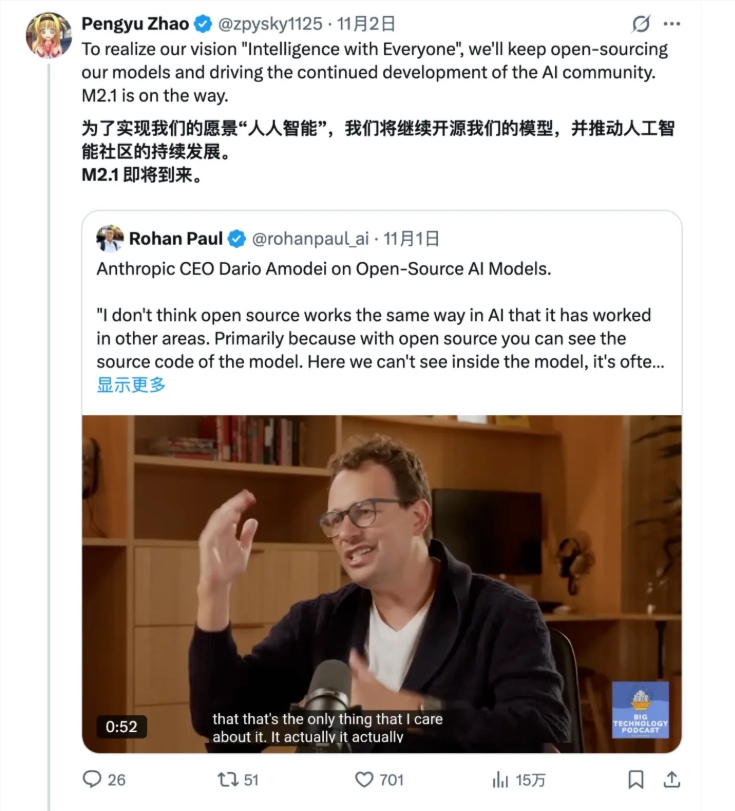
As competition intensifies in the open-source large language model sector, MiniMax has announced the imminent release of its M2.1 model, scheduled within the next two weeks. The Chinese AI company continues its aggressive push to democratize AI technology through performance improvements and accessible pricing.

Building on M2's Success

The upcoming M2.1 represents a strategic upgrade rather than a complete overhaul, refining the capabilities that made its predecessor stand out. The M2 model gained rapid adoption by offering:

  • 8% of Claude Sonnet's pricing
  • Double the reasoning speed
  • Specialized optimization for AI Agent development and code generation scenarios
Image

Open Ecosystem Strategy

MiniMax has distinguished itself through an unusually open approach:

"We will continue providing free access to our Agent service until our servers can't handle it anymore," stated Pengyu Zhao, head of MiniMax's large model team. This policy has significantly lowered barriers to entry for developers experimenting with agent-based applications.

The company simultaneously released:

  • Free API access for testing
  • Comprehensive documentation
  • Community support channels

Technical Advancements in M2.1

The new version focuses on three core improvements:

  1. Enhanced reasoning efficiency for complex tasks
  2. Deeper context understanding capabilities
  3. More robust tool calling functionality for integrated workflows

These upgrades aim to provide developers with a more stable foundation for building production-grade AI applications.

Market Implications

MiniMax's strategy arrives during a critical transition period where:

  • Traditional closed-source models face growing competition
  • Cost remains a significant barrier to adoption
  • Developer communities increasingly value transparency and customization options

The company's approach challenges both the technical benchmarks and pricing structures established by larger AI providers.

Key Points:

  • Launch Timeline: M2.1 model expected within 1-2 weeks
  • Pricing Strategy: Continues MiniMax's tradition of cost-effective solutions
  • Technical Focus: Enhanced reasoning, context handling, and tool integration
  • Open Ecosystem: Free access policies foster developer community growth
  • Market Position: Challenges both performance standards and business models in commercial AI
Enjoyed this article?

Subscribe to our newsletter for the latest AI news, product reviews, and project recommendations delivered to your inbox weekly.

Weekly digestFree foreverUnsubscribe anytime

Related Articles

Alibaba's Qwen3.5-Plus Takes the Open-Source AI Crown
News

Alibaba's Qwen3.5-Plus Takes the Open-Source AI Crown

Just in time for Chinese New Year, Alibaba has unveiled Qwen3.5-Plus - a game-changing open-source AI model that outperforms industry giants like Gemini 3 Pro. With revolutionary architecture and multimodal capabilities, this lean yet powerful model delivers top-tier performance at a fraction of the cost. Benchmark results show it surpassing even GPT-5.2 and Claude 4.5 in key evaluations.

February 17, 2026
Qwen3.5OpenSourceAIAlibabaTech
News

China's Healthcare AI Race Heats Up as Baichuan Outperforms GPT-5.2

The global healthcare AI landscape is witnessing intense competition in 2026, with Chinese models like Baichuan-M3 demonstrating surprising strength against international giants. While OpenAI's ChatGPT Health and Google's MedGemma1.5 make waves globally, domestic players are leveraging local advantages in policy compliance and Chinese medical data to gain ground. Industry analysts highlight ten promising Chinese contenders across different specialties, from comprehensive platforms to niche imaging experts, signaling a new era where practical applications trump pure technological prowess.

February 10, 2026
HealthcareAIMedicalTechnologyChinaTech
OpenAI's Codex App Hits macOS, Promising Smarter Coding
News

OpenAI's Codex App Hits macOS, Promising Smarter Coding

OpenAI has unveiled its Codex application for macOS, powered by the GPT-5.2-Codex model. While it leads in some benchmarks, competitors like Gemini 3 and Claude Opus remain close behind. The app introduces features like automated task scheduling and flexible agent interaction modes, aiming to streamline developers' workflows. CEO Sam Altman highlights its potential to simplify complex coding tasks, though user experience improvements may still be needed.

February 3, 2026
OpenAICodexAIProgramming
OpenClaw: The Lobster AI That Finally Found Its Name
News

OpenClaw: The Lobster AI That Finally Found Its Name

The open-source AI assistant formerly known as Clawd has undergone its third rebranding, settling on OpenClaw after trademark hurdles and community feedback. Despite the naming drama, the project has exploded in popularity, surpassing 100,000 GitHub stars while maintaining its quirky lobster mascot. Offering local AI processing across multiple platforms, OpenClaw lets users manage emails, calendars and more while keeping all data private.

January 30, 2026
AIOpenSourcePrivacyTech
News

AI Architecture Debate: Mistral Claims Influence Over DeepSeek's Design

A tech controversy erupted when Mistral CEO Arthur Mensch suggested China's DeepSeek-V3 model borrowed from their architecture. The claim sparked scrutiny as developers noted near-simultaneous paper releases and fundamental design differences. Interestingly, some argue Mistral's later models actually adopted DeepSeek innovations, flipping the narrative.

January 26, 2026
AIArchitectureMistralDeepSeek
News

MiniMax Unleashes Custom AI Assistants That Learn Your Workflow

MiniMax shakes up the AI assistant game with its new desktop platform that lets users create specialized digital helpers. Forget generic chatbots - these 'Expert Agents' can be trained as tax advisors, coding assistants, or market researchers tailored to your exact needs. The hybrid desktop-cloud system keeps sensitive data secure while allowing deep customization of tools and knowledge bases. Currently in free trial, this could redefine how professionals interact with AI.

January 21, 2026
AI assistantsproductivity techMiniMax