
Microsoft's BioEmu Model Revolutionizes Protein Simulation

Microsoft Unveils Groundbreaking BioEmu Model for Protein Simulation

In a landmark announcement, Microsoft CEO Satya Nadella revealed the BioEmu model, a revolutionary AI system that slashes protein dynamic simulation times from years to mere hours. This advancement is set to transform pharmaceutical research and accelerate the development of personalized medicine.
Image

A Leap Forward in Biological Research

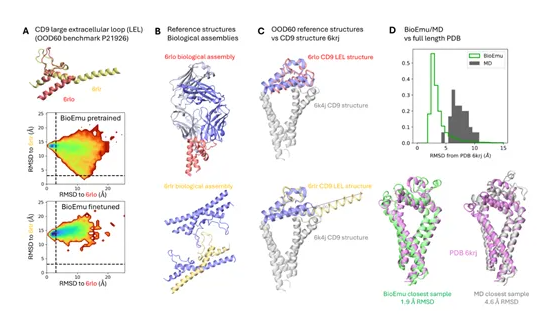
The research, published in the prestigious journal Nature, represents a significant stride in computational biology. Unlike traditional methods like X-ray crystallography and nuclear magnetic resonance, which are time-consuming and expensive, BioEmu offers rapid, high-accuracy simulations. While Google's AlphaFold2 excels at predicting single protein structures, it falls short in simulating dynamic conformations—a gap BioEmu effectively fills.

How BioEmu Works

The model's core innovation lies in its ability to convert protein sequences into diverse 3D structures. Key components include:

  • A protein sequence encoder based on AlphaFold2's pre-trained model
  • Coarse-grained methods that reduce computational complexity while preserving critical structural details
  • A diffusion conditional generation model that produces protein conformations by systematically removing noise

The system employs a sophisticated score model to ensure accuracy and stability throughout the simulation process.

Training and Data Integration

BioEmu's effectiveness stems from its comprehensive training approach:

  • Incorporates over 200 milliseconds of molecular dynamics simulation data
  • Utilizes experimental measurements of protein stability data
  • Implements a multi-stage training strategy to enhance model reliability

This robust methodology enables BioEmu to capture the dynamic behavior of proteins with unprecedented precision.

Implications for Healthcare and Research

The implications of this breakthrough extend far beyond academic circles:

  1. Drug development: Dramatically reduces time-to-market for new medications
  2. Personalized medicine: Enables faster customization of treatments based on individual protein profiles
  3. Research efficiency: Frees scientists from lengthy simulation processes, allowing focus on innovation
  4. Cost reduction: Lowers barriers to entry for smaller research institutions
  5. Disease understanding: Provides new tools for studying protein-related disorders like Alzheimer's and Parkinson's

The scientific community has welcomed this development as a transformative moment in biotechnology.

Key Points:

  • Speed breakthrough: Reduces protein simulation from years to hours
  • 🔍 Comprehensive modeling: Overcomes limitations of traditional methods and AlphaFold2
  • 🧠 Advanced architecture: Combines sequence encoding, coarse-grained methods, and diffusion models
  • 📊 Data-driven: Trained on extensive molecular dynamics and stability data
  • 💊 Healthcare impact: Accelerates drug discovery and personalized treatment development

Enjoyed this article?

Subscribe to our newsletter for the latest AI news, product reviews, and project recommendations delivered to your inbox weekly.

Weekly digestFree foreverUnsubscribe anytime

Related Articles

AI Cracks Erdős' Toughest Puzzles: Mathematicians Stunned by GPT5.2's Breakthroughs
News

AI Cracks Erdős' Toughest Puzzles: Mathematicians Stunned by GPT5.2's Breakthroughs

In an unprecedented feat, GPT5.2 has solved 11 of Paul Erdős' legendary unsolved mathematical problems in just two weeks, verified by formal proof tools. The breakthrough has top mathematicians like Terry Tao taking notice, with Harvard's Noam Elkies building on AI-generated solutions. This marks a turning point where artificial intelligence isn't just assisting human researchers - it's making autonomous discoveries at the frontiers of pure mathematics.

January 15, 2026
Artificial IntelligenceMathematicsGPT5
News

South Korea's AI Ambition Hits Snag Over Chinese Code Controversy

South Korea's push for AI independence faces scrutiny as homegrown models show striking similarities to Chinese open-source code. Major tech players like Naver and SK Telecom find themselves embroiled in debates about technological sovereignty versus practical development realities. While companies defend their approach as standard industry practice, the revelations spark discussions about what truly constitutes 'domestic' AI innovation.

January 14, 2026
Artificial IntelligenceTechnology PolicySouth Korea Tech
News

Instagram Co-Founder Shifts Gears to Lead Anthropic's Innovation Lab

Mike Krieger, Instagram co-founder and Anthropic's Chief Product Officer, is stepping into a new role leading the company's internal 'Labs' team focused on experimental AI products. As Anthropic plans to double its innovation team size within six months, Krieger sees this as a pivotal moment to shape AI applications firsthand. Meanwhile, Ami Vora will take over Krieger's product leadership duties as the startup intensifies its competition with tech giants.

January 14, 2026
Artificial IntelligenceTech StartupsExecutive Moves
News

Microsoft Pledges Full-Price Power for AI Data Centers Amid Trump Pressure

In a significant policy shift, Microsoft has committed to paying full electricity rates for its AI data centers following pressure from the Trump administration. The tech giant announced it would no longer seek tax breaks or subsidies that could push energy costs onto local communities. This comes as AI's massive power demands spark nationwide concerns over rising utility bills and resource shortages.

January 14, 2026
MicrosoftAI InfrastructureEnergy Policy
News

Trump Draws Line on AI Power Costs: Microsoft First to Face Heat

President Trump has taken aim at tech giants over their energy-hungry AI data centers, warning companies can't pass these costs to consumers. Microsoft finds itself first in the firing line, with reports indicating immediate power usage adjustments. As residential bills spike near data hubs nationwide, the industry scrambles for off-grid solutions while Washington watches closely.

January 13, 2026
AI RegulationMicrosoftEnergy Policy
News

South Korea secures priority access to NVIDIA's cutting-edge AI chips

At CES 2026, South Korean officials announced NVIDIA's commitment to prioritize delivery of next-generation Vera Rubin GPUs to the country. This strategic move comes as part of a broader partnership that includes supplying up to 260,000 GPUs for South Korea's AI infrastructure development. Officials emphasized how securing advanced chip technology early could give Korean tech firms a crucial edge in global AI competition.

January 13, 2026
NVIDIAArtificial IntelligenceTech Partnerships