Meta's Matrix Framework Breaks Bottlenecks in AI Data Generation

Meta's New Approach to Synthetic Data Challenges

Anyone who's worked with large language models knows the struggle: generating enough diverse, high-quality synthetic data without creating bottlenecks. Meta AI researchers believe they've cracked this problem with their new Matrix framework, which fundamentally rethinks how synthetic dialogues and reasoning chains get produced.
Image

Why Current Systems Fall Short

Traditional approaches rely on centralized controllers that manage all agent interactions—a bit like having one overwhelmed air traffic controller trying to coordinate thousands of planes simultaneously. While conceptually simple, this architecture hits serious limits when scaling up.

"When you're generating millions of synthetic conversations," explains lead researcher Amanda Chen, "that single point of coordination becomes a major bottleneck. Agents sit idle waiting their turn while GPUs go underutilized."

How Matrix Changes the Game

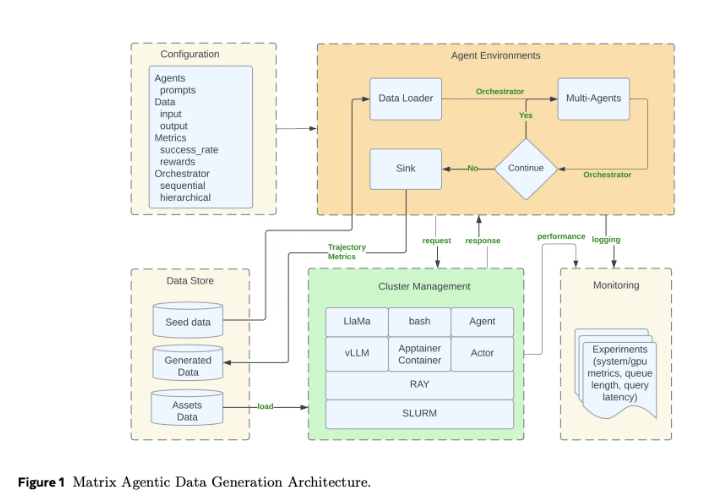
The breakthrough comes from Matrix's decentralized design:

  • Instead of a central controller, agents communicate peer-to-peer through messages
  • Each specialized agent (dialogue generator, fact checker, etc.) operates independently
  • Workflows get serialized into "scheduler" message objects passed between agents
  • Ray cluster technology handles the distributed computing heavy lifting

The results speak for themselves: in testing, Matrix generated 200 million tokens where traditional methods managed just 62 million—all while maintaining equivalent quality standards.

Real-World Performance Gains

The team demonstrated Matrix's advantages across three key scenarios:

  1. Dialogue generation: 3.2x more tokens produced for Collaborative Reasoner training
  2. Dataset creation: 2.1x throughput boost building the NaturalReasoning dataset
  3. Tool usage trajectories: Stunning 15.4x improvement in Tau2-Bench evaluations

The secret sauce? Matrix eliminates coordination overhead while optimizing resource use through clever techniques like message offloading—storing large conversation histories separately to reduce network strain.

What This Means for AI Development

As synthetic data becomes increasingly crucial for training advanced models, solutions like Matrix could dramatically accelerate progress across the field. The framework isn't just faster—its decentralized nature makes it more resilient too, with failures affecting only small parts of ongoing operations rather than bringing down entire workflows.

The team has open-sourced their work via arXiv (paper link), inviting the broader AI community to build upon their innovations.

Key Points:

  • Decentralized design avoids single-point bottlenecks plaguing current systems
  • Peer-to-peer messaging enables agents to work independently yet coordinatedly
  • 2-15x speed improvements demonstrated across multiple use cases
  • Ray cluster integration provides robust distributed computing foundation

Enjoyed this article?

Subscribe to our newsletter for the latest AI news, product reviews, and project recommendations delivered to your inbox weekly.

Weekly digestFree foreverUnsubscribe anytime

Related Articles

News

Google's Gemma 4: A Powerhouse AI Model Set to Shake Up Open-Source Landscape

Google is gearing up to unveil Gemma 4, its next-generation open-source AI model that promises four times the parameters of its predecessor. With a rumored 120 billion parameters and innovative MoE architecture, this release marks Google's strategic move to reclaim influence in the open-source AI space. The tech world watches closely as this development could redefine the balance between commercial and open-source AI models.

April 2, 2026
AI DevelopmentOpen Source TechMachine Learning
ClawHub's China Mirror Site Goes Live - AI Developers Rejoice!
News

ClawHub's China Mirror Site Goes Live - AI Developers Rejoice!

ClawHub, the popular 'npm for AI Agents,' has launched its official Chinese mirror site, bringing faster access and better stability for domestic developers. The new mirror at https://mirror-cn.clawhub.com solves previous network latency issues, making it easier than ever to share and discover AI skills. Sponsored by ByteDance's VolcanoEngine, this move signals growing localization in the AI Agent ecosystem.

April 1, 2026
AI DevelopmentOpen SourceMachine Learning
China's AI Models Make Global Waves: Doubao Nears GPT-5, Xiaomi Shines in Math
News

China's AI Models Make Global Waves: Doubao Nears GPT-5, Xiaomi Shines in Math

The latest SuperCLUE rankings reveal China's AI models are closing the gap with global leaders. ByteDance's Doubao now trails GPT-5 by less than one point, while Xiaomi's MiMo surprises with standout math performance. In open-source categories, Chinese models dominate completely, signaling a shift from language specialists to all-around competitors.

March 30, 2026
AIChinese TechMachine Learning
News

Moonshot AI's Stunning Pivot: From Tech Demo to Revenue Powerhouse

In a dramatic shift, Moonshot AI has transformed from a promising tech startup to a commercial juggernaut. The company's recent K2.5 model release generated more revenue in 20 days than all of last year, prompting a rush toward IPO preparations. With valuations soaring to $18 billion and overseas revenue surpassing domestic for the first time, China's AI landscape is witnessing a fundamental transformation from speculative investment to proven business models.

March 30, 2026
Artificial IntelligenceTech IPOMoonshot AI
News

116 AI Innovations Honored with China's Prestigious Wu Wenjun Award

China's AI community celebrated its brightest minds as the 15th Wu Wenjun Artificial Intelligence Science and Technology Award recognized 116 groundbreaking projects. The awards highlight advancements in generative AI, large models, and embodied intelligence, with top honors going to Tsinghua's Professor Sun Fuchun and Chongqing University's Academician Song Yongduan. Industry applications in autonomous driving and healthcare signal China's growing AI ecosystem.

March 30, 2026
Artificial IntelligenceWu Wenjun AwardAI Research
News

Robots Get a Crash Course in Common Sense with New AI Model

DeepMind Intelligence has unveiled PhysBrain 1.0, a breakthrough AI model that teaches robots to understand physical laws like humans do. Unlike traditional approaches that simply mimic actions, this system grasps the underlying principles of how objects interact in space and time. Developed by Beijing's Zhongguancun tech hub, the technology could help robots adapt to unpredictable real-world environments with remarkable efficiency.

March 27, 2026
Artificial IntelligenceRoboticsMachine Learning