IndexTTS2: A Breakthrough in AI-Powered Film Dubbing
IndexTTS2: The Next Generation of AI Voice Technology
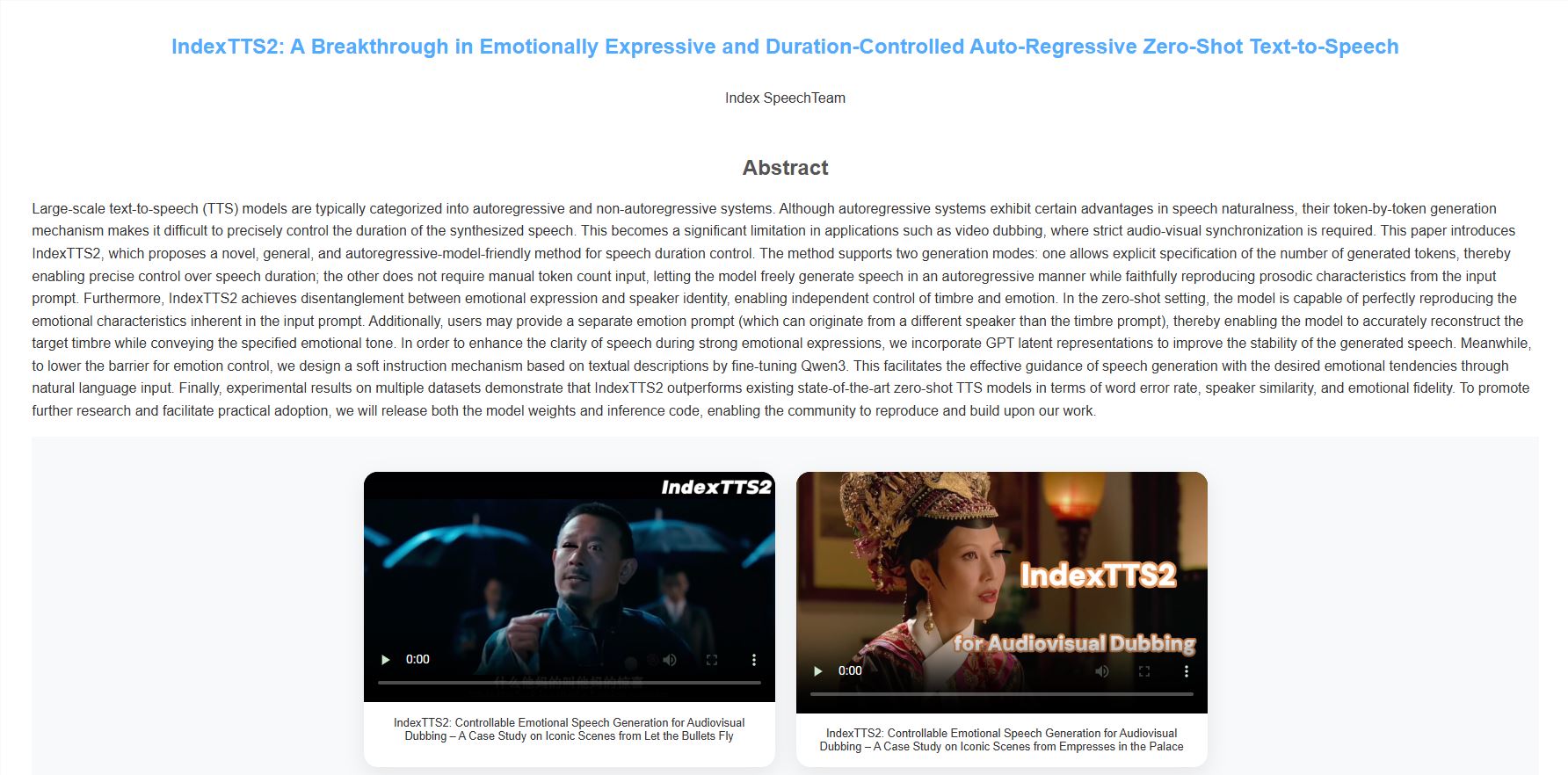
Recent advancements in Text-to-Speech (TTS) technology have reached new heights with the upcoming release of IndexTTS2, a model that reportedly achieves "film-level" quality. This development has captured significant attention across the AI and entertainment industries.
Key Features of IndexTTS2
Open Architecture for Developers
One of IndexTTS2's most notable aspects is its completely localized deployment capability with plans to open model weights. This approach gives developers unprecedented flexibility, enabling high-quality speech generation without reliance on cloud services.
Advanced Voice Cloning
The model introduces significant improvements in zero-shot voice cloning. Users can replicate a target voice's tone, style, and rhythm from just one audio sample—regardless of language—with accuracy surpassing current leading models like MaskGCT and F5-TTS.
Emotional Intelligence Breakthrough
IndexTTS2 pioneers zero-shot emotional cloning, allowing users to:
- Clone emotions from reference audio (whispering, screaming, fear, anger)
- Control emotions through simple text descriptions (e.g., "angry" or "gentle") This dual approach makes emotional voice generation more accessible than ever before.
Precision Timing for Film Applications
The model offers two duration modes:
- Precise control for exact audio lengths (critical for film dubbing)
- Automatic adjustment based on text content This flexibility makes IndexTTS2 particularly valuable for professional media production.
Technical Specifications
Currently supporting English and Chinese, IndexTTS2 uses an advanced autoregressive architecture with three core modules:
- Text-to-Semantic (T2S)
- Semantic-to-Mel Spectrogram (S2M)
- Vocoder
The integration with large language models and a "soft instruction" mechanism via Qwen3 fine-tuning ensures natural, stable speech output.
Future Developments
The development team plans to release model weights and inference code publicly, potentially accelerating global TTS innovation. This open approach could lead to rapid adoption across various industries.
Key Points
- Film-quality TTS output
- Zero-shot cloning of voices and emotions
- Precise duration control for professional dubbing
- Open-weight model for developer flexibility
- Current support for English and Chinese with potential expansion
The project is available at: IndexTTS2 GitHub