
Google's NotebookLM Now Understands Your Scribbles and Snapshots

Google's NotebookLM Gets Eyes: Image Understanding Arrives
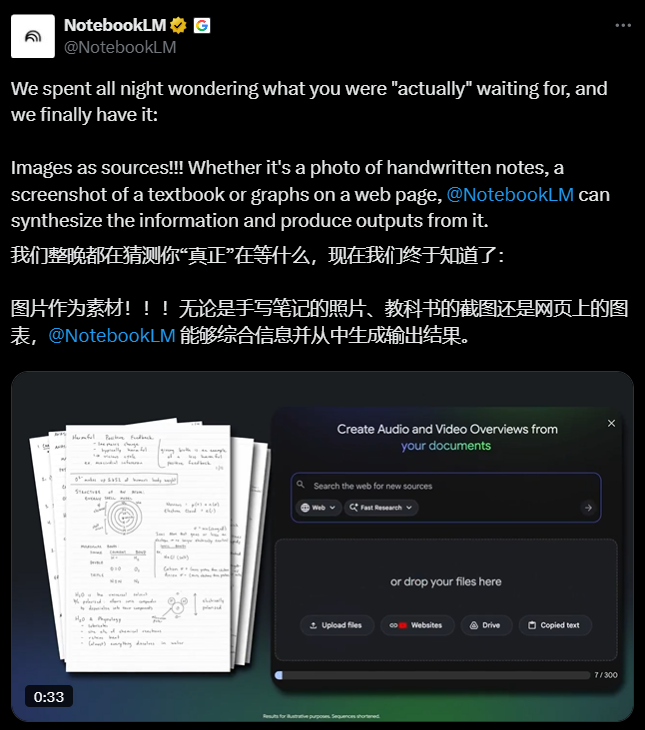
Image

Ever snapped a photo of a whiteboard crammed with formulas, only to forget what they meant later? Google's NotebookLM just solved that problem. The AI-powered note-taking tool now understands images—from hastily scribbled lecture notes to textbook pages and even coffee shop menus.

How It Works

The upgraded system uses multimodal AI to perform optical character recognition (OCR) and semantic analysis on uploaded images. What sets it apart:

  • Handwriting recognition that distinguishes between professors' scrawls and printed text
  • Table extraction that preserves complex data structures
  • Contextual linking that connects visual content with your existing notes

"Ask how the formula in the lower left corner was derived," suggests Google's demo, "and NotebookLM will not only find it but generate step-by-step explanations."

Real-World Magic

The implications are staggering:

  1. Students can photograph textbook pages and instantly query specific diagrams or values ("What does Figure 3.2 show about cell mitosis?")
  2. Researchers can capture conference whiteboards and later search by concept rather than trying to decipher handwriting
  3. Foodies can snap a restaurant menu abroad and ask "How spicy is the tom yum soup?"

The feature launched to overwhelming demand—educational accounts alone uploaded 500,000+ images in the first 48 hours, a 340% surge from previous usage patterns.

Privacy First Approach

While processing happens in the cloud initially, Google promises local processing options "in coming weeks" for sensitive materials. The company hasn't announced pricing plans yet—all image analysis currently uses existing free quotas.

Looking ahead, an AR glasses integration slated for 2026 could enable real-time "ask anything you see" functionality, potentially revolutionizing fieldwork across industries.

Key Points:

  • 📸 NotebookLM now processes images through advanced OCR and AI analysis
  • ✍️ Understands both printed materials and handwritten notes with context awareness
  • 🔍 Enables natural language queries about visual content ("Explain this formula derivation")
  • 🚀 Education sector adoption skyrocketing with 500K+ uploads in two days
  • 🕶️ AR glasses integration coming next year for real-time visual queries

Enjoyed this article?

Subscribe to our newsletter for the latest AI news, product reviews, and project recommendations delivered to your inbox weekly.

Weekly digestFree foreverUnsubscribe anytime

Related Articles

Google Gemini Brings Science to Life with Interactive 3D Models
News

Google Gemini Brings Science to Life with Interactive 3D Models

Google's Gemini AI now lets users explore science in 3D. Instead of just reading about complex concepts, learners can manipulate molecular structures, simulate physics experiments, and watch planetary orbits unfold in real-time. These interactive features respond to voice commands and allow parameter adjustments, making abstract ideas suddenly tangible. While currently unavailable for educational accounts, the tool promises to revolutionize how we visualize everything from quantum physics to fractal geometry.

April 10, 2026
AI EducationInteractive LearningSTEM Technology
Tongyi Lab's Qwen3.6-Plus Brings Stability to AI Programming
News

Tongyi Lab's Qwen3.6-Plus Brings Stability to AI Programming

Tongyi Lab has unveiled Qwen3.6-Plus, a significant upgrade to its AI programming model that tackles developers' biggest frustration: unreliable task execution. This new version shines in coding tasks and long-context understanding while maintaining impressive cost efficiency. What really excites developers is its seamless integration with popular coding tools and breakthrough visual agent capabilities that can turn design drafts into functional code.

April 2, 2026
AI ProgrammingTongyi LabQwen3.6
Alibaba's Qwen3.5-Omni Outshines Gemini with Breakthrough Multimodal Capabilities
News

Alibaba's Qwen3.5-Omni Outshines Gemini with Breakthrough Multimodal Capabilities

Alibaba has unveiled Qwen3.5-Omni, a revolutionary multimodal AI model that's setting new benchmarks. With superior performance across 215 tasks and the ability to process images, videos, audio, and text seamlessly, it outperforms Google's Gemini in key areas. What makes it stand out? Exceptional language support for 113 tongues, innovative 'speak-to-code' features, and pricing that undercuts competitors by 90%. This release signals China's growing leadership in advanced AI technologies.

March 31, 2026
AI InnovationMultimodal AIAlibaba Tech
Mysterious AI Models Emerge on OpenRouter With Trillion-Parameter Power
News

Mysterious AI Models Emerge on OpenRouter With Trillion-Parameter Power

OpenRouter has quietly introduced two enigmatic AI models—Hunter Alpha and Healer Alpha—that are sparking intense speculation. Hunter Alpha boasts a staggering trillion parameters and specializes in complex reasoning, while Healer Alpha shines in multimodal understanding. Both currently operate anonymously and offer free access, leading to intriguing theories about their origins.

March 12, 2026
AI ModelsOpenRouterMultimodal AI
Google's NotebookLM Now Turns Your Notes Into Mini Movies
News

Google's NotebookLM Now Turns Your Notes Into Mini Movies

Google's AI-powered NotebookLM just got a Hollywood makeover. The tool can now transform your research notes into cinematic video summaries, complete with smooth animations and rich visuals. Powered by Gemini 3 and Veo 3 AI models, this premium feature helps visual learners grasp complex topics through immersive storytelling. Currently English-only and available to Ultra subscribers, it signals Google's push into creative productivity tools.

March 5, 2026
NotebookLMAIvideoGoogleAI
Alibaba's New Compact AI Models Bring Powerful Capabilities to Edge Devices
News

Alibaba's New Compact AI Models Bring Powerful Capabilities to Edge Devices

Alibaba's Qwen team has unveiled a series of lightweight AI models that pack impressive capabilities into small packages. These new models, ranging from 0.8B to 9B parameters, offer multimodal processing while being optimized for edge devices like smartphones and IoT gadgets. The smallest models deliver lightning-fast performance, while the larger ones rival much bigger systems in capability - all while consuming fewer resources. Available now on popular platforms, these models could revolutionize how we deploy AI in everyday devices.

March 3, 2026
Edge AIAlibaba QwenLightweight Models