Google's AI Breakthrough: Agents Now Learn from Mistakes

Google's Revolutionary AI Framework Enables Self-Learning

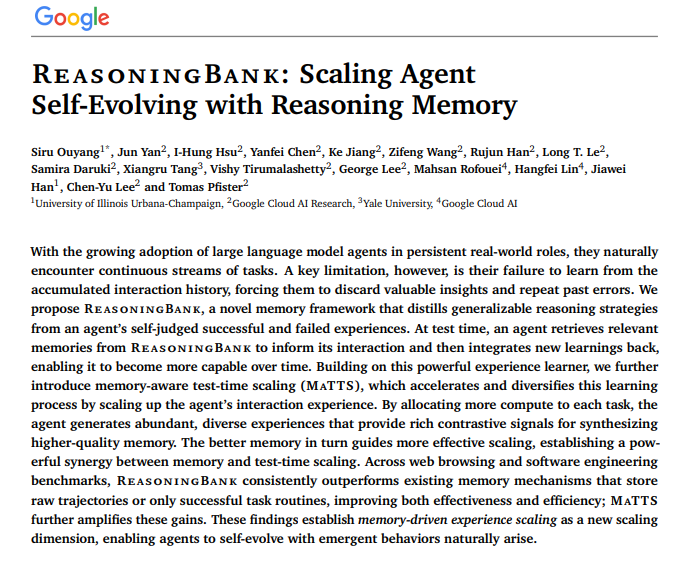
Google researchers have developed a novel "Reasoning Memory" framework that allows artificial intelligence agents to accumulate knowledge from their experiences and mistakes - marking a significant step toward truly self-improving AI systems.
Image

The Limitations of Current AI Agents

While large language model (LLM)-based agents excel at reasoning and task execution, they lack sustainable learning mechanisms. Currently, these agents essentially reset after each task completion, unable to build upon previous experiences. This leads to:

  • Repeated errors in similar scenarios
  • Wasted historical data
  • Limited decision optimization
  • Inability to form abstract generalizations

The fundamental issue lies in existing memory modules primarily serving as simple information caches rather than enabling true experiential learning.
Image

How Reasoning Memory Works

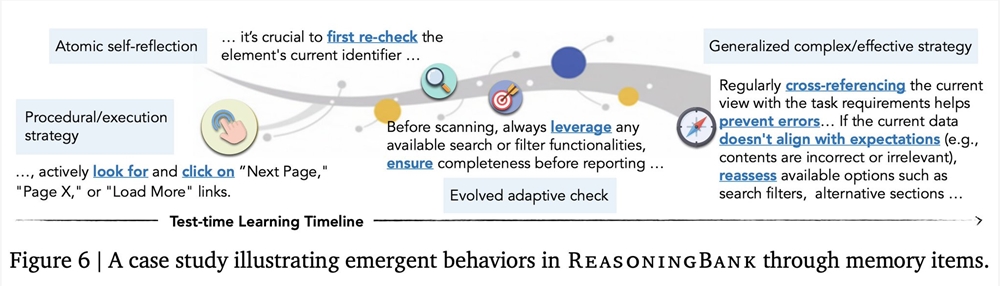
The new framework introduces three key capabilities:

  1. Experience Accumulation: Agents systematically record reasoning processes and outcomes rather than discarding task history.
  2. Generalization: Algorithms transform specific experiences into reusable rules and patterns.
  3. Optimization: Memories inform future decisions, reducing repetitive mistakes.

This creates a closed-loop system where AI agents can progressively improve their performance - much like human learning processes. Early experiments show significant performance gains in complex tasks.

Potential Applications and Implications

The Reasoning Memory framework could transform multiple industries:

  • Customer Service: Chatbots that continuously improve responses
  • Healthcare: Diagnostic tools that learn from case outcomes
  • Gaming: NPCs that adapt strategies based on player behavior

The technology addresses what researchers call the "evolutionary gap" in current LLM systems, moving closer to autonomous AI that requires less human oversight.

Challenges Ahead

While promising, the technology faces hurdles including:

  • Validating memory generalization capabilities
  • Managing computational costs
  • Ensuring reliable performance at scale

The research paper is available at arXiv.

Key Points:

  • Google's new framework enables AI to learn from experience
  • Solves critical limitation of current LLM-based systems
  • Allows accumulation and reuse of reasoning patterns
  • Potential applications across multiple industries
  • Represents progress toward autonomous AI systems
Enjoyed this article?

Subscribe to our newsletter for the latest AI news, product reviews, and project recommendations delivered to your inbox weekly.

Weekly digestFree foreverUnsubscribe anytime

Related Articles

Doubao AI Gets Major Upgrade: Faster, Cheaper and Now Open to Developers
News

Doubao AI Gets Major Upgrade: Faster, Cheaper and Now Open to Developers

Volcano Engine's Doubao Large Model 2.0 brings game-changing improvements with tenfold cost reductions and expanded capabilities. The update introduces four specialized models catering to different needs, from complex reasoning to coding assistance. Notably, its multimodal understanding now rivals top global models, excelling in video analysis and professional domains. Developers can now access these powerful tools through newly opened APIs.

February 14, 2026
AI DevelopmentMachine LearningTech Innovation
Ant Group's Trillion-Parameter AI Model Breaks New Ground
News

Ant Group's Trillion-Parameter AI Model Breaks New Ground

Ant Group has unveiled Ring-2.5-1T, a groundbreaking trillion-parameter AI model that sets new standards in mathematical reasoning and long-text processing. This open-source marvel outperforms competitors in complex tasks while dramatically improving efficiency. From solving Olympiad-level math problems to powering AI assistants, it represents a significant leap forward in artificial intelligence capabilities.

February 13, 2026
AI InnovationMachine LearningOpen Source Technology
Gemini 3 Deep Think Outsmarts All But Seven Humans in Programming
News

Gemini 3 Deep Think Outsmarts All But Seven Humans in Programming

Google's Gemini 3 Deep Think AI has made staggering leaps in programming and scientific reasoning, scoring higher than all but seven human coders worldwide. Beyond dominating Codeforces with a 3455 Elo rating, it's spotting flaws in physics papers that elude peer reviewers and solving complex mathematical conjectures. The model also revolutionizes engineering by turning rough sketches into precise 3D models ten times faster than traditional methods.

February 13, 2026
AI BreakthroughsProgrammingMachine Learning
News

OpenAI Swallows Its Pride: ChatGPT Rolls Out Ads Amid Financial Crunch

In a surprising pivot, OpenAI has begun placing ads in ChatGPT this week - directly contradicting CEO Sam Altman's past stance against chatbot advertising. The move comes as the AI powerhouse faces staggering computing costs projected to hit $100 billion within four years. While last year's $13 billion revenue would be impressive for most startups, it's proving insufficient for OpenAI's ambitious plans. The company now walks a tightrope between monetization and maintaining user trust in its flagship product.

February 13, 2026
OpenAIChatGPTAI Monetization
Anthropic Secures $3 Billion Boost Amid AI Arms Race
News

Anthropic Secures $3 Billion Boost Amid AI Arms Race

AI powerhouse Anthropic has landed a massive $3 billion Series G funding round, catapulting its valuation to $38 billion - more than double its previous worth. The investment, led by Singapore's GIC and Coatue, fuels Anthropic's battle against OpenAI for dominance in the enterprise AI market. CFO Krishna Rao says the funds will accelerate development of their Claude AI platform that's becoming essential for businesses worldwide.

February 13, 2026
Artificial IntelligenceVenture CapitalTech Industry
News

Google's Gemini 3 Takes AI Reasoning to New Scientific Heights

Google has unveiled Gemini 3 Deep Think, marking a significant leap in AI capabilities beyond everyday conversations. This specialized model tackles complex scientific problems with Olympiad-level reasoning skills, scoring impressively on mathematical and programming challenges. Available now for select researchers and Google AI Ultra subscribers, it promises to transform from benchmark champion to actual lab partner.

February 13, 2026
AI ResearchMachine LearningScientific Computing