DeepSeek's New OCR Model Reads Documents Like Humans Do

DeepSeek-OCR2: A Smarter Way for Machines to Read
Image

Imagine flipping through a dense research paper - your eyes naturally jump between headings, tables, and key paragraphs rather than reading every word sequentially. That's exactly how DeepSeek's new OCR model now operates.

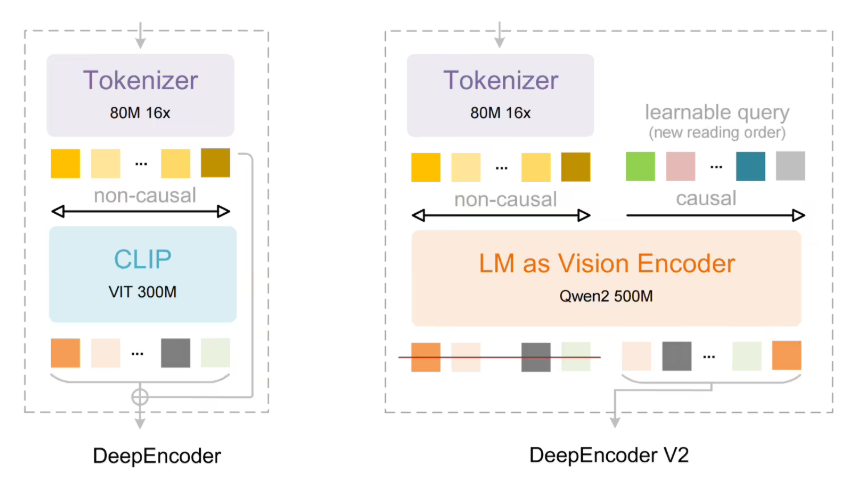
The recently launched DeepSeek-OCR2 represents a significant leap forward in document recognition technology. At its core lies the innovative DeepEncoder V2, which replaces rigid left-to-right scanning with intelligent "visual causal flow" processing.

How It Works Differently

Traditional OCR systems treat documents like simple grids, processing content mechanically from top-left to bottom-right. This often leads to jumbled outputs with tables misread as plain text or formulas losing their structure.

DeepSeek-OCR2 changes the game by:

  • Analyzing document layouts semantically before recognition
  • Dynamically adjusting its reading path based on content importance
  • Preserving logical relationships between different elements

The system essentially teaches machines to "skim" documents first - identifying structural patterns humans instinctively recognize before diving into detailed text extraction.

Measurable Improvements

Independent benchmark tests tell a compelling story:

  • 91.09% accuracy on OmniDocBench v1.5 (3.73% better than v1)
  • Fewer sequencing errors in complex layouts (measured by edit distance)
  • Reduced repetition rates during batch processing of PDFs

The model achieves these gains while maintaining computational efficiency through its mixture-of-experts (MoE) architecture - proving you don't always need brute-force power for smarter results.

Real-World Impact

For businesses drowning in paperwork, these technical advances translate to:

  • More reliable digitization of financial reports and legal contracts
  • Better preservation of scientific formulas and research data structures
  • Reduced manual correction time for archival projects

The technology shows particular promise for Asian language documents where complex layouts traditionally challenged OCR systems.

Key Points:

  • Human-like reading patterns: Processes content based on meaning rather than fixed sequences
  • Structural awareness: Maintains relationships between tables, text blocks and formulas
  • Efficient architecture: Delivers accuracy improvements without heavy resource demands
  • Practical benefits: Reduces error rates in batch processing scenarios

Enjoyed this article?

Subscribe to our newsletter for the latest AI news, product reviews, and project recommendations delivered to your inbox weekly.

Weekly digestFree foreverUnsubscribe anytime

Related Articles

News

Tesla Shifts Gears: Farewell to Model S/X as Fremont Goes All-In on Robots

Tesla's latest earnings call brought seismic changes - the iconic Model S and X are being phased out as the company doubles down on AI and robotics. Their Fremont factory will transform into an Optimus robot production hub, aiming for a staggering 1 million units annually. While automotive revenue dipped slightly in Q4 ($24.9 billion), energy sector growth (up 25%) and massive AI investments signal Tesla's bold pivot toward becoming a 'physical AI company.'

January 29, 2026
TeslaElectric VehiclesRobotics
News

Waabi Accelerates Into Robotaxi Race With $1B Boost From Uber

Autonomous vehicle pioneer Waabi just shifted into high gear, securing a massive $1 billion investment round backed by Uber. The funding catapults the Toronto-based startup from trucking into the competitive robotaxi arena, with plans to deploy 25,000 driverless cabs on Uber's platform. What sets Waabi apart? Their AI learns primarily in simulation rather than through endless real-world testing - potentially rewriting the rulebook for self-driving tech.

January 29, 2026
Autonomous VehiclesWaabiUber
News

AI Architecture Debate: Mistral Claims Influence Over DeepSeek's Design

A tech controversy erupted when Mistral CEO Arthur Mensch suggested China's DeepSeek-V3 model borrowed from their architecture. The claim sparked scrutiny as developers noted near-simultaneous paper releases and fundamental design differences. Interestingly, some argue Mistral's later models actually adopted DeepSeek innovations, flipping the narrative.

January 26, 2026
AIArchitectureMistralDeepSeek
News

Mobileye Drives Forward with Strong Growth Amid Autonomous Vehicle Push

Mobileye, the Intel-owned autonomous driving tech leader, posted impressive 2025 results with revenue climbing 15% to $1.89 billion. The company saw operating cash flow jump 51% while securing $24.5 billion in future orders. Beyond cars, Mobileye is expanding into robotics through its Mentee Robotics acquisition and preparing for commercial robotaxi launches.

January 26, 2026
autonomous vehiclesMobileyeautomotive tech
North Korean Hackers Weaponize AI Against Blockchain Experts
News

North Korean Hackers Weaponize AI Against Blockchain Experts

Security researchers uncovered a disturbing trend: North Korea's Konni hacking group is now using AI-generated malware to target blockchain engineers across Asia. Their sophisticated attacks begin with Discord phishing links, deploying eerily efficient scripts that steal cryptocurrency credentials. This marks a dangerous evolution in cybercrime tactics.

January 26, 2026
cybersecurityAIblockchain
Musk's Davos Surprise: Tesla Robots Could Be in Homes by 2027
News

Musk's Davos Surprise: Tesla Robots Could Be in Homes by 2027

Elon Musk made waves at Davos with a bold prediction - Tesla's Optimus robots will be ready for household use by late 2027. While currently handling simple factory tasks, Musk envisions these humanoid assistants caring for kids and elders within three years. But experts caution about production challenges and unanswered questions about real-world performance.

January 23, 2026
TeslaRoboticsAI