Chinese AI Models Narrow Gap With Global Leaders in Latest Rankings

Chinese AI Models Show Promise Against Global Competitors

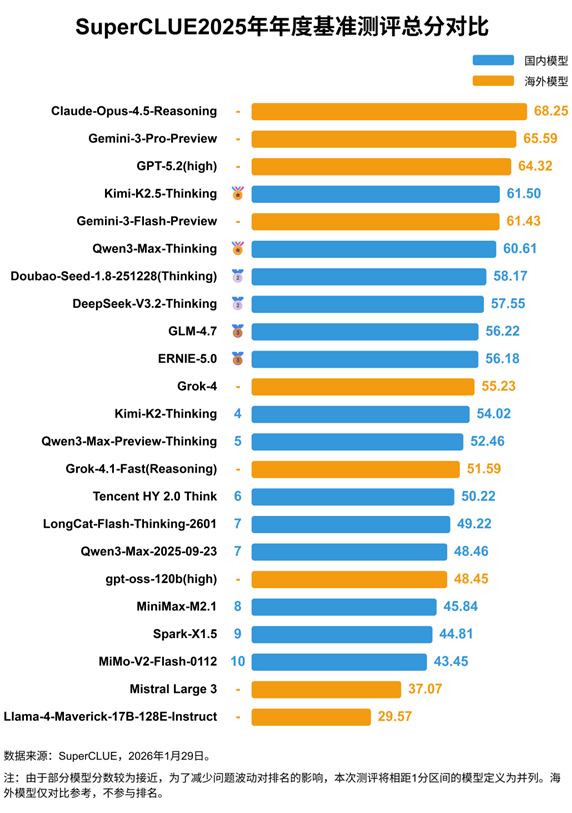
The artificial intelligence race just got more interesting. SuperCLUE's newly released 2025 evaluation of 23 top Chinese-language models reveals a landscape where domestic developers are rapidly catching up to established international players—and even surpassing them in crucial niches.
Image

The Global Leaders Maintain Their Edge

Anthropic's Claude-Opus-4.5-Reasoning topped the charts with an impressive 68.25 score, demonstrating particular strength in logical reasoning tasks. Close behind were Google's Gemini-3-Pro-Preview and OpenAI's GPT-5.2, forming what analysts call the "global elite tier" of Chinese-language AI capabilities.

"These results confirm that US-based companies still hold advantages in general reasoning and comprehension," explains Dr. Lin Wei, an AI researcher at Tsinghua University. "But the gap isn't what it was two years ago."

China's Rising Stars Shine Bright

The real story emerges further down the rankings. Domestic models Kimi-K2.5-Thinking and Qwen3-Max-Thinking cracked the global top ten, placing fourth and sixth respectively—a first for Chinese-developed AI systems.

Even more remarkably:

  • Kimi dominated global competitors in code generation tasks
  • Qwen3 tied Google for first place in mathematical reasoning

"We're seeing specialization pay off," notes Shanghai-based tech analyst Michelle Zhao. "Chinese teams have focused intensely on areas where they can leapfrog rather than just follow."

Open Source: China's Secret Weapon?

The most surprising finding might be China's open-source dominance. Five domestic open-source models outperformed all international alternatives—a stark reversal from previous years.

This suggests China's collaborative development approach could become its competitive advantage as:

  • Local developers share innovations more freely
  • Academic institutions contribute cutting-edge research
  • Companies build upon shared foundational models

The result? An ecosystem that appears to be maturing faster than many anticipated.

Key Points:

  • 🏆 Global leaders hold steady: Claude-Opus leads overall rankings with strong reasoning capabilities
  • 🚀 Chinese models find their niches: Breakthrough performances in coding (Kimi) and math (Qwen3)
  • 🌐 Open-source advantage: Domestic collaborative models now outperform foreign alternatives

Enjoyed this article?

Subscribe to our newsletter for the latest AI news, product reviews, and project recommendations delivered to your inbox weekly.

Weekly digestFree foreverUnsubscribe anytime

Related Articles

Zhipu's GLM-4.7-Flash Hits 1M Downloads in Record Time
News

Zhipu's GLM-4.7-Flash Hits 1M Downloads in Record Time

Zhipu AI's latest open-source model GLM-4.7-Flash has taken the developer community by storm, surpassing one million downloads on Hugging Face within just two weeks. This lightweight powerhouse outperforms competitors in key benchmarks while offering developers an efficient, cost-effective solution for AI applications.

February 4, 2026
AI ModelsOpen SourceMachine Learning
News

China's AI Models Break New Ground in Tech and Investment

China's AI sector is making waves globally, with groundbreaking research published in 'Nature' and open-source models leading worldwide downloads. Companies are turning AI innovations into profitable ventures, attracting significant investor interest. From smart traffic solutions to media production, Chinese firms are demonstrating how artificial intelligence can drive real-world success.

February 4, 2026
Artificial IntelligenceChinese TechInvestment Trends
News

AI's Learning Gap: Why Machines Can't Grow from Failure Like Humans

A former OpenAI researcher reveals a critical flaw in today's AI systems: they can't learn from mistakes. Jerry Tworek, who helped develop key models at OpenAI, explains why this inability to adapt threatens progress toward true artificial general intelligence. Unlike humans who evolve through trial and error, current AI hits a wall when facing unfamiliar challenges - forcing experts to rethink fundamental architectures.

February 3, 2026
Artificial IntelligenceMachine LearningAGI
News

DeepMind Pioneer Bets on AI That Learns Like Humans

David Silver, the visionary behind DeepMind's AlphaGo, has left Google to pursue his bold new vision for artificial intelligence. His startup Ineffable Intelligence champions reinforcement learning - AI that learns through experience rather than just absorbing human knowledge. This departure signals a growing divide in AI research approaches as top talent explores alternatives to today's dominant large language models.

February 2, 2026
Artificial IntelligenceMachine LearningTech Startups
Tsinghua AI Whiz Joins Tencent to Supercharge Multimodal Learning
News

Tsinghua AI Whiz Joins Tencent to Supercharge Multimodal Learning

Tencent's AI ambitions get a major boost as Peng Tianyu, a rising star in machine learning from Tsinghua University, joins their Tongyi team. The 31-year-old prodigy brings expertise in reinforcement learning and multimodal systems, fresh from his stint at Sea AI Lab in Singapore. This marks another strategic hire for Tencent following their recent acquisition of an OpenAI researcher.

January 30, 2026
TencentAI ResearchMachine Learning
News

SenseTime's New AI Model Thinks Like a Detective

SenseTime has unveiled SenseNova-MARS, an open-source AI model that combines visual reasoning with text-image search capabilities. Outperforming GPT-5.2 on multiple benchmarks, this innovative technology mimics human-like investigation skills - zooming in on tiny details, connecting information dots, and solving complex problems autonomously. The company has made both the 8B and 32B versions publicly available for developers worldwide.

January 30, 2026
AI InnovationComputer VisionMachine Learning