
China Telecom's GVC tech squeezes videos to 0.02% size without losing quality

The Tiny Future of Video: How China Telecom's AI Compresses 1GB to 200KB
Image

Imagine watching a crystal-clear HD video that traveled through space or disaster zones using less data than a single smartphone photo. That's the promise of China Telecom's new Generative Video Compression (GVC) technology, which achieves what sounds impossible - compressing video files to just 0.02% of their original size.

How It Works: Teaching AI to 'Paint' Videos

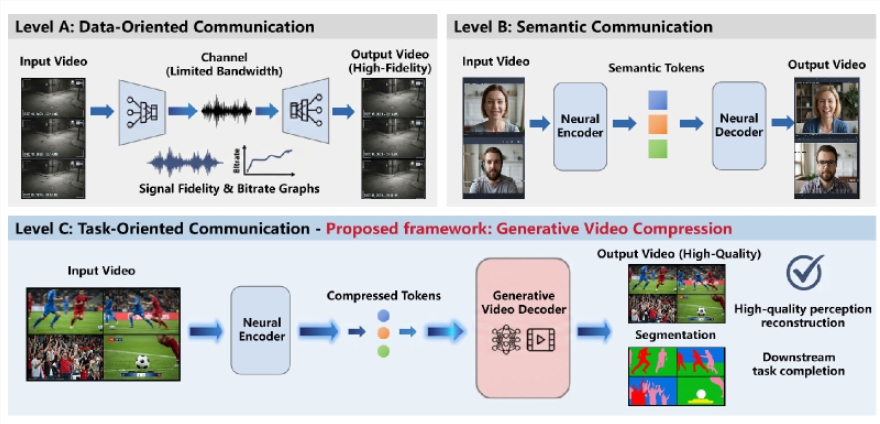
The secret lies in flipping traditional compression on its head. Where current methods like H.265 meticulously rearrange pixels, GVC takes a radically different approach:

  • No more pixel pushing: Instead of transporting complete images, it sends compact "how-to-draw" instructions called Tokens
  • AI reconstruction: At the receiving end, a pre-trained generative model acts like a digital painter, recreating videos from these Tokens
  • World knowledge advantage: The system leverages its understanding of how objects move and interact (like waves crashing or balls bouncing) to fill in details

"We're essentially trading computing power for bandwidth," explains the TeleAI research team behind the breakthrough. This shift means videos can now traverse connections too weak for conventional streaming without freezing or breaking apart.

Real-World Impact: From Space to Disaster Zones

The implications are staggering for scenarios where bandwidth comes at a premium:

  • Space communications: Future Mars missions could send HD footage using less data than a text-heavy email
  • Emergency response: Rescue teams in disaster areas could share crucial video even with barely-there signals
  • Remote medicine: Surgeons could guide procedures via high-quality video from locations with primitive internet infrastructure

Early benchmarks show GVC delivering comparable visual quality while using six times less bandwidth than top conventional codecs. Perhaps most impressively, it already runs smoothly on consumer hardware like RTX4090 graphics cards - no supercomputer required.

The team acknowledges current limitations; complex scenes with unpredictable elements still challenge the system. But as generative AI continues its rapid evolution, so too will GVC's capabilities.

Key Points:

  • 🚀 Radical compression: Turns 1GB videos into 200KB data packets without quality loss
  • 🎨 AI reconstruction: Uses generative models to "repaint" videos from compact instructions
  • 🌍 Bandwidth revolution: Enables HD video in extreme environments from deep space to disaster zones
Enjoyed this article?

Subscribe to our newsletter for the latest AI news, product reviews, and project recommendations delivered to your inbox weekly.

Weekly digestFree foreverUnsubscribe anytime

Related Articles

News

Software Giant IgniteTech's Radical AI Pivot: 80% Workforce Cut Sparks Industry Debate

IgniteTech CEO Eric Vaughan made waves by revealing the company laid off 80% of employees who resisted its aggressive AI transformation. The controversial strategy included mandatory 'AI Mondays' and ultimately replaced reluctant staff with AI-focused talent. While painful, the move appears to be paying off with new patents and soaring profits - raising tough questions about workforce adaptation in the AI era.

January 13, 2026
AI transformationworkforce disruptioncorporate restructuring
News

AI Short Dramas Poised for Takeoff as Tech Giants Roll Out Game-Changing Tools

The short drama landscape is about to transform dramatically. Leading platforms like Wenxuan Group and Chinese Online have unveiled revolutionary AI-powered production tools that automate everything from scripting to final edits. These innovations promise to slash production times while maintaining character consistency across episodes - a longtime industry headache. With TikTok's incentive programs fueling demand, experts predict an explosion of high-quality 3D short dramas by 2026, creating new opportunities for IP holders and tech-savvy creators alike.

January 13, 2026
AI video productionshort form contentdigital entertainment
News

Alibaba's Wanxiang 2.6 Brings Hollywood-Style Video Creation to Your Fingertips

Alibaba has unveiled its latest AI video generation model, Wanxiang 2.6, packed with groundbreaking features that could revolutionize digital storytelling. The update introduces China's first 'role-playing' function, allowing users to insert themselves into professionally-shot videos with just a simple prompt. With extended 15-second clips, multi-shot control, and cinematic-quality output, this tool blurs the line between amateur creation and professional filmmaking.

December 16, 2025
AI video generationdigital storytellingAlibaba Cloud
Google's Doppl App Debuts AI Shopping Videos Without Human Models
News

Google's Doppl App Debuts AI Shopping Videos Without Human Models

Google has launched a bold new shopping feature in its experimental Doppl app - entirely AI-generated fashion videos that let users click straight to checkout. These 15-second clips showcase virtual models wearing clothes you can actually buy, skipping influencers entirely. While innovative, the approach raises questions about digital authenticity and style diversity.

December 9, 2025
AI shoppingvirtual commercegenerative AI
New York Times Takes Legal Action Against AI Startup Over Content Scraping
News

New York Times Takes Legal Action Against AI Startup Over Content Scraping

The New York Times has filed a lawsuit against AI search company Perplexity, alleging unauthorized use of copyrighted content. The complaint cites nearly 180,000 visits to NYTimes.com in one month and accuses Perplexity of reproducing articles almost verbatim through its AI system. This marks the second major copyright lawsuit by the Times against AI companies, following their case against OpenAI/Microsoft last year.

December 9, 2025
AI copyrightNew York TimesPerplexity
News

George R.R. Martin Takes ChatGPT to Court Over Alleged Copyright Infringement

Fantasy author George R.R. Martin has filed a lawsuit against OpenAI and Microsoft, claiming ChatGPT may have used his 'A Song of Ice and Fire' series without permission. The legal battle highlights growing tensions between creators and AI companies over copyright issues in the age of generative AI.

November 17, 2025
copyright lawgenerative AIliterary lawsuits