ChatTutor Brings AI Teaching to Life with Real-Time Drawing
ChatTutor Revolutionizes Learning with Visual AI Teaching
The landscape of AI education has taken a dramatic leap forward with the launch of ChatTutor. Unlike traditional text-based AI tutors, this innovative system combines verbal explanations with real-time visual demonstrations, creating an experience remarkably similar to learning from a human teacher.
Bringing Concepts to Life Through Drawing
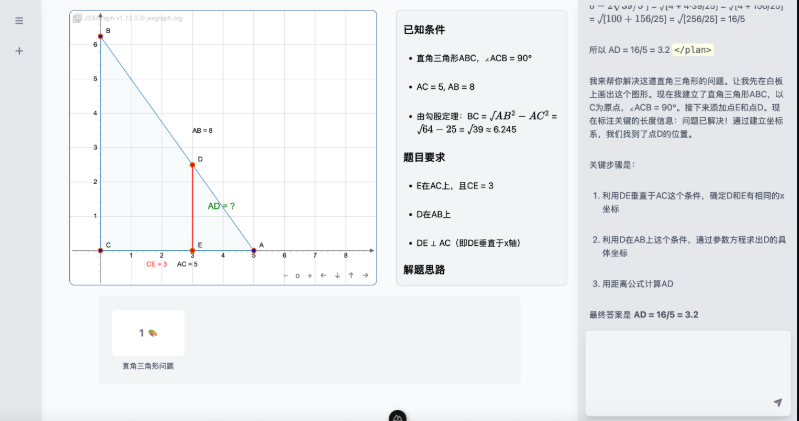
Imagine asking "How do quadratic functions work?" and seeing the AI not just explain verbally, but dynamically sketch curves on screen, mark vertices with precision, and animate transformations before your eyes. That's exactly what ChatTutor delivers - turning abstract mathematical concepts into clear visual logic.
"It's like having a personal tutor who can instantly illustrate any concept you're struggling with," explains one beta tester. "The drawings appear naturally as the explanation unfolds, just like when my favorite math teacher used to work through problems on the whiteboard."
Five Powerful Teaching Modes
The system's versatility stems from its multimodal generation technology:
- Math Made Visual: Instantly generates function graphs and geometric constructions that respond dynamically to parameter changes
- Physics Experiments Without Labs: Creates detailed force diagrams and motion simulations that make Newton's laws tangible
- Hands-On Circuit Design: Lets users build and test digital circuits through intuitive drag-and-drop interfaces
- Code That Teaches Itself: Explains programming concepts line-by-line in Python and JavaScript while highlighting execution flow
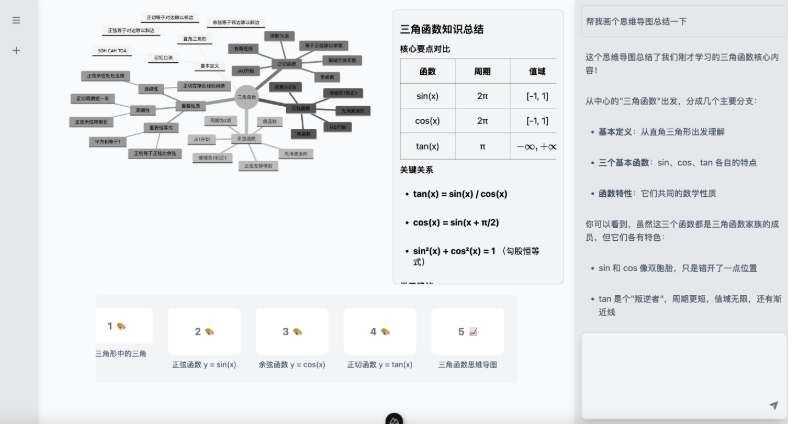
- Concept Mapping Simplified: Automatically organizes complex ideas into clear visual structures perfect for study or collaboration
Testing Against Human Teachers
The developers put ChatTutor through rigorous comparisons with human educators. When explaining inclined plane physics using Newton's second law, the AI impressed evaluators by:
- Drawing precise diagrams showing gravitational components
- Using color-coding to distinguish vector directions
- Breaking down acceleration formulas step-by-step
- Maintaining perfect pacing throughout explanations
The result? Test subjects understood concepts faster and retained information better compared to traditional text-only AI tutors.
From Answers to Understanding
"Previous educational AIs could tell you what something was," notes Dr. Lisa Chen, an educational technology researcher not involved with the project. "ChatTutor shows you why it works that way - that's fundamentally different."
The secret lies in built-in pedagogical techniques borrowed from master teachers: scaffolding complex ideas, providing timely feedback, and most importantly - making abstract concepts visually concrete.
The implications are profound for students struggling with STEM subjects worldwide. As one high school physics teacher remarked after testing the system: "This could be revolutionary for visual learners who've always struggled with textbook explanations alone."
The open-source project invites educators and developers to contribute at GitHub. With plans expanding beyond STEM subjects soon, ChatTutor may well represent the future of personalized digital learning.