Apple's STARFlow-V Takes a Radical Approach to Stable Video Generation

Apple Bets on Normalizing Flow for Next-Gen Video AI

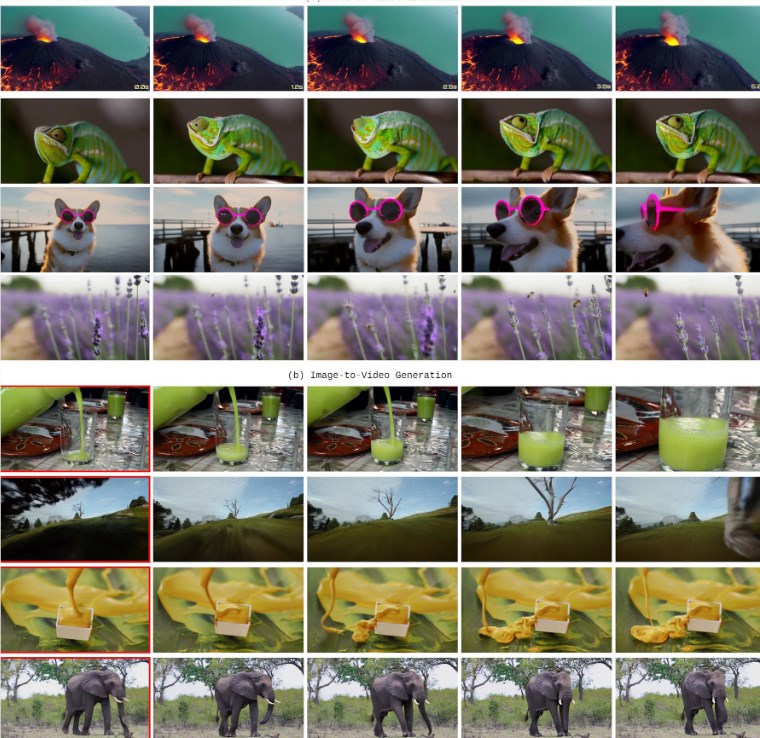
In a surprising departure from industry trends, Apple has introduced STARFlow-V, a video generation model that completely bypasses the diffusion technology powering most competitors. Instead, it relies on normalizing flow - a mathematical approach that directly transforms random noise into coherent video frames.
Image

Why Normalizing Flow Matters

While diffusion models like those in Sora or Runway gradually refine videos through multiple noisy iterations, STARFlow-V takes a more direct route. Imagine teaching someone to paint by showing completed masterpieces rather than having them erase and redraw repeatedly - that's essentially how this technology differs.

The benefits are tangible:

  • Training happens in one go, eliminating the need for countless small adjustments
  • Generation is nearly instantaneous after training completes
  • Fewer errors creep in without iterative processing steps

Apple claims STARFlow-V matches diffusion models in quality while being about 15 times faster at producing five-second clips than its initial prototypes.

Solving the Long Video Puzzle

The real breakthrough comes in handling longer sequences. Most AI video tools struggle beyond a few seconds as errors compound frame by frame. STARFlow-V tackles this with an innovative dual architecture:

  • One system maintains consistent motion across frames
  • Another polishes details within individual frames

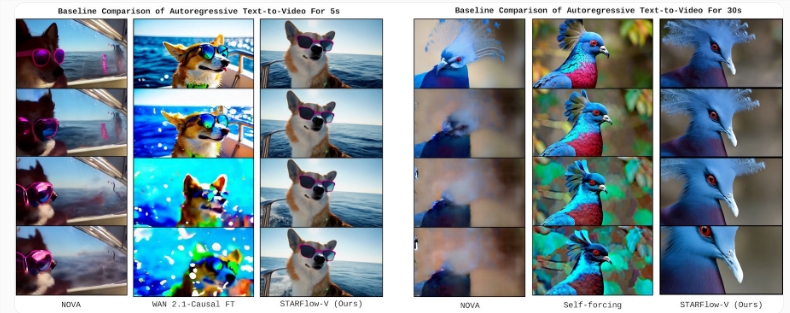
The result? Stable 30-second demonstrations where competing models start showing blur or distortion within seconds.
Image

Capabilities and Limitations

The model handles multiple tasks out of the box:

  • Creating videos from text prompts
  • Animating still images
  • Editing existing footage by adding or removing objects

Benchmark tests reveal STARFlow-V scoring 79.7 points on VBench - respectable but trailing leaders like Veo3 (85.06). However, it significantly outperforms other autoregressive models, particularly in rendering spatial relationships and human figures realistically.

The current version isn't perfect though:

  • Resolution tops out at modest 640×480 pixels
  • Standard GPUs can't handle real-time processing yet
  • Physical simulations sometimes glitch (think octopuses phasing through glass)

Apple acknowledges these limitations and plans to focus on speed optimization, model compression, and incorporating more physically accurate training data moving forward. The company has already published code on GitHub with model weights coming soon to Hugging Face.

Key Points:

  • Apple's STARFlow-V uses normalizing flow instead of diffusion models
  • Achieves stable 30-second videos where competitors falter
  • Processes frames directly rather than iteratively refining them
  • Currently trails top models slightly in benchmark scores
  • Available soon via Hugging Face with code already on GitHub

Enjoyed this article?

Subscribe to our newsletter for the latest AI news, product reviews, and project recommendations delivered to your inbox weekly.

Weekly digestFree foreverUnsubscribe anytime

Related Articles

Kling AI 3.0 Unleashed: Bringing Cinematic Magic Within Reach
News

Kling AI 3.0 Unleashed: Bringing Cinematic Magic Within Reach

Kling AI's latest 3.0 version transforms video creation with smart storyboarding and extended clips up to 15 seconds. The update introduces film-grade lighting tech for stunning 4K images and simplifies multi-image style blending. Currently available for Black Gold members, these tools promise to democratize professional-quality storytelling.

February 5, 2026
AI video generationcreative toolsdigital storytelling
Kunlun Wanwei's Open-Source Video AI Takes Creativity to New Heights
News

Kunlun Wanwei's Open-Source Video AI Takes Creativity to New Heights

Chinese tech firm Kunlun Wanwei has unveiled SkyReels-V3, an open-source video generation model that's turning heads in the AI community. This versatile tool combines image-to-video conversion, cinematic-style extensions, and lifelike virtual avatars in one package. Early tests show it outperforms commercial rivals in visual quality and consistency. Best of all? It's free to use—for now.

January 29, 2026
AI video generationopen source AImultimodal models
Kling AI's Video Revolution: How a Feature Sparked Global Adoption
News

Kling AI's Video Revolution: How a Feature Sparked Global Adoption

Kuaishou's Kling AI has taken the video creation world by storm, with its user base skyrocketing to 12 million monthly active users in early 2026. The secret? A clever 'Motion Control' feature that turned pet videos into a global phenomenon. Revenue smashed expectations, hitting $140 million in 2025 - more than double initial projections. Now topping download charts in 40 countries, this tool is proving that AI-generated content has reached a turning point.

January 21, 2026
AI video generationKling AIcontent creation tools
News

AI Brings Stories to Life: Yuedao and Shengshu Team Up for Next-Gen Film Tech

China's entertainment landscape gets a tech boost as Yuedao partners with Shengshu Technology to revolutionize IP visualization. Their collaboration integrates Shengshu's Vidu video generation model into Yuedao's creative platform, transforming text into dynamic visuals with unprecedented ease. Beyond technology, the duo tackles industry talent gaps through specialized education programs, creating a complete ecosystem from creation to production.

January 13, 2026
AIGCdigital storytellingAI video generation
ByteDance's StoryMem Gives AI Videos a Memory Boost
News

ByteDance's StoryMem Gives AI Videos a Memory Boost

ByteDance and Nanyang Technological University researchers have developed StoryMem, an innovative system tackling persistent issues in AI video generation. By mimicking human memory mechanisms, it maintains character consistency across scenes - a challenge even for models like Sora and Kling. The solution cleverly stores key frames as references while keeping computational costs manageable. Early tests show significant improvements in visual continuity and user preference scores.

January 4, 2026
AI video generationByteDancecomputer vision
ByteDance's StoryMem Brings Consistency to AI-Generated Videos
News

ByteDance's StoryMem Brings Consistency to AI-Generated Videos

ByteDance and Nanyang Technological University researchers have developed StoryMem, a breakthrough system tackling character consistency issues in AI video generation. By intelligently storing and referencing key frames, the technology maintains visual continuity across scenes - achieving 28.7% better consistency than existing models. While promising for storytelling applications, the system still faces challenges with complex multi-character scenes.

January 4, 2026
AI video generationByteDancecomputer vision