
Ant Group Open-Sources Ming-lite-omni, Rivaling GPT-4o

Ant Group's Bai Ling team has made waves in the AI community by fully open-sourcing its Ming-lite-omni multimodal large model. Announced during Ant Technology Day, this strategic move represents a major step in making advanced AI technology accessible worldwide while challenging proprietary systems like OpenAI's GPT-4o.
Image

Technical Specifications Break New Ground

The model builds upon Ant's Ling-lite foundation using an innovative MoE (Mixture of Experts) architecture. With 22 billion total parameters and 3 billion active parameters, Ming-lite-omni sets a new benchmark for open-source multimodal models. Developers now have access to the complete model weights and inference code, with training materials scheduled for future release.

Consistent Open-Source Commitment

This release continues Ant Group's pattern of technological transparency:

  • Earlier this year saw open-sourcing of Ling-lite and Ling-plus language models
  • The Ming-lite-uni multimodal model became publicly available
  • May's Ling-lite-1.5 version demonstrated SOTA-level capabilities

The team has particularly emphasized their success in training high-performance models using non-high-end computing platforms, proving that cutting-edge AI development doesn't require exclusive access to premium hardware.

Performance That Challenges Industry Leaders

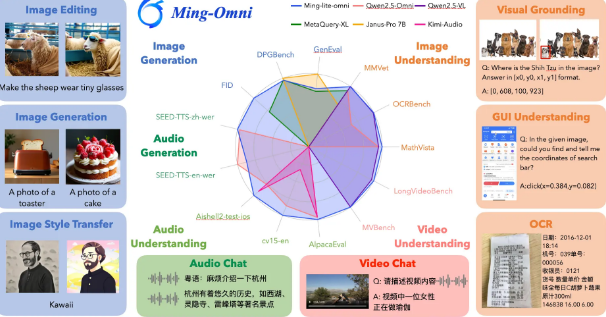
Independent evaluations place Ming-lite-omni's capabilities on par with leading 10B-scale multimodal models. The Bai Ling team asserts this represents the first open-source alternative matching GPT-4o's modality support - potentially reshaping how developers approach multimodal AI projects worldwide.

"Our MoE architecture implementation," explains Bai Ling leader Xiting, "combined with strategic use of domestic GPU resources, demonstrates we can achieve GPT-4o level performance without relying on specialized infrastructure."

The implications are significant for global AI development. By removing proprietary barriers while maintaining competitive performance, Ant Group may have altered the landscape for accessible advanced AI systems.

Key Points

  1. Ming-lite-omni offers 22B parameters with 3B active via MoE architecture
  2. Complete weights and inference code now available to developers
  3. Represents Ant Group's latest step in ongoing open-source strategy
  4. Performance benchmarks comparable to leading proprietary models
  5. Demonstrates viability of non-premium computing platforms for advanced AI

Enjoyed this article?

Subscribe to our newsletter for the latest AI news, product reviews, and project recommendations delivered to your inbox weekly.

Weekly digestFree foreverUnsubscribe anytime

Related Articles

India's Alpie AI Model Makes Waves - But Is It Truly Homegrown?
News

India's Alpie AI Model Makes Waves - But Is It Truly Homegrown?

A new AI contender from India called Alpie is turning heads with performance that rivals giants like GPT-4o and Claude3.5 in math and coding tests. However, technical analysis reveals it's actually built on a Chinese open-source model, raising questions about innovation versus optimization. What makes Alpie special is its ability to run efficiently on consumer hardware, potentially democratizing AI access for smaller developers.

January 15, 2026
AIMachine LearningIndia Tech
News

Tailwind CSS Crisis: How AI Boom Left Developers Divided

Tailwind CSS, the beloved utility-first framework, faces an existential paradox. While its adoption hits record highs thanks to AI coding tools, these same technologies have gutted its revenue streams - triggering massive layoffs. Founder Adam Wathan reveals documentation traffic dropped 40% as developers bypass official channels entirely. The crisis sparks urgent debates about open-source sustainability in the AI era.

January 12, 2026
TailwindCSSOpenSourceAIEthics
Mugen3D Turns Single Photos Into Stunning 3D Worlds
News

Mugen3D Turns Single Photos Into Stunning 3D Worlds

A groundbreaking AI tool called Mugen3D is transforming how we create 3D content. Using advanced 3D Gaussian Splatting technology, it can generate remarkably realistic models from just one image - capturing textures, lighting, and materials with astonishing accuracy. This innovation promises to democratize 3D creation across industries from gaming to e-commerce.

January 12, 2026
AIComputerGraphicsDigitalCreation
News

Qualcomm and Google Join Forces to Revolutionize Car Tech with AI

Qualcomm and Google are teaming up to tackle one of the automotive industry's biggest headaches: fragmented in-car systems. Their new 'Automotive AI Agent' combines Qualcomm's Snapdragon Digital Chassis with Google's Android Automotive OS, promising smoother development and smarter features like facial recognition. The partnership also introduces cloud-based development tools that could cut R&D time significantly. This collaboration marks a major step toward more unified, intelligent vehicle systems.

January 9, 2026
automotive-techAIsmart-cars
News

Tailwind's AI Paradox: Soaring Popularity, Plummeting Profits

Tailwind Labs faces a cruel irony - while its CSS framework enjoys record-breaking adoption thanks to AI tools generating Tailwind code, the company has slashed 75% of its engineering team. As AI agents bypass documentation pages, traffic dropped 40%, causing revenue to nosedive nearly 80%. Founder Adam Wathan calls this 'AI's brutal impact' on traditional open-source business models.

January 9, 2026
TailwindCSSOpenSourceAIDisruption
ChatGPT Steps Into Healthcare as Ant Group's AI Doctor Hits 30 Million Users
News

ChatGPT Steps Into Healthcare as Ant Group's AI Doctor Hits 30 Million Users

OpenAI has entered the AI healthcare race with ChatGPT Health, launching features similar to Ant Group's popular Afu app. The Chinese platform now serves 30 million monthly users, doubling its base in just one month. Both tools offer health Q&A and smart device integration, though Afu maintains an edge with full medical service connections.

January 8, 2026
AIHealthcareDigitalWellnessChatGPT