
Alipay's New AI Shopping Protocol Makes Chat-to-Checkout a Reality

China Takes Lead in AI-Assisted Commerce with New Protocol

In a move that could redefine digital shopping experiences, Alipay unveiled its Agentic Commerce Trust Protocol (ACT) on January 16 through partnerships with Qwen App, Taobao Flash Sale, Rokid, Damaic, and Alibaba Cloud Bailing. This pioneering framework creates standardized rules for how AI assistants can safely handle commercial transactions across different platforms.

Image

How It Works: From Chat to Checkout

The protocol transforms how consumers interact with everyday services. Want bubble tea? Simply tell Qwen App "Please order a pearl milk tea." The AI then:

  • Scans nearby options based on your location
  • Compares prices and applies coupons automatically
  • Presents the best deal for one-click Alipay approval

No app switching. No manual searching. Just conversation-style shopping where your AI assistant handles the legwork.

Solving the Trust Problem in AI Commerce

As AI capabilities expand beyond chatting into task execution, critical questions emerge:

  • Who authorizes purchases?
  • How secure are financial transactions?
  • Can experiences remain consistent across devices?

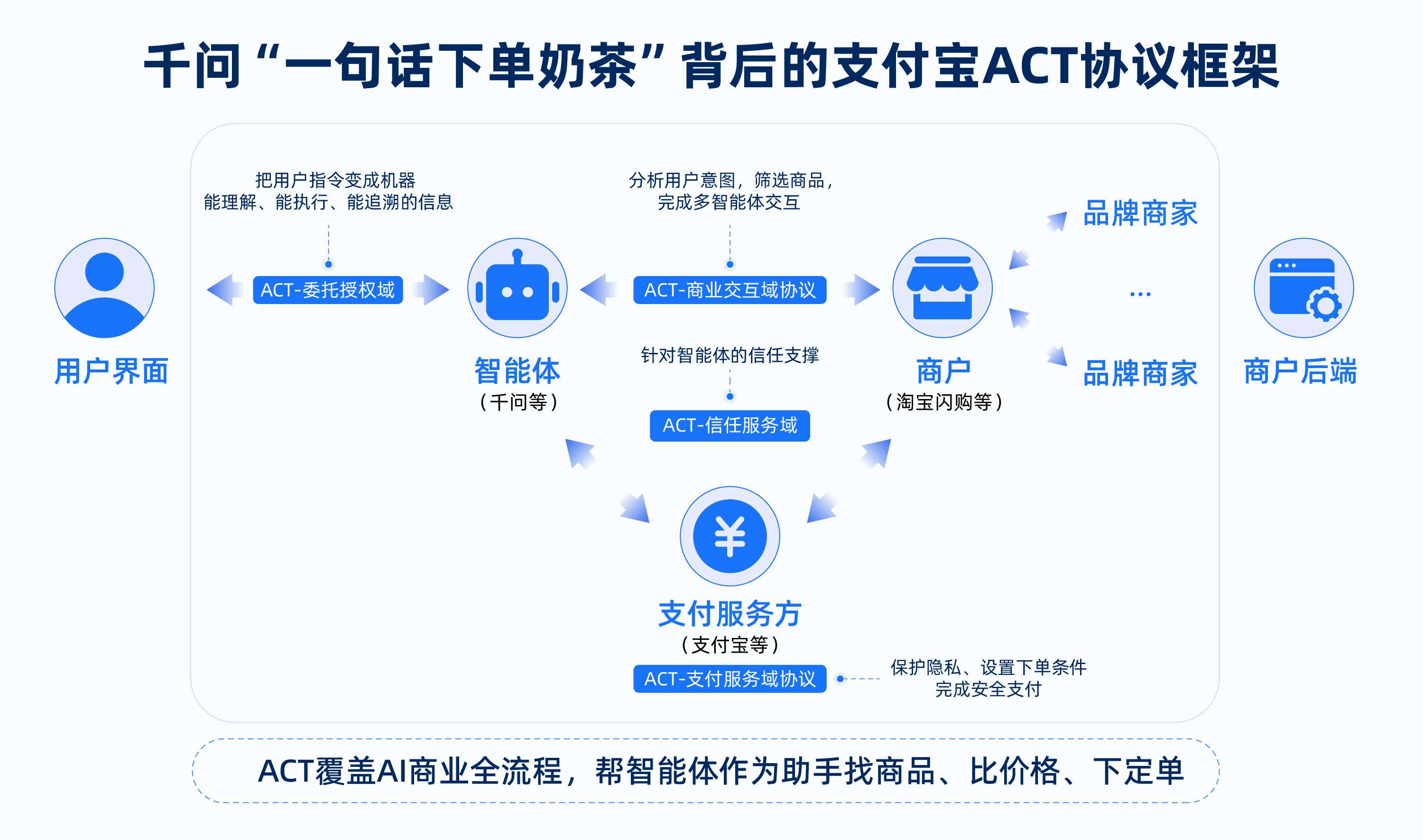
The ACT Protocol addresses these through four security pillars:

  1. Delegation Authorization - Clear user consent mechanisms
  2. Commercial Interaction - Standardized transaction processes
  3. Payment Services - Secure financial handling
  4. Trust Services - Full operation traceability
Image

Benefits Beyond Convenience

The system maintains crucial user control - AIs execute orders but never initiate payments without approval. For merchants, it simplifies integration; one standardized connection works across all participating platforms instead of requiring custom API development for each.

The protocol supports two payment modes:

  • Instant decisions: Real-time conversations ending with user verification (ideal for food delivery)
  • Pre-authorized: Set spending limits/time windows for automatic purchases (perfect for travel bookings)

Global Context

The move positions China at the forefront of AI commerce standardization amid growing international competition:

  • OpenAI partnered with Stripe for ChatGPT payments
  • Google recently released its Universal Commerce Protocol (UCP) Unlike these Western counterparts focusing primarily on payments though, ACT takes a holistic approach covering the entire commercial interaction chain.

The protocol prioritizes compatibility with existing systems while remaining adaptable to future AI advancements. Alipay aims to expand participation among payment providers, merchants, developers and device manufacturers to refine what could become the global standard for trustworthy AI commerce.

Enjoyed this article?

Subscribe to our newsletter for the latest AI news, product reviews, and project recommendations delivered to your inbox weekly.

Weekly digestFree foreverUnsubscribe anytime

Related Articles

News

Ant and Google Team Up to Revolutionize AI Shopping with New Protocol

Ant International and Google have joined forces to launch the Universal Commerce Protocol (UCP), a groundbreaking standard that enables AI assistants to handle complete shopping journeys within chat interfaces. This innovation eliminates the need for switching between apps, allowing users to browse, order, pay and get after-sales service all through conversation. The protocol promises to transform digital commerce by creating a common language between AI agents, merchants and payment systems.

January 13, 2026
AI commercedigital paymentstech collaboration
How AI is Transforming Live Streaming with Virtual Reality
News

How AI is Transforming Live Streaming with Virtual Reality

OTO Electronics is revolutionizing live streaming through AI-powered XR technology. Their MetaBox solutions blend artificial intelligence with extended reality, helping brands create immersive shopping experiences. With over 100 major clients and record-breaking engagement metrics, this innovation proves virtual commerce isn't just futuristic—it's happening now.

January 14, 2026
AI commercevirtual shoppinglive streaming tech
News

The Quiet Rise of Yaochu Capital: How This Investor Backed Tomorrow's AI Chip Giants

While flashy tech startups grab headlines, Yaochu Capital has been making calculated bets on AI chip companies that are now paying off big time. The investment firm quietly backed several semiconductor innovators like Bitmain and Hanbo Semiconductor years ago - companies that are now preparing for IPOs as China's AI infrastructure matures. Their secret? Focusing on original technology rather than just following the 'domestic substitution' trend.

January 12, 2026
AI chipsventure capitalsemiconductors
News

Zhuzhou's AI Manufacturing Push: Solving Real Factory Problems

Zhuzhou, China's rail manufacturing hub, is tackling concrete industrial challenges with AI. The city unveiled 51 real-world scenarios where artificial intelligence can transform production lines - from welding inspections to robotic decision-making. Local manufacturers like CRRC Zhuzhou are leading the charge, moving beyond theoretical applications to solve actual quality control and efficiency issues.

January 9, 2026
smart manufacturingindustrial AIfactory automation
News

China Tightens Rules on Live Commerce: AI Hosts Now Come With Accountability

China's live-streaming e-commerce sector faces stricter oversight as new regulations take effect. The rules clarify responsibilities across the industry, from platforms to AI-powered hosts. Notably, operators must now disclose when digital influencers aren't human and bear legal responsibility for their actions. Platforms will implement 'traffic supervision' penalties for violators, while merchants can't simply vanish - they'll need to maintain current contact details or face consequences.

January 7, 2026
live commercedigital regulationAI accountability
News

China's Digital Leap: HarmonyOS Hits 1.19B Devices Amid Tech Boom

As China wraps up its 14th Five-Year Plan, the country's tech sector shows remarkable progress. HarmonyOS now powers over 1.19 billion devices while AI innovation surges with 700 registered large models. Rural areas are catching up fast too - the urban-rural digital gap narrowed significantly, bringing better healthcare and e-commerce opportunities to the countryside.

December 26, 2025
China techHarmonyOSAI regulation