Alibaba's New AI Training Method Promises More Stable, Powerful Language Models
Alibaba Breakthrough Makes AI Training More Reliable
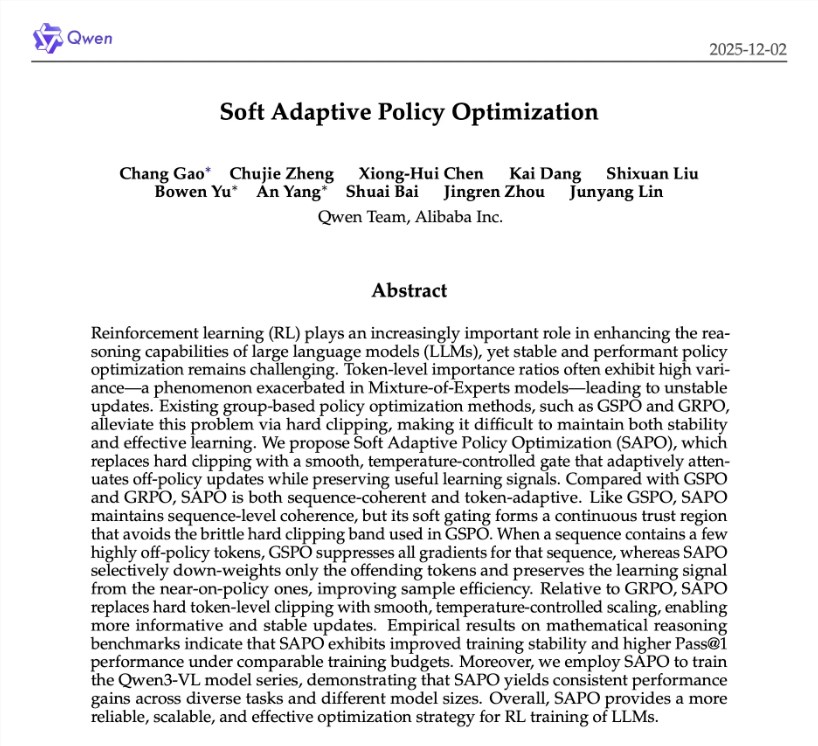
In the fast-moving world of artificial intelligence, Alibaba's Tongyi Qwen research team has developed a potentially game-changing approach to training large language models. Their new Soft Adaptive Policy Optimization (SAPO) method addresses one of the field's persistent headaches: keeping these complex systems stable during the crucial learning phase.
The Problem With Current Methods
Traditional approaches like GRPO and GSPO rely on what experts call "hard clipping" - essentially putting strict limits on how much the AI can adjust its learning parameters at once. While this prevents disastrous mistakes, it comes with significant drawbacks. Imagine trying to learn piano while wearing thick gloves; you won't break anything, but you'll miss subtle nuances in your playing.
"The existing methods often throw out valuable learning opportunities," explains Dr. Li Wei, lead researcher on the project. "If one part of a sequence performs poorly, current systems might discard the entire thing - like rejecting a whole essay because of one awkward sentence."
How SAPO Works Differently
The Qwen team's solution replaces these blunt-force restrictions with something more sophisticated. SAPO uses:
- Smart filtering: Instead of hard cutoffs, it employs smooth, adjustable thresholds that preserve more useful information
- Asymmetric handling: It treats positive and negative learning signals differently for better efficiency
- Context awareness: The system makes decisions at both the sequence and individual token levels
This approach maintains stability while allowing models to learn from more of their experiences. Early testing shows particular promise for mixture-of-experts models - the complex architectures powering today's most advanced AI systems.
Real-World Performance Gains
The proof came in rigorous testing across multiple domains:
- Math problems: SAPO-powered models solved 15% more complex equations correctly
- Coding tasks: Generated code showed fewer errors and better structure
- Logical reasoning: Demonstrated more consistent performance on tricky word problems
- Multimodal challenges: Combined text and visual information more effectively
"What excites us most is how broadly applicable these improvements are," notes Dr. Li. "From technical applications to creative tasks, we're seeing better results across the board."
The team has published their findings in detail (paper link: https://arxiv.org/abs/2511.20347), inviting peer review and collaboration from the global AI community.
Key Points:
- Alibaba's SAPO method offers a smarter way to train large language models
- Replaces crude "hard clipping" with nuanced, adaptive controls
- Preserves valuable learning signals while maintaining stability
- Shows measurable improvements across diverse AI applications
- Particularly effective for complex mixture-of-experts architectures