Tsinghua & Kuaishou Breakthrough: SVG Model Boosts AI Training by 6200%

Revolutionary AI Model Shatters Efficiency Barriers

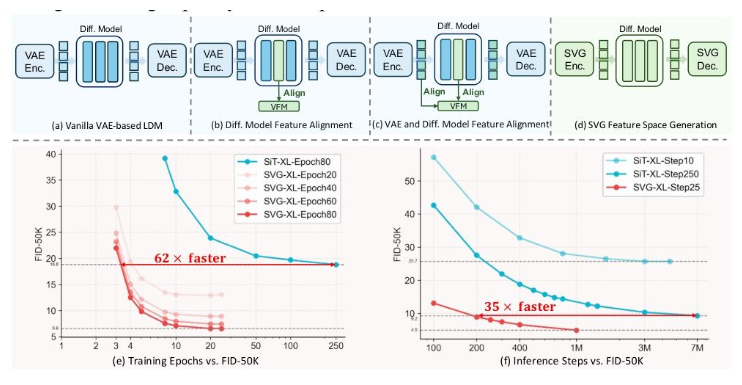
In a landmark collaboration, Tsinghua University and Kuaishou's Ling team have unveiled the SVG (VAE-free latent diffusion model), marking a potential paradigm shift in generative AI technology. Their breakthrough addresses fundamental limitations plaguing current Variational Autoencoder (VAE) systems while delivering unprecedented performance gains.

The Decline of Traditional VAE Models

VAE technology has increasingly struggled with "semantic entanglement" - where modifying one image feature inadvertently alters unrelated characteristics. This phenomenon creates distorted outputs when attempting targeted edits (e.g., changing a cat's color while preserving its expression).
Image

Architectural Innovations Behind SVG

The research team implemented three key technical advancements:

  1. Semantic Extraction: Employed DINOv3 pre-trained models for precise feature separation through large-scale self-supervised learning
  2. Detail Preservation: Designed lightweight residual encoders to maintain intricate visual elements without semantic interference
  3. Feature Fusion: Developed novel distribution alignment mechanisms ensuring harmonious integration of semantic and detail features

The approach fundamentally rethinks latent space construction, eliminating compromises between generation quality and computational efficiency.

Image

Benchmark-Defying Performance

The SVG model demonstrates extraordinary capabilities across multiple metrics:

  • Achieved FID score of 6.57 on ImageNet after just 80 training cycles (versus hundreds typically required)
  • Requires fewer sampling steps while maintaining superior image clarity
  • Features direct applicability to downstream tasks (classification, segmentation) without fine-tuning
  • Demonstrates strong generalization across multimodal generation scenarios

The paper reveals particularly impressive comparisons against conventional approaches:

Metric SVG Improvement

Future Implications & Availability

This technological leap promises transformative applications across:

  • Real-time content generation platforms
  • Professional creative tools
  • Automated visual design systems The research paper detailing these findings is publicly available on arXiv.

Key Points:

  • SVG model eliminates VAE's semantic entanglement limitation
  • Combines DINOv3 semantic extraction with novel residual encoding
  • Delivers order-of-magnitude improvements in speed and efficiency
  • Maintains backward compatibility with existing workflows
  • Opens new possibilities for real-time generative applications
Enjoyed this article?

Subscribe to our newsletter for the latest AI news, product reviews, and project recommendations delivered to your inbox weekly.

Weekly digestFree foreverUnsubscribe anytime

Related Articles

Shanghai Expands AI Ecosystem with 11 New Generative Models
News

Shanghai Expands AI Ecosystem with 11 New Generative Models

Shanghai continues to solidify its position as China's AI hub, adding 11 new generative AI services to its official registry this month. The city's total now stands at 149 approved models, with the Shanghai Innovation Institute emerging as a standout contributor. These developments come as local authorities refine regulatory frameworks to cover both independent models and API-based services, ensuring responsible innovation in this fast-evolving field.

February 28, 2026
GenerativeAITechRegulationShanghaiTech
News

Chinese Tech Giants Unveil Cutting-Edge AI Models During Spring Festival Rush

This Lunar New Year witnessed an AI arms race among China's tech leaders. ByteDance's Seedance 2.0 brings Hollywood-quality video generation to smartphones, while Zhipu's GLM-5 model doubles down on processing power with its massive 745 billion parameters. Meanwhile, MiniMAX and DeepSeek are taking their innovations global. The flurry of announcements sent shockwaves through stock markets, with AI-related shares soaring up to 70%.

February 12, 2026
ArtificialIntelligenceChineseTechGenerativeAI
ByteDance's Seedance 2.0 Faces Backlash Over Voice Cloning Feature
News

ByteDance's Seedance 2.0 Faces Backlash Over Voice Cloning Feature

ByteDance's latest AI video tool, Seedance 2.0, sparked controversy when it demonstrated uncanny voice cloning capabilities without user consent. After tech blogger Tim Pan shared his unsettling experience, the company quickly disabled the real-person reference feature. While the model's technical prowess impressed many - supporting 12 multimodal inputs and native audio-visual sync - the incident raises important questions about AI ethics in creative tools.

February 10, 2026
AIethicsVoiceCloningGenerativeAI
News

China's AI Boom: Over Half a Billion Now Use Generative Tools

China's generative AI adoption has skyrocketed, with 602 million users embracing the technology—that's nearly half of all internet users nationwide. The rapid growth comes alongside massive computing infrastructure investments, positioning China as a global leader in smart computing power. From creative work to daily productivity, these AI tools are reshaping how Chinese citizens live and work.

February 5, 2026
GenerativeAITechTrendsDigitalTransformation
Adobe Firefly Unleashes Unlimited AI Creativity for Subscribers
News

Adobe Firefly Unleashes Unlimited AI Creativity for Subscribers

Adobe just supercharged its Firefly AI platform, removing all limits on image and video generation for paying users. Subscribers can now create endlessly across Adobe's ecosystem, tapping into premium AI models while enjoying seamless integration with Creative Cloud favorites like Photoshop and Premiere. This bold move positions Adobe as a serious contender in the generative AI space.

February 3, 2026
AdobeFireflyGenerativeAICreativeTools
DeepSeek's New OCR Tech Mimics Human Vision, Slashes Costs
News

DeepSeek's New OCR Tech Mimics Human Vision, Slashes Costs

Chinese AI firm DeepSeek has unveiled OCR2, a breakthrough visual encoder that processes documents like human eyes scan pages. By ditching rigid grid processing for flexible 'causal flow tokens,' the system cuts visual token usage by 80% while outperforming Gemini3Pro in benchmarks. The open-sourced technology could pave the way for truly unified multimodal AI.

February 2, 2026
ComputerVisionAIBreakthroughsDocumentAI