
Tsinghua and Ant Group Unveil BodyGen: Robot Performance Up 60%

In a significant leap for embodied AI, researchers from Tsinghua University and Ant Group have introduced BodyGen, an innovative algorithm framework that boosts robot performance by an impressive 60%. This breakthrough, detailed in their ICLR 2025 paper, combines reinforcement learning and deep neural networks to enable robots to rapidly adapt their morphology and control strategies to their environment. The team has also open-sourced the code on GitHub, making it accessible to the broader scientific community.
Image

Addressing Traditional Challenges

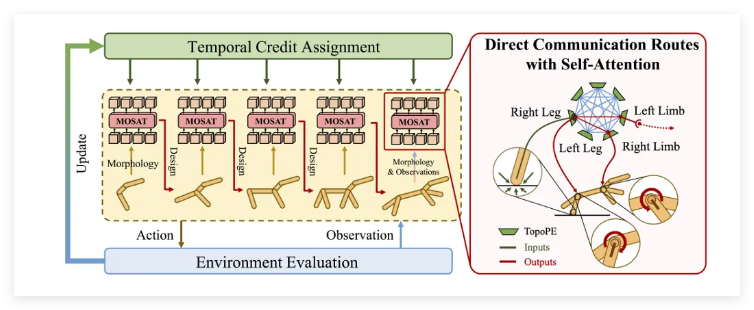
Traditional robot design has long faced hurdles such as heavy reliance on expert knowledge, iterative experimentation for specific environments, and the complex interplay between morphology and control strategies. The BodyGen framework tackles these issues through a two-stage process: morphology design and environmental interaction. In the first stage, a Transformer-based autoregressive model (GPT-Style) constructs and optimizes robot body structure parameters. In the second stage, another Transformer (Bert-Style) processes joint information to achieve interactive feedback with the environment.
Image

Core Technologies of BodyGen

The framework incorporates three key technologies:

  1. TopoPE (Topological Positional Encoder): Acts as the robot's "body awareness" system, enabling rapid adaptation to morphological changes.
  2. MoSAT (Transformer-based Central Brain): Handles information processing and command issuance.
  3. Specialized Reward Allocation Mechanism: Allows the AI to rationally evaluate design decisions.
Image

Impressive Test Results

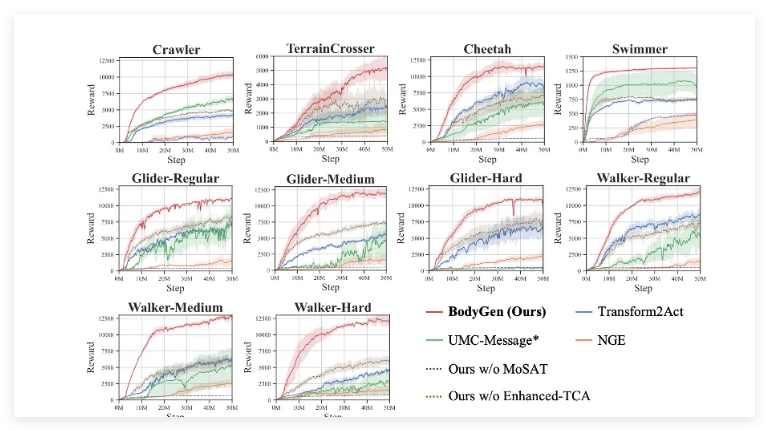
In tests across 10 diverse tasks—including crawling and swimming—robots generated by BodyGen achieved a 60.03% higher adaptability score compared to existing state-of-the-art methods. Additionally, with a parameter count of just 1.43M, BodyGen is significantly more lightweight, making it ideal for resource-constrained environments.

The research team plans to promote its application in real-world scenarios, positioning BodyGen as a key enabler for the development of general-purpose embodied AI. For more details or to explore the code, visit GitHub.

Key Points

  1. BodyGen enhances robot performance by 60% through optimized morphology and control strategies.
  2. The framework addresses traditional challenges in robotics with a two-stage process: morphology design and environmental interaction.
  3. Core technologies include TopoPE, MoSAT, and a specialized reward allocation mechanism.
  4. Test results show significant improvements in adaptability across diverse tasks.
  5. The lightweight design (1.43M parameters) makes it suitable for resource-constrained environments.

Enjoyed this article?

Subscribe to our newsletter for the latest AI news, product reviews, and project recommendations delivered to your inbox weekly.

Weekly digestFree foreverUnsubscribe anytime

Related Articles

AutoNavi's Bold Leap: From Digital Maps to Intelligent Robots
News

AutoNavi's Bold Leap: From Digital Maps to Intelligent Robots

AutoNavi, Alibaba's mapping subsidiary, is making waves with its ambitious pivot from digital navigation to embodied intelligence. After topping Stanford's spatial AI benchmarks, the company has quietly formed a new division focused on bringing its world model technology into physical form—potentially through robots. This move signals AutoNavi's transformation from a simple map app into what could become the 'brain' for next-generation intelligent machines.

January 5, 2026
AutoNaviEmbodiedAIRobotics
Robotics Startup ZiLiangJi Lands $140M Boost From Tech Heavyweights
News

Robotics Startup ZiLiangJi Lands $140M Boost From Tech Heavyweights

Chinese robotics innovator ZiLiangJi has secured a massive 1 billion yuan ($140M) funding round backed by ByteDance and Sequoia China. The investment signals strong confidence in the company's general-purpose robotics technology, which shows promise across industrial, logistics and elderly care applications. Founder Wang Qian reveals plans to accelerate global deployment of their intelligent systems.

January 12, 2026
RoboticsTechInvestmentArtificialIntelligence
Boston Dynamics' Atlas Robot Steps Off Demo Stage Into Hyundai Factories
News

Boston Dynamics' Atlas Robot Steps Off Demo Stage Into Hyundai Factories

Boston Dynamics' iconic Atlas robot is shedding its research lab origins and heading to Hyundai's production lines. The humanoid machine, now equipped with Google DeepMind's AI smarts and 360-degree vision, promises to transform manufacturing floors while working safely alongside humans. This marks a pivotal moment as robotics transitions from flashy prototypes to real-world workhorses.

January 7, 2026
RoboticsIndustrialAutomationArtificialIntelligence
China's Humanoid Robot Pioneer Hits Regulatory Speed Bump
News

China's Humanoid Robot Pioneer Hits Regulatory Speed Bump

Yuque Technology, China's leading humanoid robotics firm, faces a setback as its fast-track IPO approval gets suspended. While regulators aim to cool overheated market enthusiasm, the company remains profitable with billion-yuan revenues. Industry watchers see this as a move to prevent valuation bubbles rather than a rejection of Yuque's fundamentals.

January 4, 2026
RoboticsIPOTechRegulation
JD.com Brings Robot Rentals to Life with New Physical Store
News

JD.com Brings Robot Rentals to Life with New Physical Store

JD.com has teamed up with Unitree to open its first physical robot store in Beijing, marking a major step in making advanced robotics accessible to everyday consumers. Through an innovative rental model, customers can now experience cutting-edge quadrupedal and humanoid robots without hefty price tags. The store offers immersive demonstrations showcasing how these robots could transform homes, education, and healthcare.

December 31, 2025
JD.comRoboticsRetail Innovation
News

Musk envisions AI doctors and robot surgeons replacing traditional healthcare

Elon Musk has proposed a radical vision for healthcare, combining AI diagnostics with robotic surgery to replace what he calls bureaucratic government systems. Following a tragic Canadian ER case, Musk criticized public healthcare as inefficient, suggesting his xAI's Grok and Tesla's Optimus could provide faster, cheaper care. While experts question feasibility, Musk frames this as part of Tesla's broader robotics revolution.

December 29, 2025
Elon MuskAI HealthcareRobotics