
Tongyi Qianwen Unveils Qwen3-4B AI Models for Mobile Devices

Tongyi Qianwen's Qwen3-4B Series Brings Powerful AI to Mobile Devices

Tongyi Qianwen has announced its latest breakthrough in artificial intelligence with the release of the Qwen3-4B series, a set of compact yet powerful language models specifically designed for deployment on edge devices. This development marks a significant step forward in making advanced AI capabilities accessible on smartphones and other mobile hardware.

Performance Breakthroughs in Compact Form

The new models include two variants:

  • Qwen3-4B-Instruct-2507: Excelling in non-reasoning tasks, surpassing closed-source GPT4.1-Nano
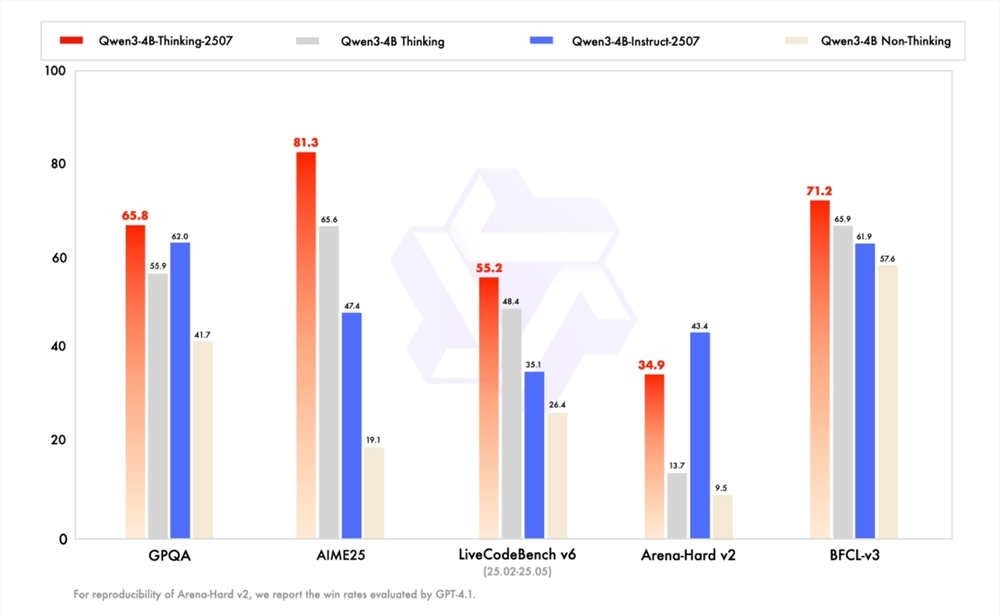
  • Qwen3-4B-Thinking-2507: Delivering reasoning capabilities comparable to the medium-sized Qwen3-30B-A3B model
Image

According to the development team, these small language models (SLMs) hold particular importance for the advancement of Agentic AI. The "2507" version demonstrates that size doesn't necessarily limit capability, with performance metrics that challenge much larger models.

Technical Advancements and Availability

The Qwen3-4B series introduces several notable improvements:

  • 256K context window for handling long-form content
  • Enhanced multilingual knowledge coverage
  • Improved alignment with human preferences for subjective tasks

The models are now available as open-source through:

  • ModelScope community
  • Hugging Face platform

This accessibility has already attracted significant attention from developers looking to implement advanced AI in resource-constrained environments.

Benchmark Performance Highlights

The Qwen3-4B-Instruct-2507 shows particularly strong results in:

  • General capability benchmarks (surpassing GPT-4.1-nano)
  • Long-tail knowledge retention across languages
  • Subjective task performance approaching medium-sized models

The thinking variant, Qwen3-4B-Thinking-2507, achieved an impressive 81.3 score on the AIME25 mathematical evaluation - a result comparable to its larger 30B counterpart. Its agent capabilities actually surpass those of the larger Qwen3-30B-Thinking model in some tests.

Practical Applications and Future Outlook

The reduced size and enhanced capabilities of these models open new possibilities for: The reduced size and enhanced capabilities of these models open new possibilities for:

  1. On-device document analysis
  2. Long-content generation
  3. Complex cross-paragraph reasoning
  4. Mobile-first AI applications
  5. Privacy-sensitive processing

The development team anticipates these models will enable innovative applications that bring AI convenience directly to users' pockets without relying on cloud infrastructure.

Key Points:

  • Compact 4B parameter models rival performance of much larger AI systems *
  • Specialized variants for both instruction-following and reasoning tasks *
  • Open-source availability accelerates mobile AI development *
  • 256K context window enables sophisticated long-form processing *
  • Demonstrated superiority over commercial closed-source alternatives *

Enjoyed this article?

Subscribe to our newsletter for the latest AI news, product reviews, and project recommendations delivered to your inbox weekly.

Weekly digestFree foreverUnsubscribe anytime

Related Articles

News

Tailwind CSS Crisis: How AI Boom Left Developers Divided

Tailwind CSS, the beloved utility-first framework, faces an existential paradox. While its adoption hits record highs thanks to AI coding tools, these same technologies have gutted its revenue streams - triggering massive layoffs. Founder Adam Wathan reveals documentation traffic dropped 40% as developers bypass official channels entirely. The crisis sparks urgent debates about open-source sustainability in the AI era.

January 12, 2026
TailwindCSSOpenSourceAIEthics
Mugen3D Turns Single Photos Into Stunning 3D Worlds
News

Mugen3D Turns Single Photos Into Stunning 3D Worlds

A groundbreaking AI tool called Mugen3D is transforming how we create 3D content. Using advanced 3D Gaussian Splatting technology, it can generate remarkably realistic models from just one image - capturing textures, lighting, and materials with astonishing accuracy. This innovation promises to democratize 3D creation across industries from gaming to e-commerce.

January 12, 2026
AIComputerGraphicsDigitalCreation
News

Qualcomm and Google Join Forces to Revolutionize Car Tech with AI

Qualcomm and Google are teaming up to tackle one of the automotive industry's biggest headaches: fragmented in-car systems. Their new 'Automotive AI Agent' combines Qualcomm's Snapdragon Digital Chassis with Google's Android Automotive OS, promising smoother development and smarter features like facial recognition. The partnership also introduces cloud-based development tools that could cut R&D time significantly. This collaboration marks a major step toward more unified, intelligent vehicle systems.

January 9, 2026
automotive-techAIsmart-cars
News

Tailwind's AI Paradox: Soaring Popularity, Plummeting Profits

Tailwind Labs faces a cruel irony - while its CSS framework enjoys record-breaking adoption thanks to AI tools generating Tailwind code, the company has slashed 75% of its engineering team. As AI agents bypass documentation pages, traffic dropped 40%, causing revenue to nosedive nearly 80%. Founder Adam Wathan calls this 'AI's brutal impact' on traditional open-source business models.

January 9, 2026
TailwindCSSOpenSourceAIDisruption
News

Bosch Bets Big on AI with €2.5 Billion Push Into Smart Cars

At CES 2026, automotive giant Bosch unveiled plans to invest over €2.5 billion in AI development by 2027, targeting smarter cockpits and safer autonomous driving systems. The German supplier aims to transform from hardware specialist to software leader, projecting its tech division could hit €10 billion in sales by the mid-2030s.

January 7, 2026
BoschAIautonomous vehicles
MiniMax IPO Fever: Hong Kong Investors Flock to China's AI Pioneer
News

MiniMax IPO Fever: Hong Kong Investors Flock to China's AI Pioneer

MiniMax, China's rising star in AI technology, has concluded its Hong Kong IPO with staggering investor enthusiasm. The offering saw subscriptions oversubscribed by 1,209 times, raising over HK$253 billion. Backed by heavyweight investors like Alibaba and Abu Dhabi Investment Authority, MiniMax is set to become one of the fastest-growing AI companies ever to go public when it lists on January 9.

January 6, 2026
AIIPOHongKongMarkets