Tencent Dives Into AI Agents With Its 'Shrimp' Ecosystem

Tencent Bets Big on AI Assistants With New 'Shrimp' Ecosystem

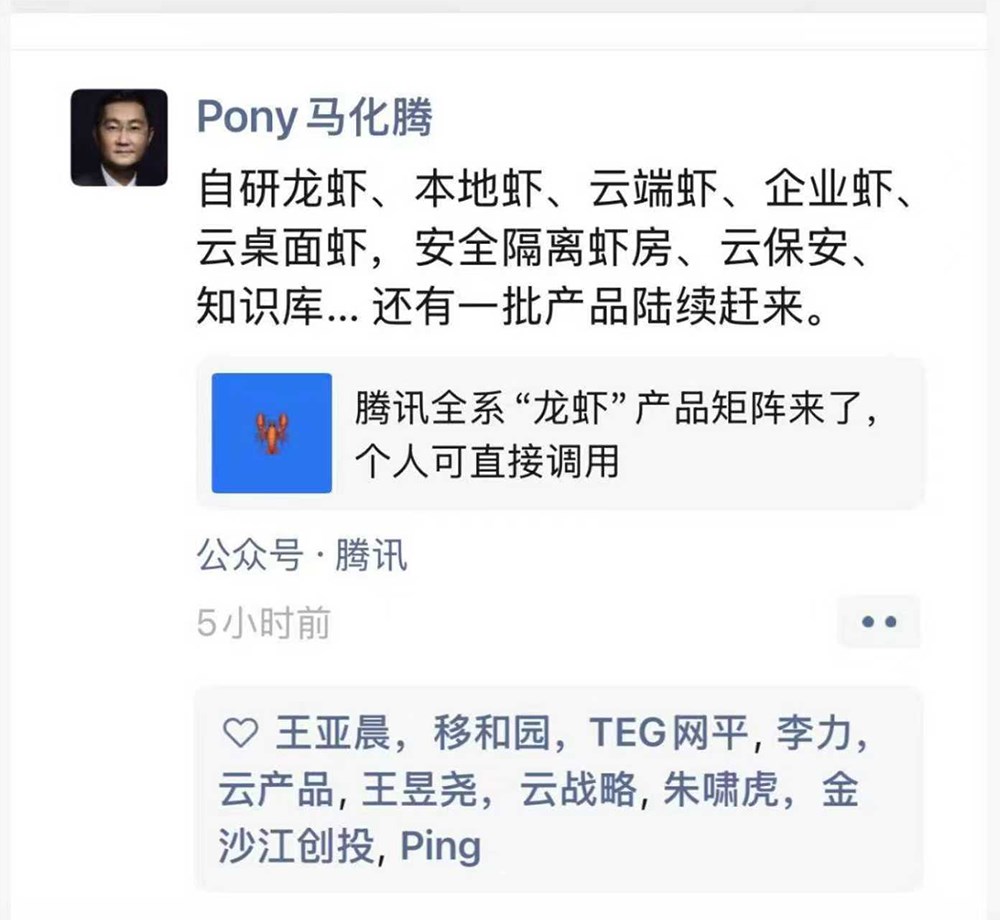
Tencent is making waves in artificial intelligence with its newly announced "Shrimp" ecosystem - a suite of AI agents designed to simplify both work and daily life. CEO Ma Huateng revealed the ambitious project through his social media channels, signaling the tech giant's serious commitment to practical AI applications.

From Desktop to Pocket: The Shrimp Family Expands

The Shrimp lineup isn't just one product but an entire ecosystem:

  • WorkBuddy: The flagship desktop assistant launched March 9 that works across software platforms
  • Local Shrimp: An offline-capable version for privacy-conscious users
  • Cloud Shrimp: For businesses needing scalable solutions
  • Enterprise Shrimp: Tailored for corporate environments
  • Secure Isolated Shrimp Rooms: Specialized versions for sensitive operations
Image

The star player, WorkBuddy, stands out for its simplicity. "It installs like any regular app," explains Tencent's announcement, "but then transforms how you interact with your computer." The assistant can handle complex workflows across different programs while supporting multiple Chinese AI models.

WeChat Integration Looms Large

Industry watchers are particularly excited about rumors of a WeChat-integrated AI agent coming later this year. Such integration could revolutionize how China's billion-plus users interact with mini-programs for services like ride-hailing and food delivery - all through natural conversation.

The company has also begun internal testing of QClaw, a local AI assistant built on Tencent's OpenClaw open-source framework. This move strengthens Tencent's position in the growing "AI at the edge" market where processing happens on devices rather than in the cloud.

Market Responds Enthusiastically

The announcements sparked an 11% surge in Tencent's stock price this week, peaking at HK$578. Investors appear bullish on Tencent's strategy of combining its massive user base with practical AI applications rather than chasing flashy but unproven technologies.

As one Hong Kong-based analyst noted: "While others talk about futuristic AI, Tencent is showing how it works today - in our offices and on our phones."

Key Points:

  • Tencent launches diverse "Shrimp" AI agent ecosystem
  • WorkBuddy leads as easy-to-use desktop assistant
  • WeChat integration could arrive by Q3 2026
  • Stock jumps 11% on practical AI focus
  • Positions Tencent strongly in commercializing AI technology
Enjoyed this article?

Subscribe to our newsletter for the latest AI news, product reviews, and project recommendations delivered to your inbox weekly.

Weekly digestFree foreverUnsubscribe anytime

Related Articles

Honor's Magic V6 Brings AI to Life with 'Lobster Universe'
News

Honor's Magic V6 Brings AI to Life with 'Lobster Universe'

Honor has unveiled its ambitious AI ecosystem called 'Lobster Universe' alongside the new Magic V6 foldable. This innovative system integrates AI agents across devices, allowing PCs and tablets to handle automated tasks. While showcasing impressive capabilities, security concerns linger as the company prepares for wider testing. The launch also highlights growing demand for AI infrastructure, with MiniMax seeing record usage.

March 11, 2026
Honor Magic V6AI EcosystemOn-Device AI
WeChat's AI Assistant Set to Transform Mini-Program Experience by 2026
News

WeChat's AI Assistant Set to Transform Mini-Program Experience by 2026

Tencent is quietly developing an AI assistant for WeChat that could revolutionize how users interact with mini-programs. Slated for testing in mid-2026, this intelligent agent aims to handle tasks like ride-hailing and food delivery through simple voice commands. The project represents WeChat's ambitious push into AI, potentially turning the platform into a one-stop 'smart task center' for its 1.4 billion users.

March 11, 2026
WeChatAI assistantTencent
News

Tech Giants Unite: Microsoft Backs Anthropic in Legal Fight Against Pentagon Ban

In an unprecedented show of industry solidarity, Microsoft has filed court documents supporting rival AI firm Anthropic against a controversial Pentagon ban. The tech giant argues the Defense Department's 'supply chain risk' designation lacks transparency and could cripple contractors. Meanwhile, 37 researchers from OpenAI and Google have joined the fight, signaling rare cooperation between competitors. This legal battle may redefine how government regulates emerging AI technologies.

March 11, 2026
Artificial IntelligenceGovernment RegulationTech Industry
Xie Saining's Team Unveils Solaris: A Breakthrough in Multi-User Video AI
News

Xie Saining's Team Unveils Solaris: A Breakthrough in Multi-User Video AI

Xie Saining's research team has launched Solaris, the world's first multi-user video world model, powered by Kunlun Wanzhi's Matrix-Game2.0. This innovative technology enhances player interaction in environments like Minecraft, outperforming previous solutions. The release coincides with a major funding milestone for Xie's AI company, AMI, highlighting the growing importance of world models in advancing artificial general intelligence.

March 11, 2026
AIMachine LearningVirtual Worlds
Meta snaps up AI social platform Moltbook in race for agent ecosystem
News

Meta snaps up AI social platform Moltbook in race for agent ecosystem

Meta has acquired Moltbook, a Reddit-like platform where AI agents interact and collaborate. The deal brings Moltbook's founders into Meta's Superintelligence Lab, along with their crucial identity verification technology. While financial details remain undisclosed, the move signals Meta's push to lead in developing standards for AI agent cooperation - a key battleground as tech giants shift from single models to interconnected ecosystems.

March 11, 2026
MetaAI AgentsTech Acquisitions
News

WeChat's AI Agent Could Make Daily Tasks as Easy as Saying One Sentence

Tencent is quietly developing an AI assistant that could revolutionize how we use WeChat. Unlike typical chatbots, this agent would connect directly with millions of mini-programs, potentially letting users accomplish complex tasks like ordering food and booking rides with simple voice commands. Set for testing this summer, the move signals Tencent's push to reclaim its position as China's dominant super app amid growing competition from Alibaba and ByteDance in the AI space.

March 11, 2026
WeChatAI assistantsTencent