Musk's Bold Vision: A Future Where AI Pays Your Bills

The High-Stakes Debate Over AI's Economic Impact

Imagine a world where robots do most of the work, and humans enjoy comfortable lifestyles funded by government checks. That's the future Elon Musk envisions as artificial intelligence transforms the job market. But his proposal for a "Universal High Income" (UHI) is sparking heated debates among economists and policymakers.

Musk's Generous Vision

The Tesla CEO recently took to social media to propose UHI as a solution to impending AI-related unemployment. Unlike Universal Basic Income (UBI) schemes that cover just essential living costs, Musk's plan would provide enough for people to live "more affluent" lives. He argues that as AI and robotics dramatically increase productivity, this wealth could be redistributed without causing inflation.

"When goods and services become abundant through automation," Musk suggests, "we might reach a point where traditional retirement savings become unnecessary." It's a bold claim that has many scratching their heads.

The Skeptics Speak Up

Not everyone shares Musk's rosy outlook. Professor Weidqist from Georgetown University points out that today's workers face different challenges: "The real crisis isn't job availability - it's that paychecks haven't kept pace with living costs for decades."

Across the Atlantic, University College London researcher Lanson raises practical concerns: "If we can afford UHI, shouldn't we first invest in helping workers transition to new careers? Many people want meaningful work, not just government handouts."

The Looming Job Disruption

The urgency of these discussions grows clearer by the day:

  • Boston Consulting Group predicts 10-15% of U.S. jobs could vanish within five years (17-25 million workers)
  • Goldman Sachs estimates 2.5% of workers face imminent automation risks
  • Service sectors once considered safe are now vulnerable to advanced AI systems

While Musk paints an appealing picture of leisure-filled futures, tough questions remain about implementation. How would society determine appropriate income levels? What safeguards would prevent inflation if everyone suddenly had more spending power?

The debate goes beyond economics - it touches on fundamental questions about work's role in human dignity and purpose. As one labor advocate noted: "We shouldn't just plan for people to stop working. We should plan for them to start working differently."

Key Points:

  • 💰 Radical proposal: Musk suggests UHI could provide more than basic needs
  • 🤔 Expert pushback: Economists emphasize wage stagnation over pure unemployment
  • ⏳ Tight timeline: Major job disruptions expected within 5 years
  • 🔄 Workforce transition: Retraining may prove as crucial as income support
Enjoyed this article?

Subscribe to our newsletter for the latest AI news, product reviews, and project recommendations delivered to your inbox weekly.

Weekly digestFree foreverUnsubscribe anytime

Related Articles

Tesla's AI5 Chip Hits Major Milestone with Musk's Hands-On Oversight
News

Tesla's AI5 Chip Hits Major Milestone with Musk's Hands-On Oversight

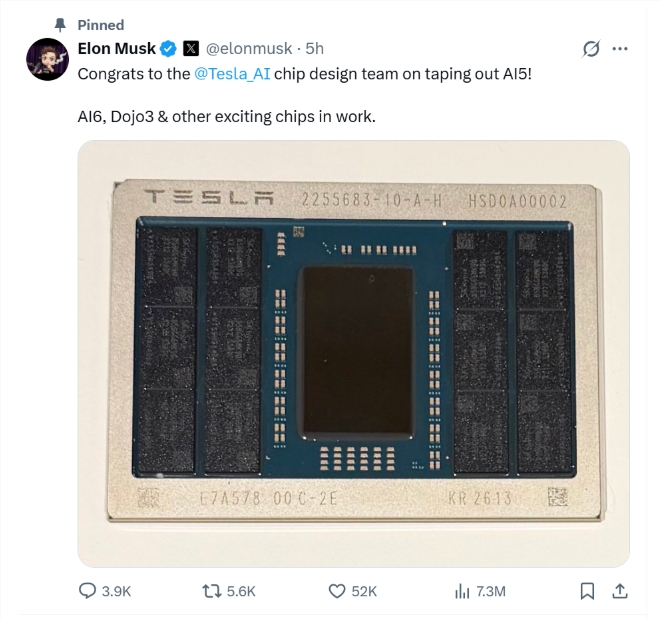
Tesla's next-generation AI5 chip has completed its tape-out phase, marking a significant step toward mass production in 2027. Elon Musk personally supervised the project for months, revealing its critical importance to Tesla's future. The dual-chip configuration promises performance comparable to NVIDIA's Blackwell, while offering lower costs and power consumption. Production will be split between Samsung and TSMC facilities in the U.S., though Musk's social media blunder about TSMC briefly caused confusion.

April 16, 2026
TeslaAI chipssemiconductors
News

Musk Takes OpenAI to Court, Seeks Ouster of Altman

Elon Musk has launched a legal battle against OpenAI, filing a lawsuit that accuses CEO Sam Altman and President Greg Brockman of fraud. The Tesla billionaire claims OpenAI strayed from its non-profit roots after he donated $38 million, and now wants the court to remove its leadership and restore its original mission. This latest clash marks another chapter in Musk's rocky relationship with the AI company he co-founded but left in 2018.

April 8, 2026
Elon MuskOpenAITech Lawsuits
Intel Joins Musk's Ambitious Plan to Build a Chip Factory for the AI Age
News

Intel Joins Musk's Ambitious Plan to Build a Chip Factory for the AI Age

In a major move for the semiconductor industry, Intel has teamed up with Elon Musk's companies to create a groundbreaking chip manufacturing project called Terafab. The collaboration aims to produce an unprecedented terawatt of computing power annually, fueling next-gen AI and robotics. Set in Austin, Texas, the facility will serve both earthly technologies like Tesla vehicles and futuristic space-based AI systems.

April 8, 2026
semiconductorsartificial intelligencetech innovation
News

FOBO: The New Workplace Anxiety Sweeping Across America

A new workplace phenomenon called FOBO (Fear of Becoming Obsolete) is gripping American professionals as AI advances at breakneck speed. While executives predict massive job displacement, MIT researchers offer a more nuanced view - AI's impact will be gradual, not sudden. With only 19% of companies actually using AI and most workers unprepared, the real challenge may be managing our fears as much as the technology itself.

April 7, 2026
AI anxietyFuture of workWorkplace psychology
OpenAI Seeks Probe Into Musk's Alleged Sabotage Tactics
News

OpenAI Seeks Probe Into Musk's Alleged Sabotage Tactics

OpenAI has formally requested state attorneys general investigate Elon Musk for what it calls anti-competitive behavior. The AI research company claims Musk, a former co-founder who now runs rival xAI, is attempting to derail OpenAI's progress through lawsuits and secret deals with competitors. At stake is more than $10 billion in potential damages that could cripple OpenAI's operations. The legal battle, stemming from Musk's 2024 lawsuit over OpenAI's corporate restructuring, is set to go to trial this month.

April 7, 2026
OpenAIElon MuskArtificial Intelligence
Zhipu's Bold API Price Hike Backfires - In the Best Way Possible
News

Zhipu's Bold API Price Hike Backfires - In the Best Way Possible

In a surprising turn of events, Chinese AI leader Zhipu saw its API usage surge despite an 83% price increase, as revealed in their stellar 2025 financial report. The company smashed records with 724 million yuan revenue and a 132% growth rate, proving that quality AI capabilities command premium prices. Their MaaS platform became the unexpected star, with revenue skyrocketing 60 times year-over-year.

March 31, 2026
AI economicsChinese techEnterprise AI