
Meta's Super Intelligence Lab Boosts AI Reasoning Speed 30x

Meta's Super Intelligence Lab Achieves Breakthrough in AI Reasoning Speed

Meta has announced a significant advancement in artificial intelligence through its newly established Super Intelligence Lab (MSL). The lab's first major publication introduces REFRAG, a novel framework that improves reasoning speeds in large language models by 30 times for Retrieval-Augmented Generation (RAG) tasks.

The REFRAG Framework: Rethinking RAG Efficiency

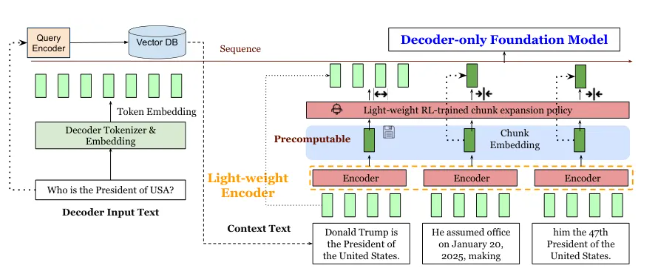
The paper, titled "REFRAG: Rethinking RAG based Decoding," addresses critical bottlenecks in how large language models process information during RAG tasks. By implementing intelligent compression techniques, the framework enables models to extract key information faster while reducing computational overhead.
Image

Behind Meta's AI Push

The Super Intelligence Lab was established in June 2025 at Meta's Menlo Park headquarters following CEO Mark Zuckerberg's dissatisfaction with the performance of the company's Llama4 model. The lab has assembled top AI talent, including Scale AI founder Alexandr Wang, and operates through four specialized teams:

  • Large Language Model Development
  • Fundamental AI Research
  • Product Technology Implementation
  • Infrastructure Support

Technical Innovation Behind REFRAG

The framework employs two key strategies:

  1. Context Compression: A lightweight model summarizes long-form content before processing by the main decoder
  2. Continuous Pre-training: Models undergo reconstruction training to preserve critical details during compression

Testing shows REFRAG outperforms previous state-of-the-art models like CEPE at 16x compression ratios with negligible accuracy loss. The system demonstrates particular strength in reducing latency and increasing throughput.

Implications for AI Development

This breakthrough comes as major tech firms race to improve large language model efficiency. Meta's innovation could significantly impact:

  • Real-time AI applications
  • Cost-effective model deployment
  • Energy-efficient computing solutions The lab plans to expand its research into other aspects of superintelligence development.

The full paper is available on arXiv.

Key Points:

30x speed improvement for RAG tasks ⚡ Significant reduction in computational load 🧠 Maintains accuracy through intelligent compression 🏢 Part of Meta's expanded AI research initiative

Enjoyed this article?

Subscribe to our newsletter for the latest AI news, product reviews, and project recommendations delivered to your inbox weekly.

Weekly digestFree foreverUnsubscribe anytime

Related Articles

News

Tsinghua-Backed AI Startup Mianshi Intelligence Lands Major Funding with China Telecom

Mianshi Intelligence, a rising star in China's AI landscape with deep Tsinghua University roots, has secured hundreds of millions in new funding led by China Telecom. The company's innovative MiniCPM series models are making waves with their efficient performance, particularly in edge computing applications. This investment signals growing confidence in the commercialization of large language models across industries like finance and government services.

February 28, 2026
Artificial IntelligenceTech StartupsChina Telecom
Apple's Core AI Overhaul Set to Supercharge Siri and App Development
News

Apple's Core AI Overhaul Set to Supercharge Siri and App Development

Apple is gearing up to revolutionize its AI capabilities with Core AI, a new framework poised to replace Core ML at WWDC2026. This strategic shift moves Apple from traditional machine learning toward generative AI integration. Developers will gain powerful new tools for incorporating device-side AI processing directly into apps, while Siri stands to receive Gemini-powered upgrades that could transform it into a more conversational assistant. Industry watchers see this as Apple's bold response to the generative AI boom.

March 2, 2026
AppleArtificial IntelligenceWWDC2026
News

China Telecom Backs AI Startup Mianbi Intelligence in Major Tech Push

China Telecom has made a strategic investment in Beijing Mianbi Intelligent Technology, signaling stronger collaboration between telecom giants and AI innovators. The move boosts Mianbi's registered capital to 7.13 million yuan and positions the Tsinghua University spin-off for accelerated growth in large model applications. With new backing from both telecom and local investment funds, Mianbi aims to expand its work in intelligent robots and AI infrastructure.

March 2, 2026
Artificial IntelligenceChina TelecomTech Investment
News

Tech Titans Converge in Nansha to Shape Bay Area's AI Future

Nansha recently hosted a powerhouse gathering of AI industry leaders and academics, sparking dynamic discussions about robotics, computing power, and large language models. Executives from Unisound, Shengshu Technology and other innovators joined forces with Hong Kong Polytechnic University (Guangzhou) researchers to bridge the gap between theory and practice. The event highlighted Nansha's growing role as an AI hub while exploring solutions to the field's toughest challenges.

February 28, 2026
Artificial IntelligenceGreater Bay AreaTech Innovation
News

ChatGPT Nears Billion-User Milestone Amid Record Growth

OpenAI's ChatGPT continues its meteoric rise, now boasting 900 million weekly active users - a staggering 100 million increase since last October. Alongside this user explosion, the AI platform has secured $110 billion in funding and attracted 50 million paying subscribers. These numbers position ChatGPT on the brink of joining tech's most exclusive club: services with over a billion regular users.

February 28, 2026
ChatGPTOpenAIAI Growth
News

Meta Bets Big on Google's AI Chips in Challenge to Nvidia's Dominance

In a bold move shaking up the AI chip market, Meta has signed a multi-billion dollar deal to rent Google's custom TPU processors for its AI development. This strategic partnership not only challenges Nvidia's long-standing dominance but signals a major shift in how tech giants are securing computing power. While Google continues buying Nvidia chips for its cloud services, it's now also competing against them by leasing its own TPUs to rivals like Meta. The ripple effects are already being felt, with reports of chip prices dropping as companies gain negotiating power.

February 28, 2026
AI ChipsTech CompetitionSemiconductor Industry